For 2025, I vote Goat!…. of food, of family, of culture, of art, of drums, of storytelling, of proverbs… Goats, GOATZ, really are the greatest of all time….
Worldwide goats are the GOAT, closely allied to man and domesticated for centuries, full of charisma and valued for their agricultural and cultural use but also as great companions, even rivaling dogs in character…
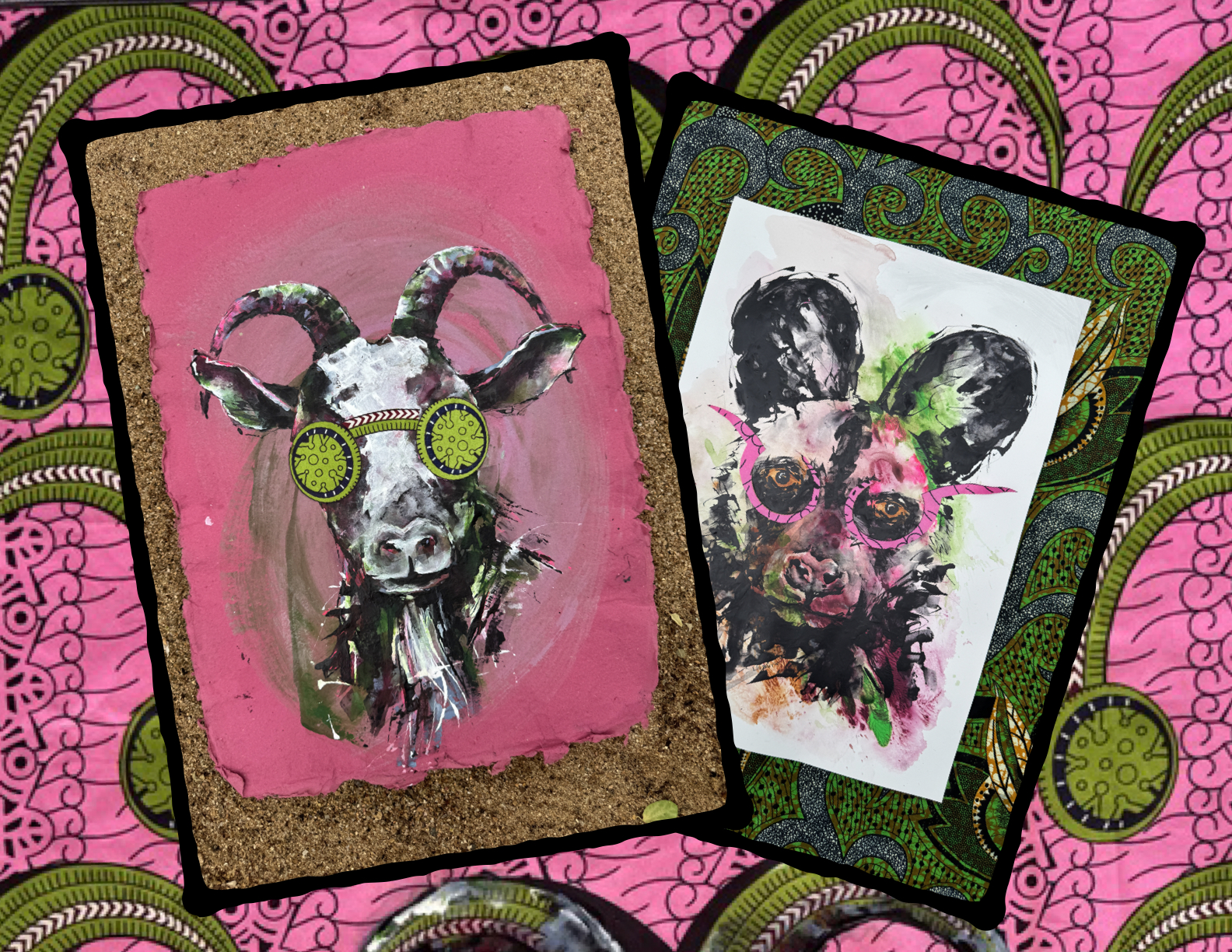
We live with goats, (our own and those of the village), at Mahenye, so of course I watch, draw and paint goats.. and we live with African wild dogs as well, which often come across the Save river, the boundary between Gonarezhou wilderness and Mahenye Village … so I paint those two beings often, one being prey, one being predator……

In the pink! The combination of local fabric collage adds another layer in the story… I could not resist buying this pink ‘macdonalds’ logo fabric from across the border in Mozambique, supplied by Janet at her village store. After I bought it and was happily wearing it as a wrap (chitenge), I realized that it also reminded me of goats horns…and so it was repurposed into collage artworks!

Heres the poster without the collage, but with lettering, fun and bold, just like a GOAT….

A new year, 2025; and of course goats featured at our Kaya Nyala homestead party at Chief Mahenye’s village, with our friends, and with Jamanda, Chilo and Mahenye representatives. We were honoured to see Chief Mahenye arrive at the party, a determined presence.

Instead of ‘supermarket meat’, the healthier and ‘happier’ option was ours, tasty sadza ne nyama ye mbudzi (a goat stew) with green vegetables, made by Julius’ wife who runs a takeaway/restaurant,

plus, a chosen village goat (mbudzi, mhudzi,) was humanely processed, and barbecued by Titus and Manuel on an open fire at the party, and it fed us all.

Titus and Manuel barbecue the nyama….

Our Chauke ‘humba’ totem, the giant snail shell, was cast in silver recycled aluminum for me by Simpli Simbi, and was given at the party to Chief Mahenye in recognition of the Chauke clan totem. The Chief, (in the pink, what is it with the colour pink in this blog?!….), was truly pleased with it…
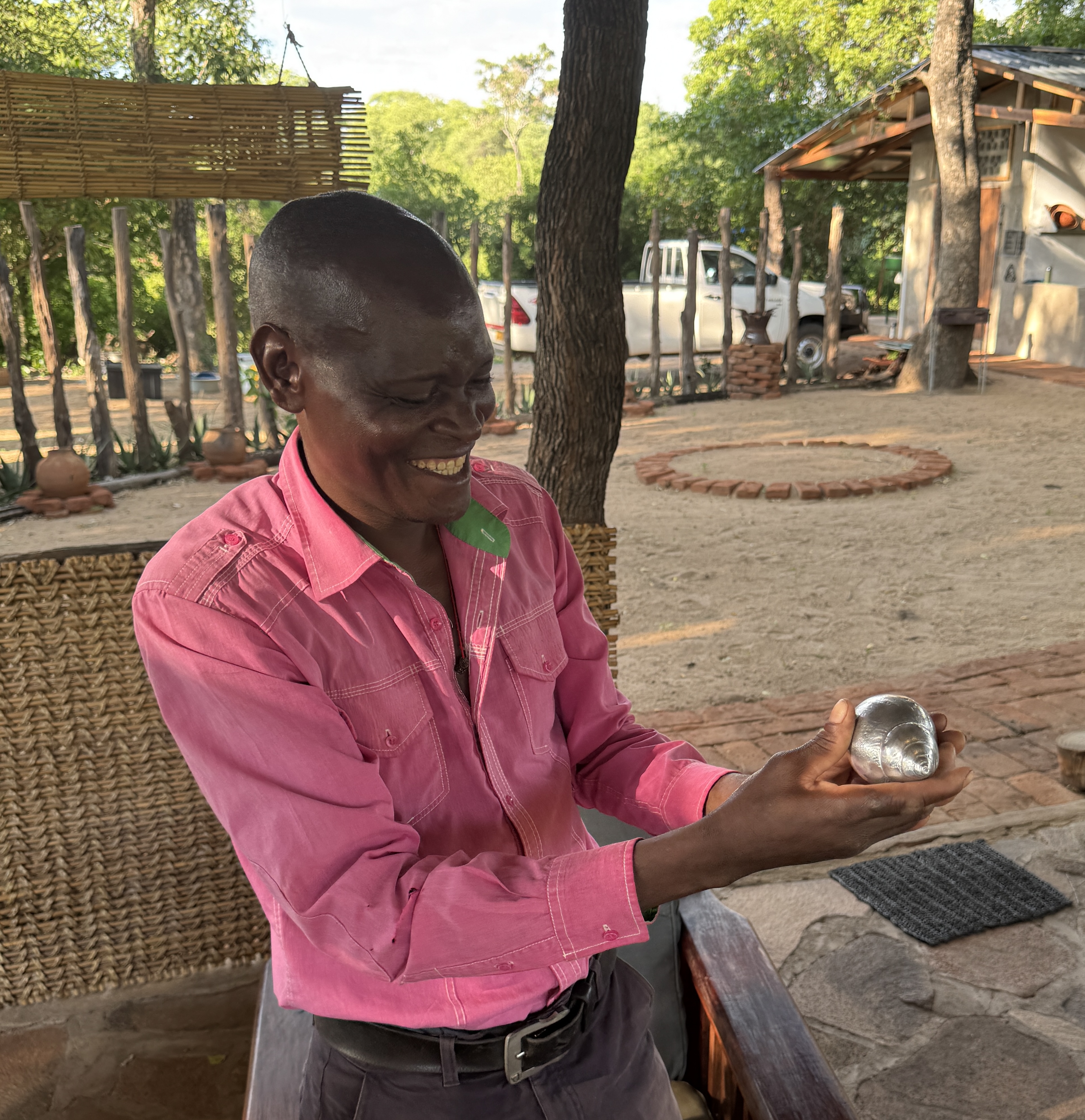
The Chauke Chahumba ( Chauke of the snail) story link https://wineandwilddogs.art/2023/05/28/around-the-campfire-giant-snailstradition-fire-and-totems/

And as an aside, thinking musical goats, from the skin of a village goat, this unique little drum (ngoma) has been created, dreamed up by me and Julius (Chochoma) out of a deep winnowing basket (hlelo) that came to me from Isaac, carried from Mozambique..
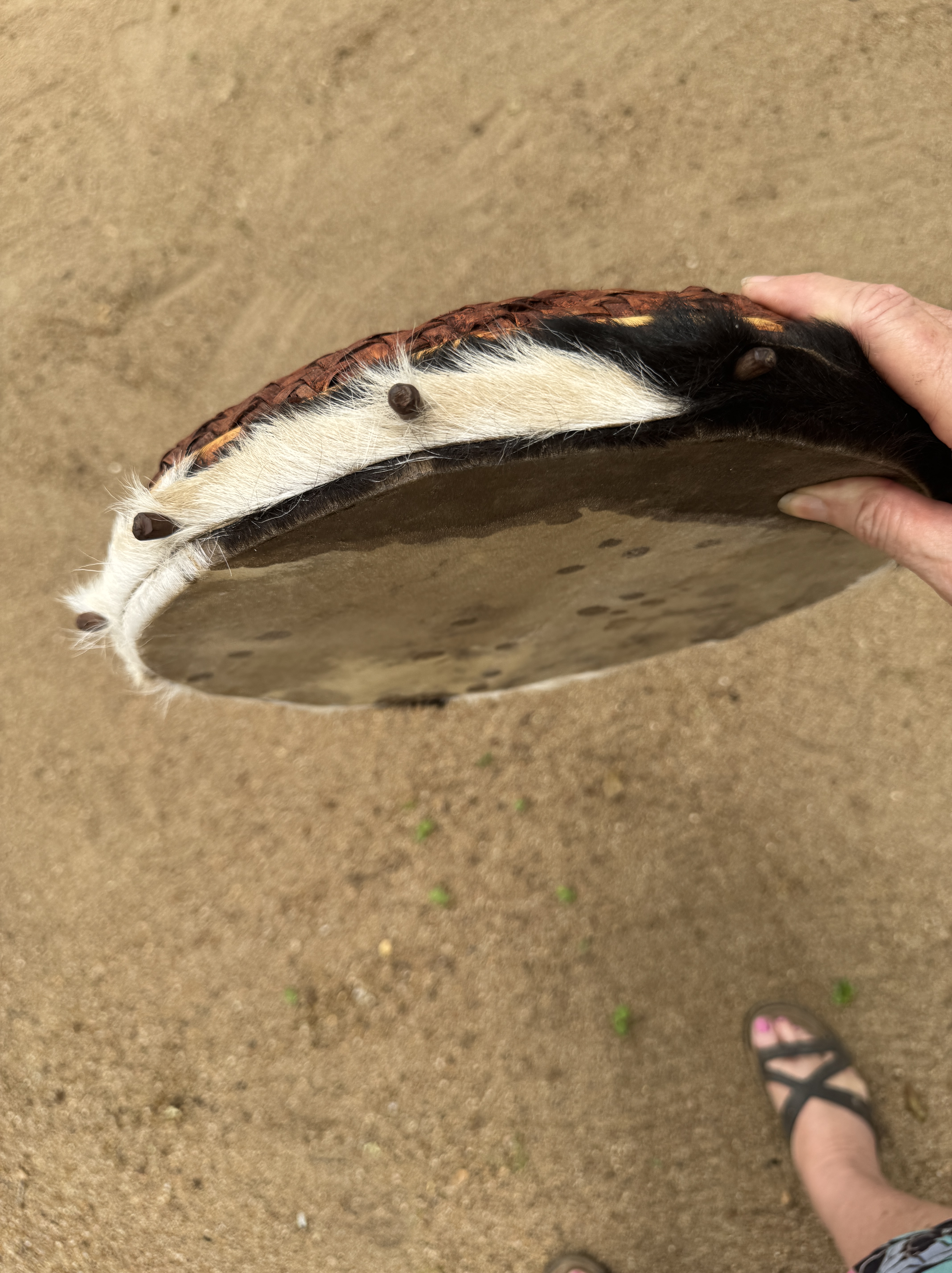
After the skin is tightened by careful exposure to a glowing mopani fire, the sound will mature and resonate, and this will be gifted to my daughter Kelli for use in her Cacao ceremony that she is exploring…
Goats are an integral part of our village life, at Mahenye as in many other parts of the world- one of our own Kaya Nyala goats is a characterful girl belonging to my granddaughter Jade, and is my model for a portrait I’ll call “Muriel”…. that iconic name to be explained shortly…


Living at Mahenye- on the banks of the Save River which is the contact zone between the wilderness of Gonarezhou and the populous Mahenye village, we feel first hand the challenge of communities living with wildlife, maintaining our goat herds and and the same time conserving African wild dogs… one of whom is eaten by the other…!!
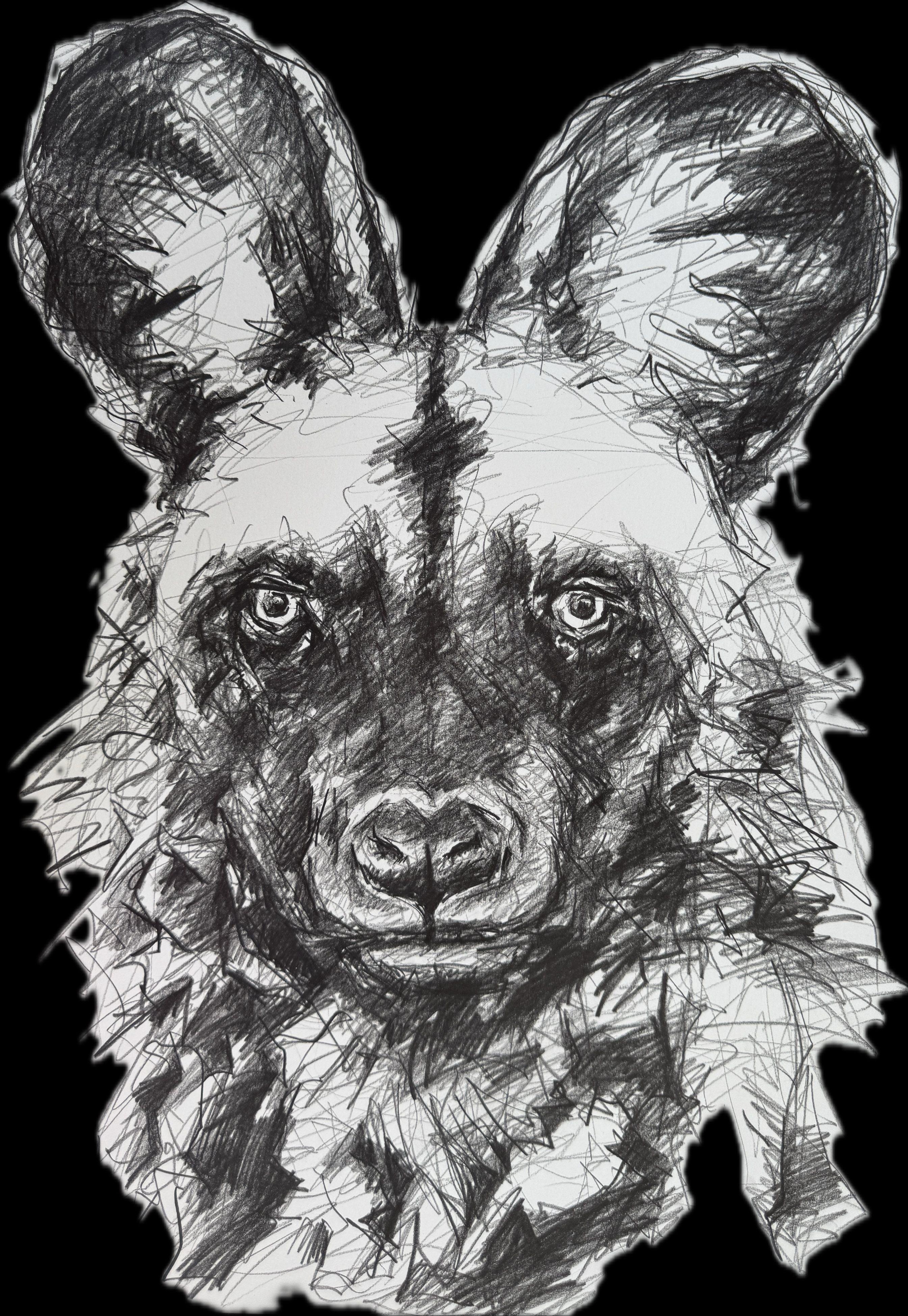
Last year one poor old lady in the village lost many of her goats to African wild dogs that denned near the village. The equivalent to someone in a town losing most of their savings, their sole bank balance, overnight to a fraudster….
Because predators can not see through the opaque sheeting of a mobile boma, even if they hear and smell the livestock within, they are wisely hesitant to jump into somewhere that they can not see into. So predator-proof Bomas are being tested, to corral livestock at night, to discourage leopard, lions, from attempting to attack the goats at night. Unfortunately the African wild dogs hunt late afternoon and early morning, so can catch any vulnerable goats that are not in a boma, or not watched over by people.
The presence of people and village dogs is a deterrent, as Wild dogs are essentially cautious and shy of people…
Goats love climbing over the semi hard clay bricks that are made in the village, before they are wood fired. (As do the village dogs…)

And so ….. many of my paintings are focussing on synergies between culture, people, goats and wild dogs – the ecosytems they inhabit…here are two original paintings, each poster size once stretched, 91 x 61 cm, created on the beloved local wrap fabrics (chitenge).
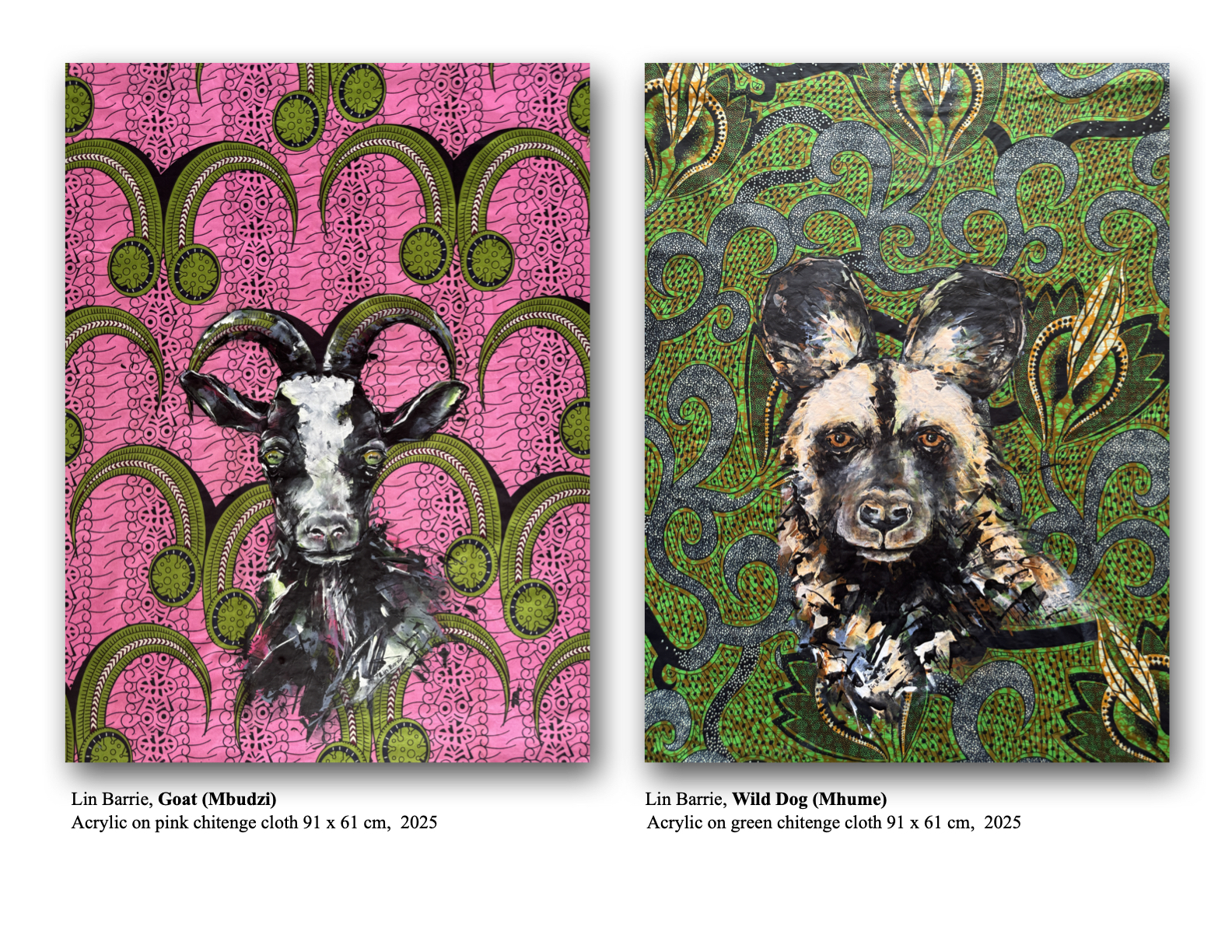
The (Painted) Wolf and the Goat .. A Painted Wolf, seeing a goat feeding on the edge of a high kopjie, where he could not come at her, besought her to come down lower, for fear she should miss her footing at that dizzy height. “Moreover,” said he, “the grass is far sweeter and more abundant here below.” But the Goat replied; “Excuse me; it is not for my dinner that you invite me, but for your own.”………
Animal imagery is used worldwide and especially within Zimbabwe as Ngano, humorous and semi tragic moral tales, to conjure up worlds of tradition and custom, and also to examine human foibles. Goat fables, myths and legends abound ….
And now to the name Muriel! One of my forever reads is Animal Farm by George Orwell- and it has even been translated into Shona, Chimurenga Chemhuka (Animal Revolution), see my previous blog… by a group of Zimbabwean writers, led by novelist and lawyer Petina Gappah and poet Tinashe Muchuri, A dozen writers contributed to the translation of Chimurenga Chemhuka (Animal Revolution) over five years.
My favourite character in the book, of course, is Muriel who is a goat, one of the oldest animals on the farm and friends with all. Muriel is one of the few animals on the farm who can read, maybe that’s why I love her so, and she reads to the other animals who can not. Some of my collage artworks depict Muriel with funky reading glasses, or could they be blinkers?!…..

Muriel survives by attending quietly to her own business, but in her simple way she is a game changer and an enabler for the other animals (she does not end up as a ‘scapegoat!), she dies a natural death in her old age, by eschewing politics!
GOATZ. Depicted through the ages in art by such as Picasso, Chagall, and our own Helen Lieros….
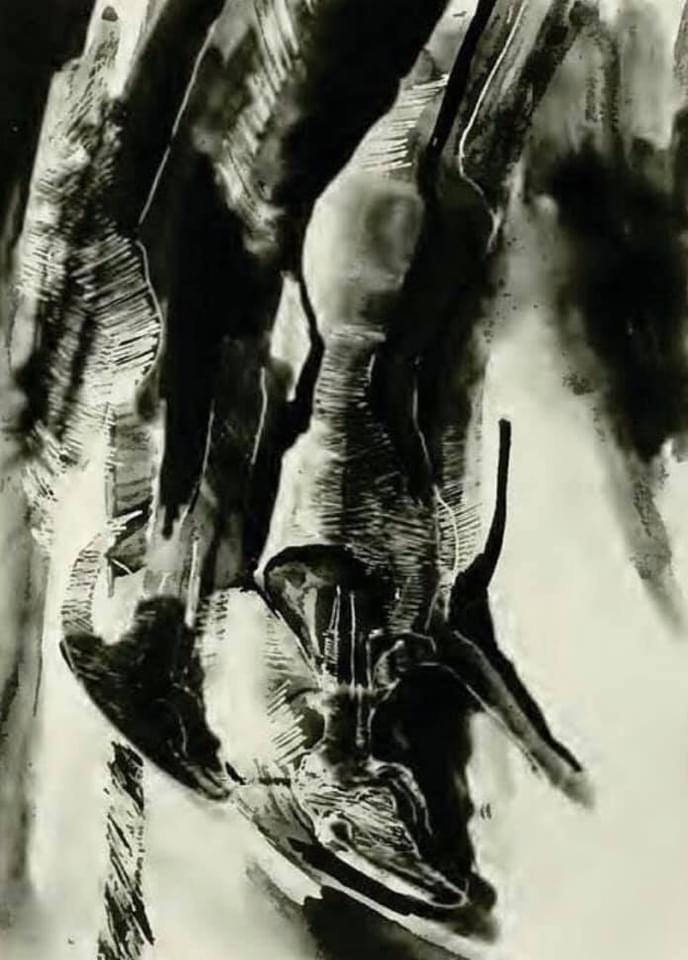
Universally inspirational always are these creatures, combined of myth and reality….. of spiritual and physical, in equal measure… My art respects them as symbols of fertility and abundance, examining their roles in our own village, in ancient mythology, acknowledging their religious symbolism from sacrifice to scapegoat, exploring their association with transformation and rebirth, and investigating their portrayal in popular culture and posters; honouring goats’ cultural history and ongoing enduring presence in human consciousness…

One of the first animals to be domesticated, in Iran around 10,000 years ago, was the
GOAT!
- The goat has been widely recognized as a symbol of fertility and abundance in various mythologies and cultural traditions. Goat worship, along with the notion of the goat as a sacred animal, can be traced back to ancient times. In many ancient civilizations, such as Egypt and Greece, goats were associated with gods and goddesses linked to fertility, agriculture, and prosperity.In Egyptian mythology, the god Amun was often depicted as a ram or a goat. As the god of creation and fertility, he represented the life-giving forces of nature. Similarly, in Greek mythology, Pan was portrayed as a half-human half-goat creature known as a satyr. He was considered the god of shepherds and flocks but also had associations with fertility and wildness.The symbolism of goats representing fertility is not limited to just these two cultures; it extends across various others around the world. For instance, in Celtic folklore, goats were believed to possess magical powers that could aid in successful farming and ensure bountiful harvests.Furthermore, the association between goats’ reproductive abilities and their status as symbols of abundance can be seen in rituals involving sacrificial offerings or prayers for an abundant life. These practices highlight the belief that by honoring or worshipping goats, one could invoke their fertile qualities for personal or communal benefit.
The Greatest of All Time (GOAT)
Goat skin skirt used muchongolo – the dance by men at festivals- also so called in ndau …

the fabulous goats ‘tails’ swing and bounce as the dancer moves..
FOR MORE ON THE CULTURE OF OUR LOWVELD TSONGA AND HLENGWE COMMUNITIES, READ MY BLOGPAGE

Mbudzi kudya mufenje, hufana nyina.
Definitions
mufenje: Small to medium sized deciduous tree.
nyina: female (human or animal) that is suckling
Translation
A goat feeds on the mufenje tree just like its mother.
Inspiration
Goats are natural browsers. They like to eat with their heads up, often reaching as high as they can for browse (food from trees, shrubs and dwarf shrubs) in a wooded area’s understory (a layer of vegetation beneath the main canopy of a forest).
Application
The habits and behavior of children very often reflect those of their parents.
Some more African goat proverbs… (I can feel possible paintings?!)
When a goat gives birth near people, it’s because she wants them to chase away the dog.
Shona proverb.
A big goat does not snort without reason
Look for a dark goat first in the daytime, you may not find him at night
It’s not the goat who should find out whether the lion has eaten
The frown on the face of a goat will not stop it from being taken to market
It’s out of ignorance that a goat will attend a leopards party
and some others…
A man with good judgement does not make the goat his gardener (Hungarian)
If a beard signified intelligence the goat would have been a genius
The goat must browse where she is tied (Romanian)
Love and hate are two horns on the same goat. (American)


 wine and wild dogs
I love this post….both text and images:)
thank you so much! GOATS rule !!
Pingback: Vote Goat at Investec 2025; The Artists’ Election, (what if artists ran the world?) | wine and wild dogs
Pingback: Cultural Variations in Child-Rearing Approaches