my art beading works and inspirations…
Hundreds of years of trade by Indian and Arab dhow, up and down the east coast of Africa and generally across the Indian ocean, are reflected in the love of glass seed beads, traded from Kenya to Mozambique, inland to Zimbabwe and onwards to South Africa, Zululand….
I, in my turn, embrace that love of beadwork, as our Hlengwe, Xangana, culture here in the south east of Zimbabwe, embraces storytelling, (karengano), dance, and craft such as beading.
Here is my blog page to that effect:
Some Lin Barrie artworks/Beadwork on canvas…..
1.
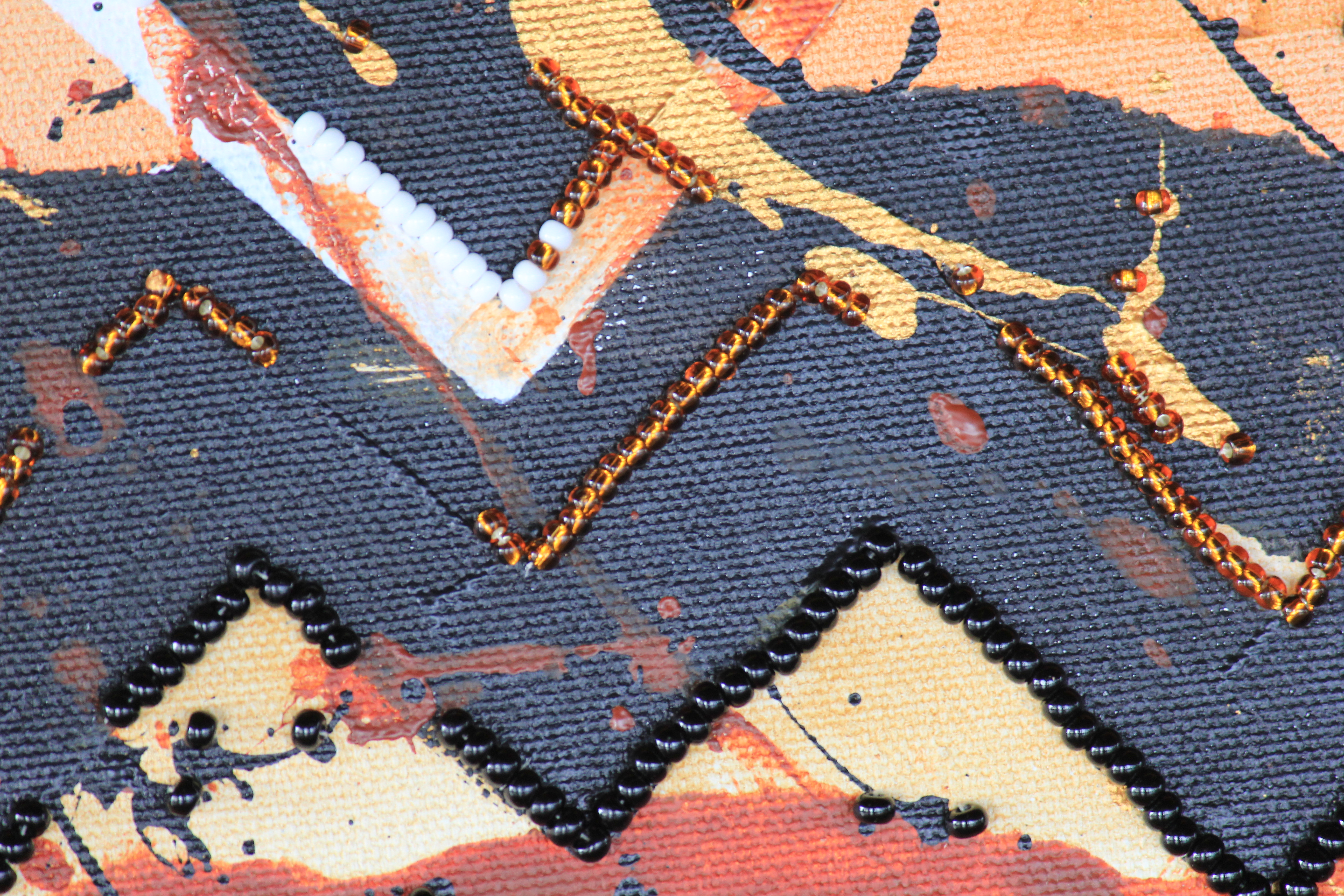
Lin Barrie, “Creative Re-imagining”, Mixed media; acrylic and beadwork on canvas, 61 x 61 cm, 2019
Shown at the Zimbabwe National Gallery, “Balance for Better” woman’s exhibition. 2019.

some detail from the artwork…
… inspired by Chief Chitsa and other hut paintings, such as this one below. created, finger painted, on mud walls with earth pigments locally gathered…
(note the gorgeous hand coiled and wood fired clay pot…)

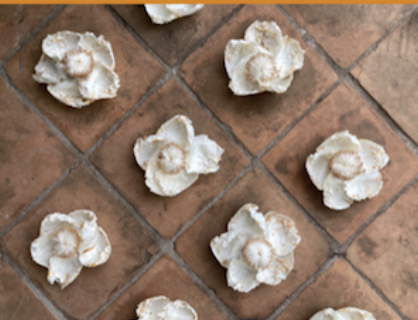
Always I am inspired by the shapes of baobab flowers, and here are some of these magnificent ‘fallen ballerinas” collected from the ground below the young baobab tree at Chilo Gorge Safari Lodge,
From Chief Chitsa’s wives designs, I created oil paintings….using my fingers to apply the paint much as the ladies would do in painting their huts with earth pigments….
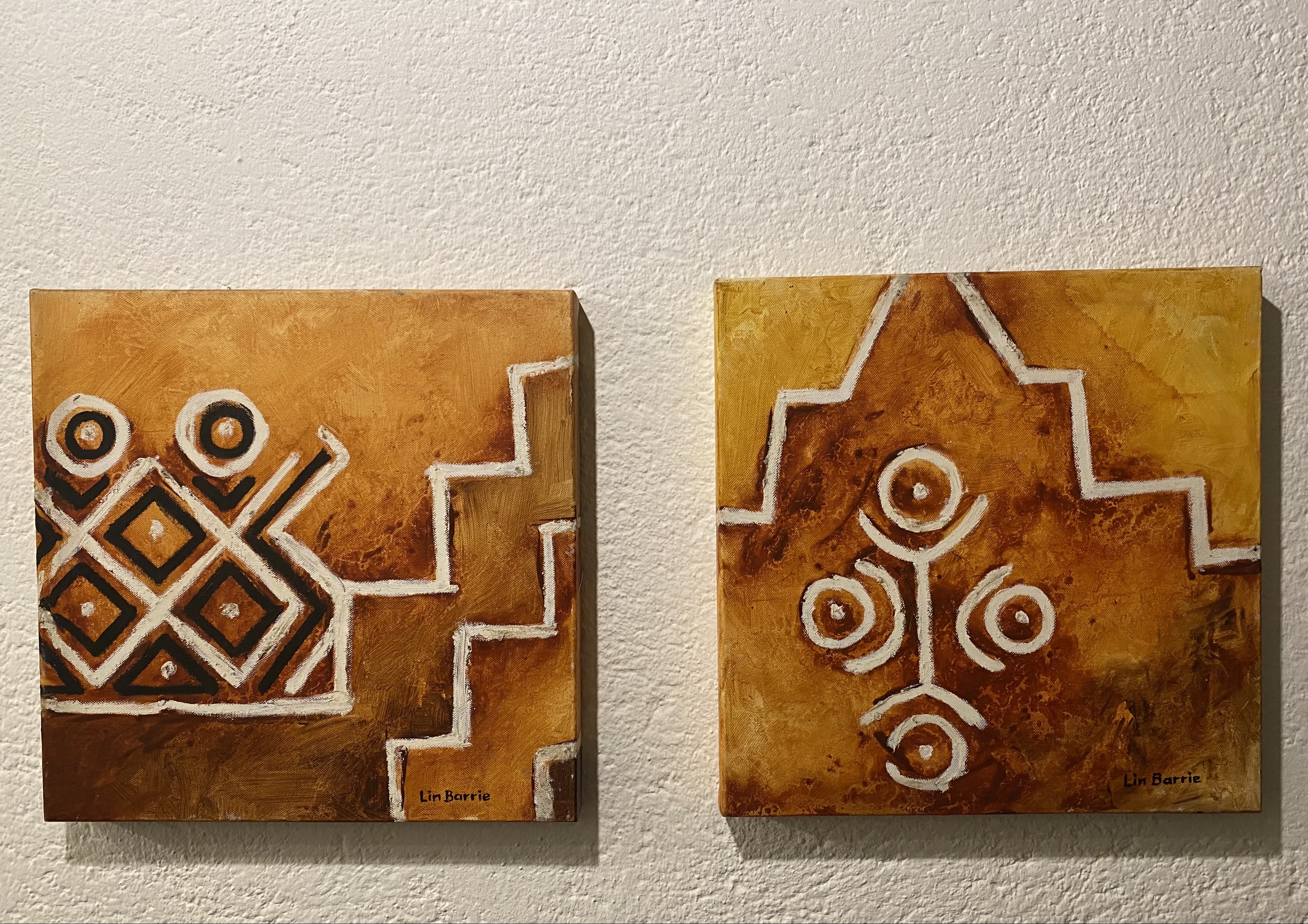
At their request, from this beaded painting, I created a Ntumbuluko print T shirt design for our local cultural group to wear at cultural festivals, printed beautifully by Paul Howard
…My Blog:
https://wineandwilddogs.art/2019/04/05/balance-for-better-art-re-designing-the-womans-space/
Balance for Better: Art, re-designing the Woman’s Space….
My artwork reflects the importance of cultural inheritance, skills and crafts which are traditionally “woman’s work“, such as hut painting and beading- it does not elevate these roles over modern progressive roles for women, but honours the cultural inheritance which in turn enables and empowers women to unleash creative energy, to think “outside their traditional space” and to splinter their traditional roles as housekeepers/carers into redesigning a new space. Bright endeavours cleverly build on traditional roles, using lessons learnt from experience to help women to compete and rise in the new world…
2.
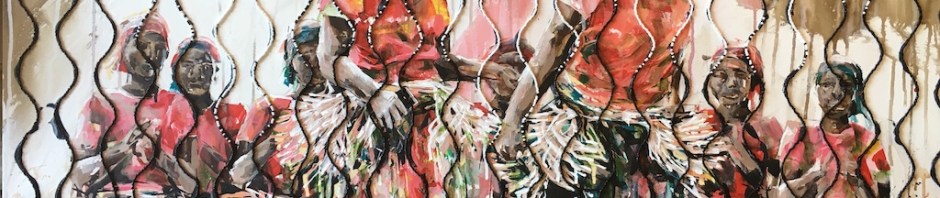
Lin Barrie, “Dancing with my sisters, Dancing with my cellphone…”, acrylic and beadwork on stretched canvas, 3 x 4 feet
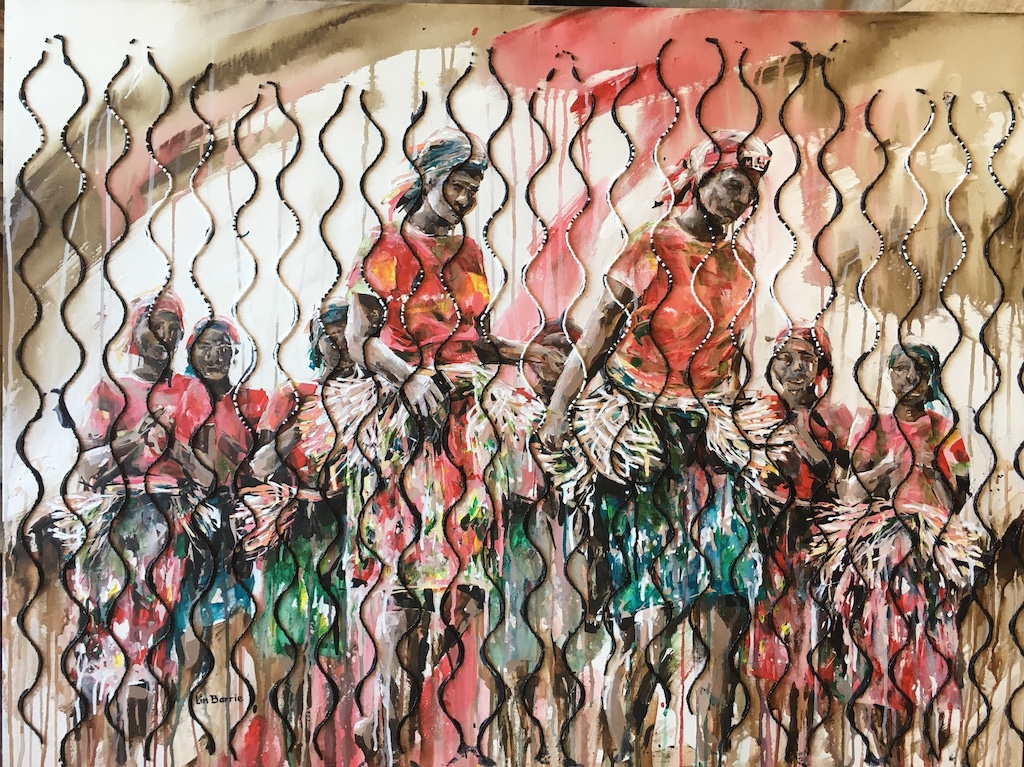
“Dancing with my sisters, Dancing with my cellphone…”, acrylic and beadwork on stretched canvas, 3 x 4 feet detail ……..

“Dancing with my sisters, Dancing with my cellphone…” by Lin Barrie …
Refer to my blog: https://wineandwilddogs.art/2023/07/27/art-student-assignment-apt-art-questions-rivers-beads-and-baobabs-all-things-connected/
In this painting/beading artwork, I choose to see the positive side of the influence of technology on family relations and culture.…..
Even as she dances, this woman clutches her cellphone, and most often the dancers carry their cellphones in secret pouches looped about their waists below their skirts, holders of their valuables…
I see the separation, yet also the connectedness, between our Zimbabwean Mahenye community and their Mozambique relatives, their sisters, separated by a man-made border, yet connected by technology, by mobile phones, by internet.
This dance group come from a remote area in Mozambique, crossing the border to join their Zimbabwean relatives to hold dance festivals.
Technology enables cultures in remote areas to connect, to communicate and to gather for festivals of dance, family functions and weddings.. and most of all during a world lockdown such as that experienced during the Covid pandemic, technology enabled communities and families to remain connected beyond a physical level.
Traditional beadwork is an integral part of the culture yet in this painting it also symbolizes the grid, the network, that connects us all…be it a human cultural network or be it a technological, internet or mobile phone network...note the mobile phone in the hand of the dancer on the left…

My focus on culture, communities and conservation embraces the natural world, #allthingsconnected is my mantra.
Here is an abstract impression of quills, a feeling of porcupine, loops of beads…….
Lin Barrie, “Porcupine Quills”, mixed media and beading on canvas, 80 x 90 cm, (private collection, Seattle)

Here is some beading detail….

More on my beadwork and painting can be found on the Contemporary African Art website:
https://www.contemporary-african-art.com/contemporary-african-bead-art.html


 wine and wild dogs
Hi all
I am grateful to come across this platform that talks about our culture and identity. By the way, a language in most cases defines who a person is. Certain names that we carry have some history of some sort. It’s unfortunate that in most cases the nicknames are more popular than the actual ones.
Who are shangani and how did they came to be called by that name? Are Vahlengwe different from machangana? Two theories are referred to the origins of the name machangana. Machangana or Amashangane are of Nguni origin.
The first theory is that shangani comes from a once king of these people Soshangane ka Ndwandwe of the Nxumalo totem. So machangana or shangani therefore means people of Soshangane. The second theory is from those who remained in Nguniland.
It is alleged that Soshangane was send to fight the Tsonga people in the current areas of Gaza province in Mozambique with its people spreading out to current Chiredzi area, part of Chipinge as well as part of the then Transvaal. When he arrived in the region he didn’t find any resident as expected. The people were very welcoming to Soshangane and his impis or soldiers. They rested there and were happy to stay with people. It was a good thing since it was the time of mfecane.
The settled and married local women of the Tsonga speaking tribes. Those that remained in Nguniland nicknamed them amashiyangane, those who left their children since they never returned to the newly Zulu established kingdom by Shaka ka Senzangakona.
So the local people ended up being defined by a general and his team that came and settled amongst them. These people are vaTsonga. They speak xitsonga and never lived under a kingdom. They believe in a flat leadership system of clans. Vahlengwe are the Cawuke. All chiefs in Zimbabwe are of the Cawuke or Chauke clan, hence the area is called Hlengweni, the Chauke land. We have other small clans within who can only rise to a village head, nduna or sabuku as well referred in Zimbabwe.
In South Africa each and every clan has its own land and rules itself. After the fall of the Gaza kingdom we find the remaining Nxumalo now chiefdom in Bushbuckridge area of Mpumalanga province of South Africa.
It is very erroneous to called these people machangana or that there’s a language called shangani. It’s xitsonga
Thanking you in advance
James Ntsanwisi Hanyani waka Hobyani
thank you James -your comments are fascinating and instructive- and will certainly include xitsonga in future blogs about our area of south East zimbabwe
Hi there
Let’s talk a little bit the dancing skirts, chibabela or xibelana. What is the meaning and where is it derived from?
Xibabela/chibabela is literally translated to, that which makes sound of a bell.
Xibelana on the other hand means a tiny bell.
The meaning is therefore intertwined. It comes from the very first designs of the skirt. It has however today evolved over a number of stages. The first one used to have drum shaped tiny balls that made sounds as women moved around wearing the skirt(s). Thus how it earned the name xibelana = tiny bell or xibabela = it makes sound of a bell!
The attire was adopted from Joao Albasin’s wife. The first Italian whiteman to live with the Tsonga people had left a heritage mark that till today the Tsonga people have live by. The Tsonga people enjoying getting dressed in colourful clothes, hence their clothes are nicknamed colour blockers.
There’s need to revive our indigenous clothing identity and other craft work eg
funeko = a bag made of ilala – xidloko = ilala hats like the Basotho trademark hats. – commercialize vucema ie the palm wire and amarula wine plus the nuts – mabuwu = commercialize the baobab fruit yogurt or simply drink.
These will advance the Tsonga identity and culture in the same time promoting local tourism.
Thinking you in advance
James Ntsanwisi Hanyani waka Hobyani