What a pleasure it is for Clive Stockil and I to arrive at Chilo Gorge Safari Lodge, rain imminent, ground steaming in anticipation!
Afternoon tea on the deck brings a stunning sight…
Chilo Gorge view from the deck with late afternoon tea
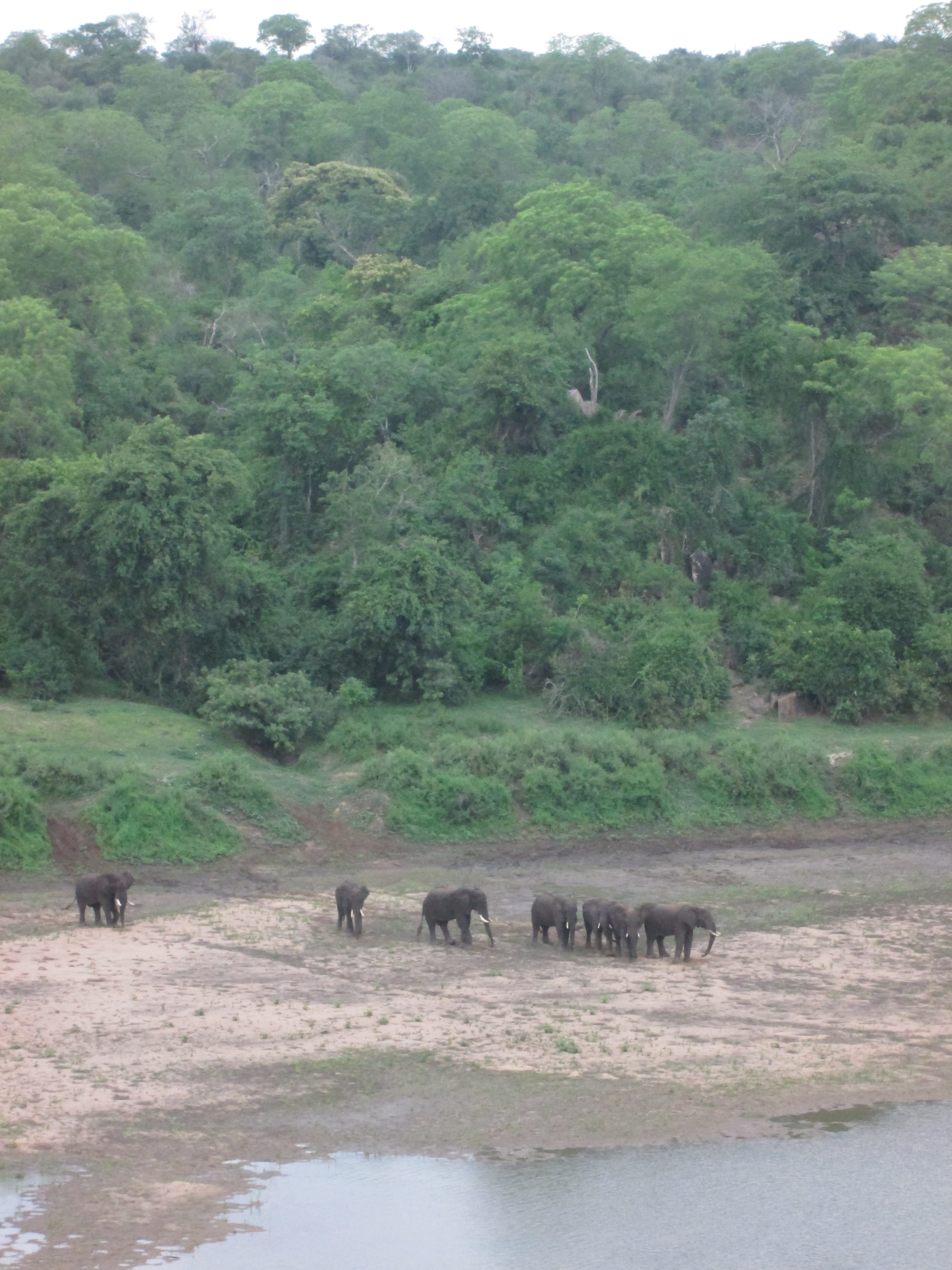
Out of the thick green canopy that lines the swelling river, come the seven naughty bull elephants who recently trashed our gardens, before being distracted by the green offerings of the newly rain-washed grass in the bush…! What a pleasure it is to watch them wallow for more than half an hour in the river below us, playfully tusking and shoving each other in the slippery delicious mud of the foreshore…endangered for their as-yet immature tusks, our challenge is to keep these youngsters safe from the threat of poaching, in this pristine Gonarezhou wilderness…more so than ever at Christmas time, since poaching is an ever present threat regardless of season or holidays….tourism, Game drives and walks, and presence of people in these wilderness areas is one of the best safeguards against poaching activity
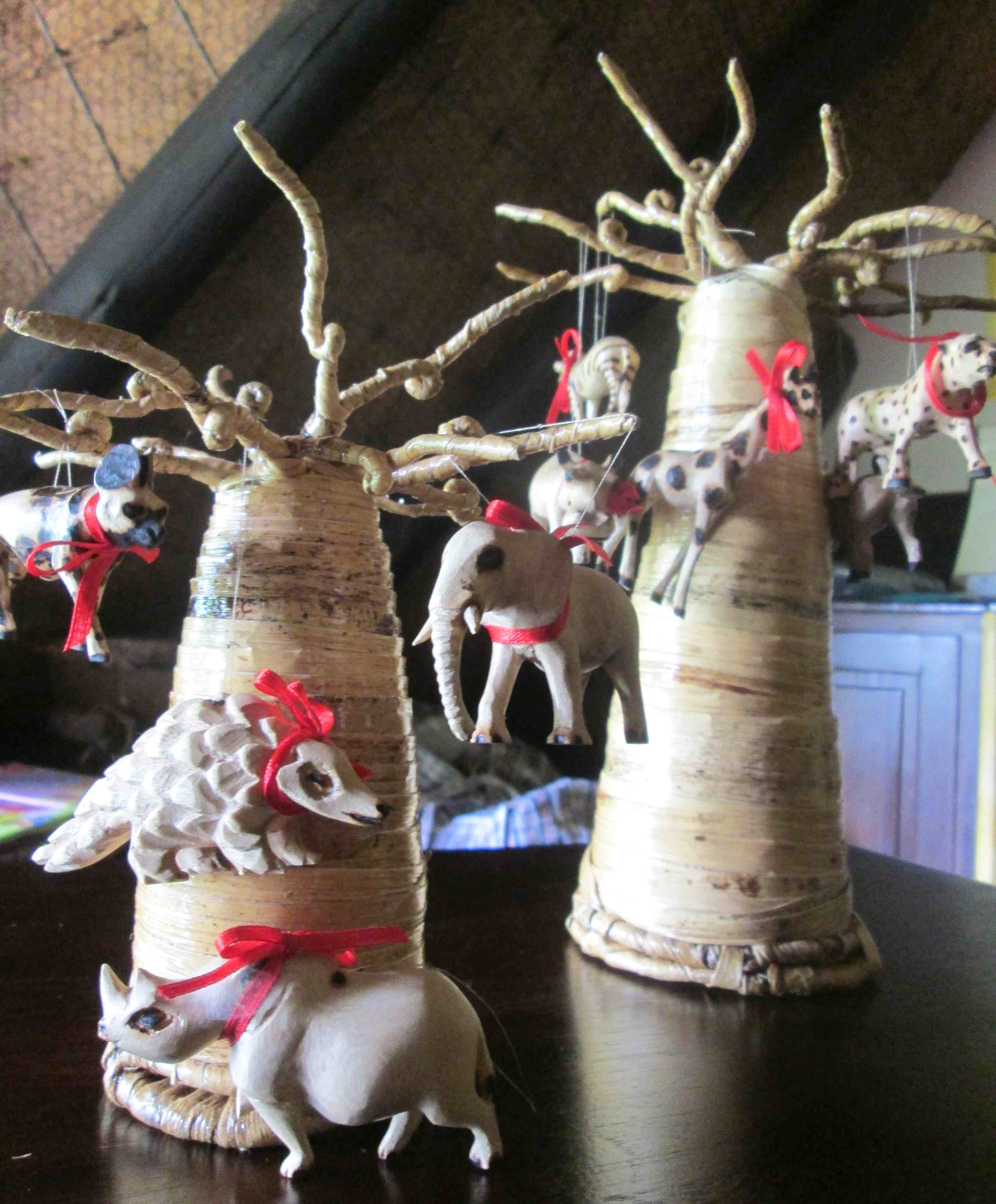
…..my musing brings to mind the Baobab tree ornament for sale in the Chilo Gorge Safari Lodge shop, festooned like a Christmas tree with little locally-carved animals, many of which reflect vulnerable species…including the elephant…the African wild dog…
baoabab tree of life
and the rhino….
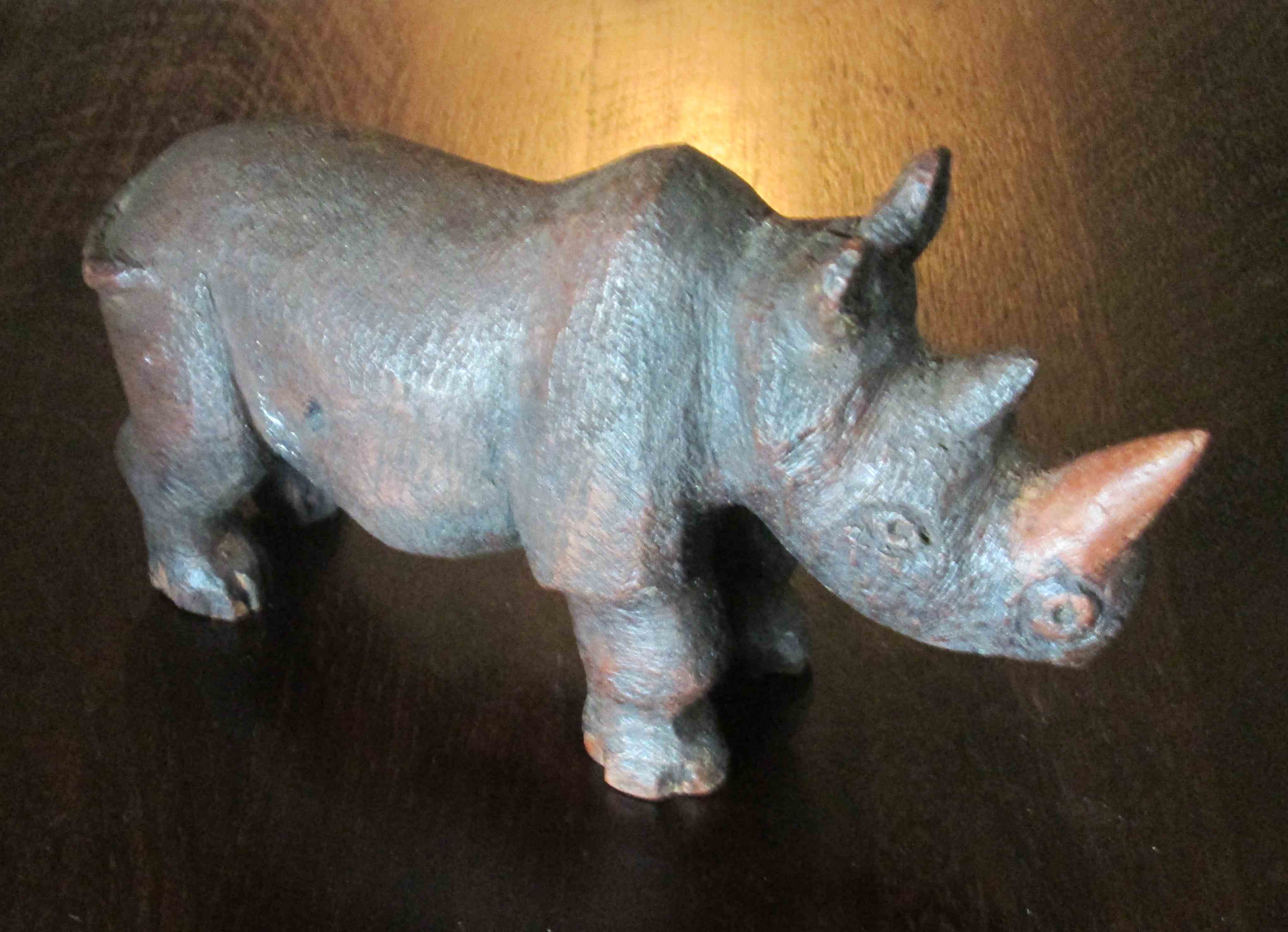
By supporting local artist in the sale of their art, much is achieved in reducing the likelihood of poaching by people who are desperate to earn a living….for example,Chilo Gorge stocks delightful caved wooden rhinos, created by master carver Lambert….
Rhino carved by Lambert
Now for the actual Chilo Christmas Tree!
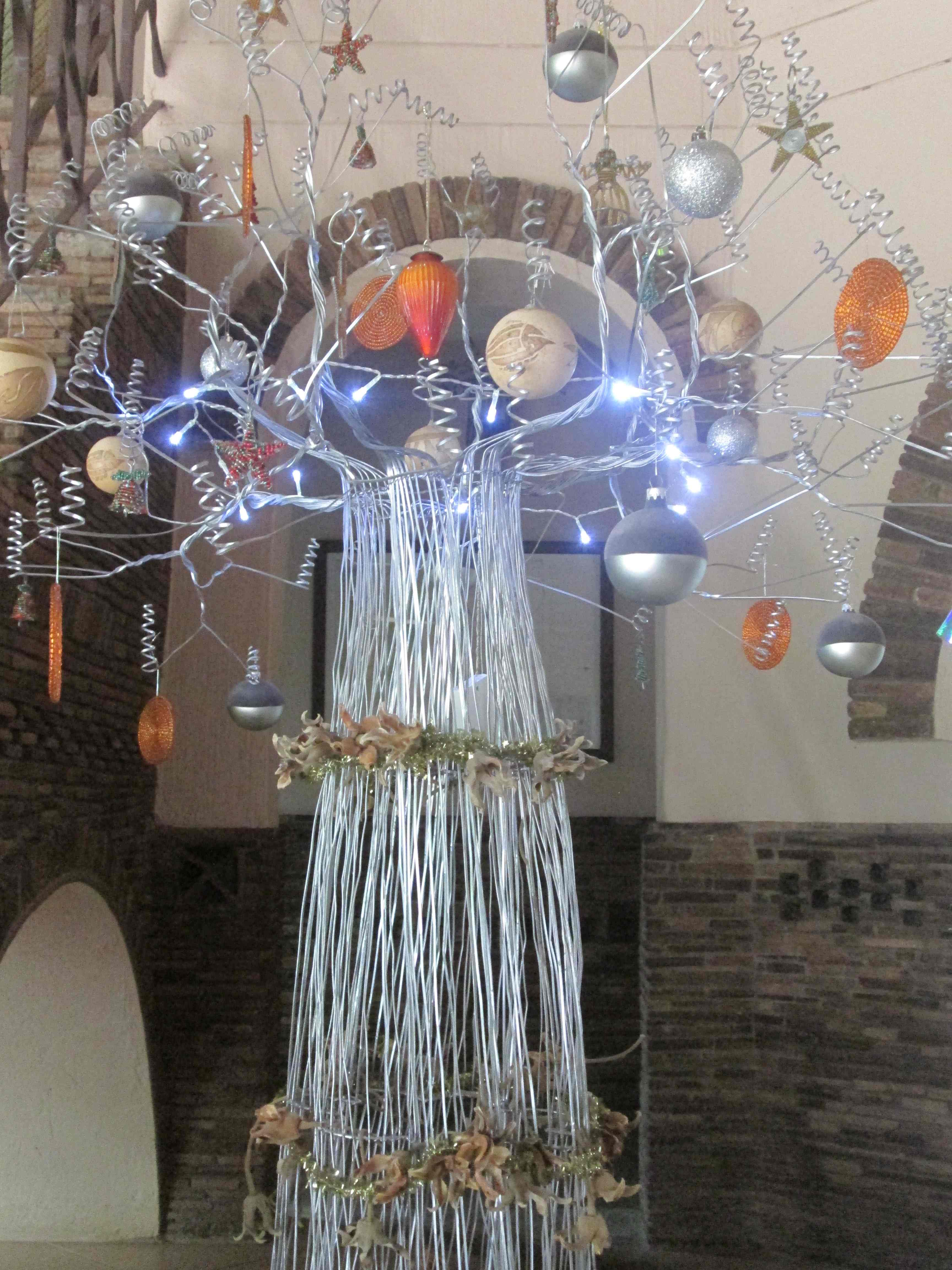
A happy result of creative collaboration between Cathie, (who manages Chilo bookings in Harare and is ably holding the fort together with Chief Guide Thomas Mutombeni, at Chilo during the festive season), and who bought the wire tree from a roadside artisan, myself, who sourced some of the re-cycled ornaments, and Nadine, who collected pods and decorated the lovely tree…..
Wire baobab tree
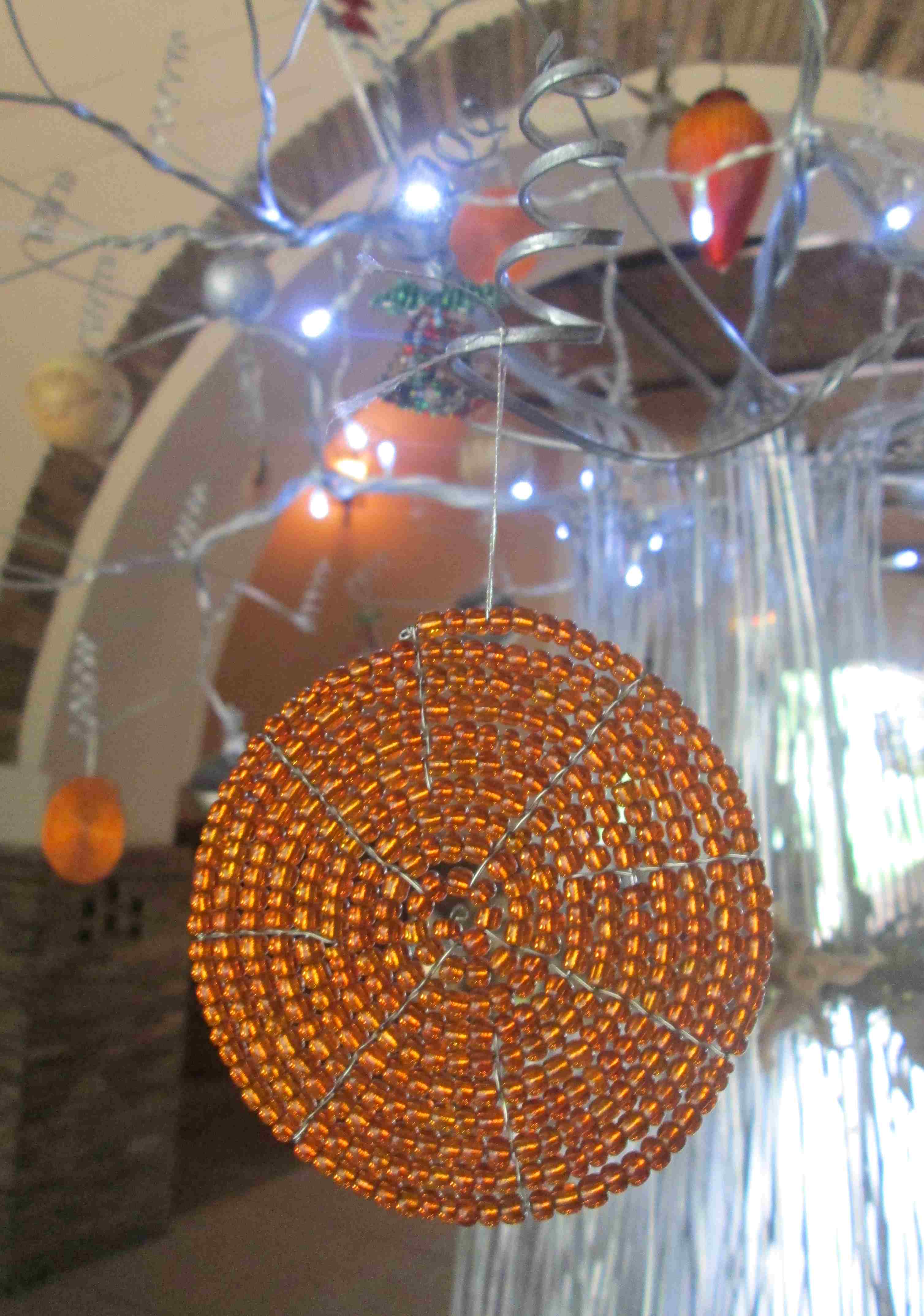
This is a joyful local creation, and is a happy memory of dear Nadine, who, sadly, with her partner John Laing, have left Chilo to move to a job where they can more easily school their little daughter. Sculpted wire forms into a funky baobab, dripping with local hand-crafted ornaments …such as this beaded “ndoro”
Ndoro decoration
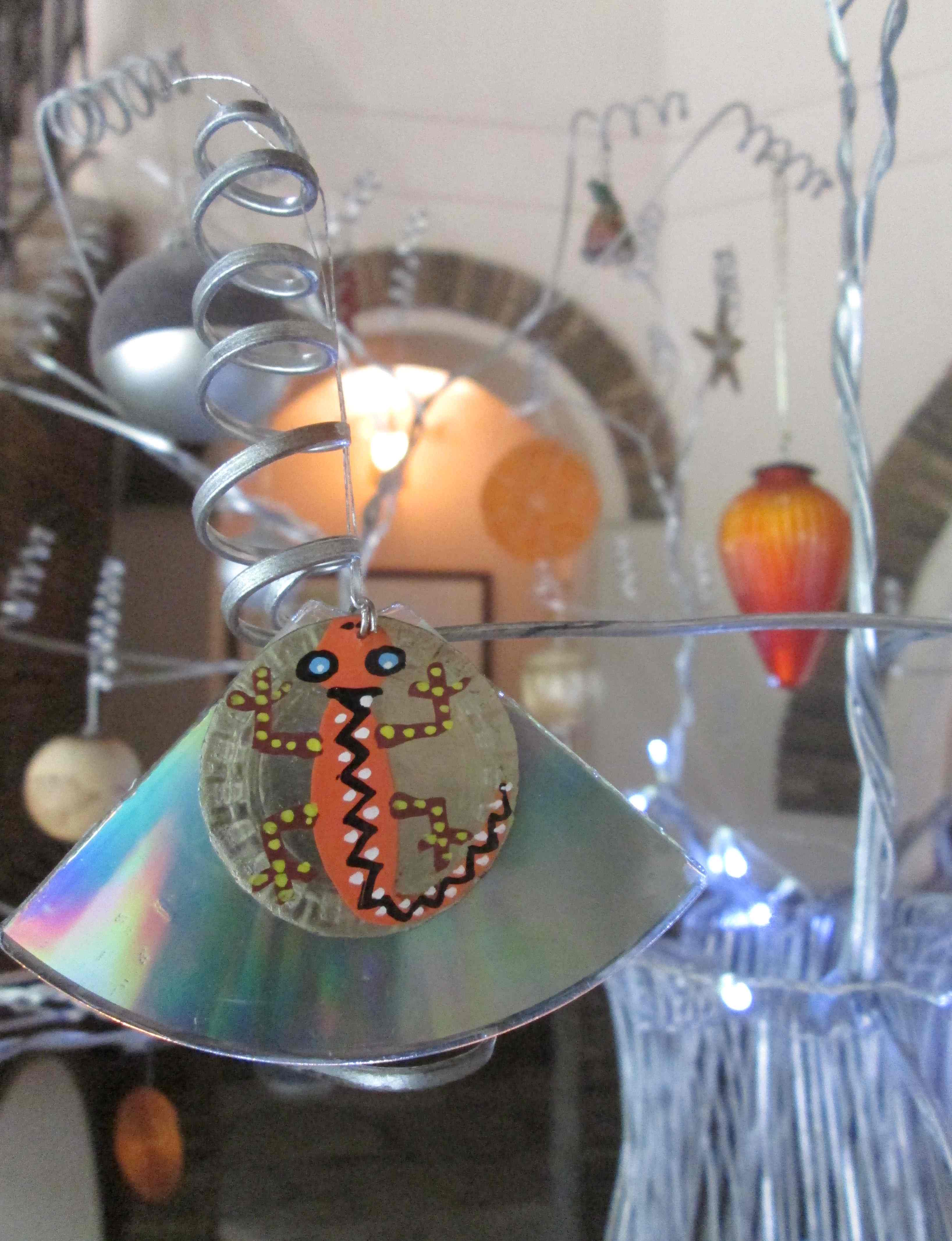
and this hand painted bottle top and cd disc decoration!
Re-cycling rules!
hand painted bottle top and cd disc decoration
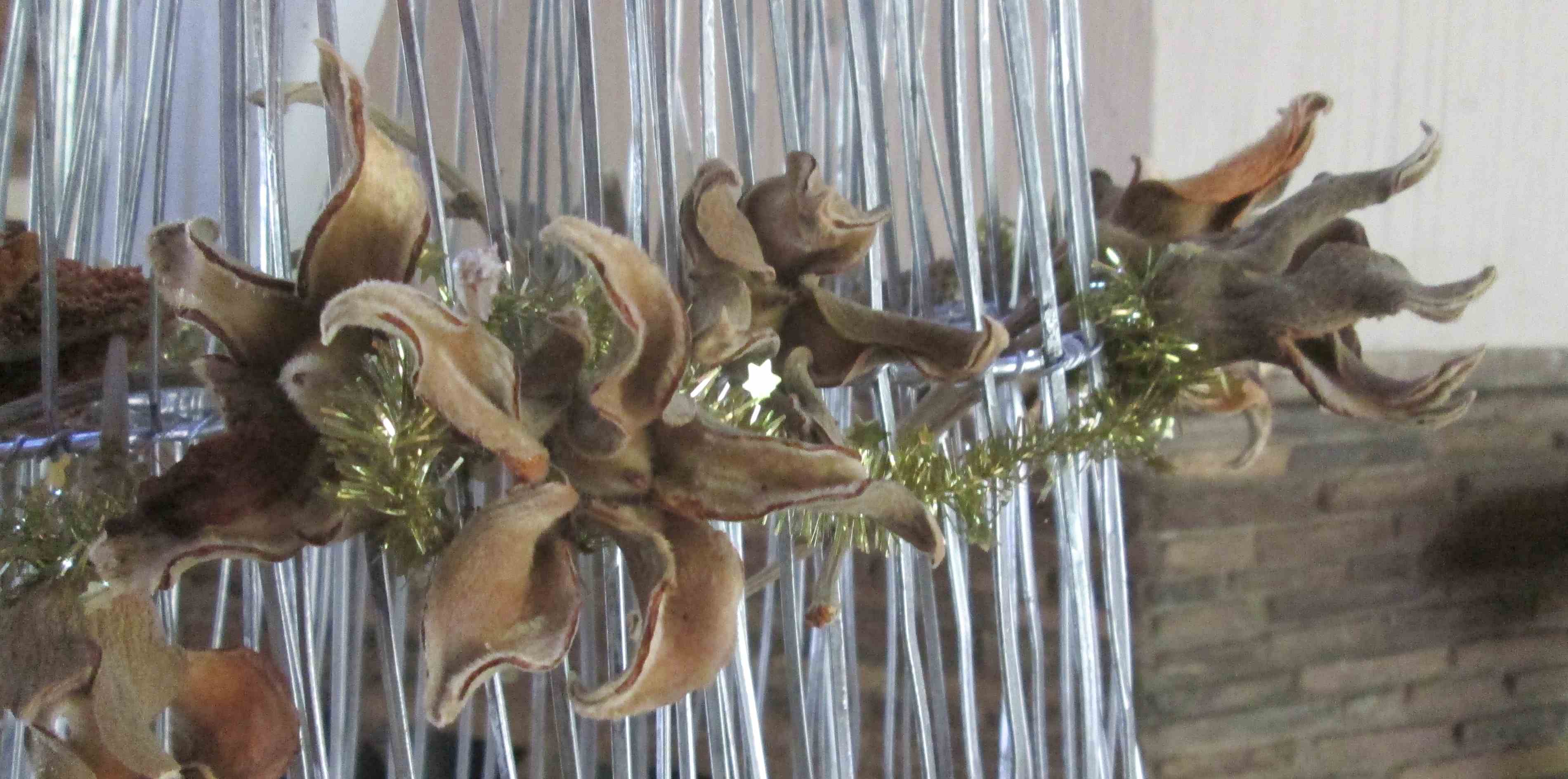
Baobab pods and glitter go well together!
Baobab Pods decoration
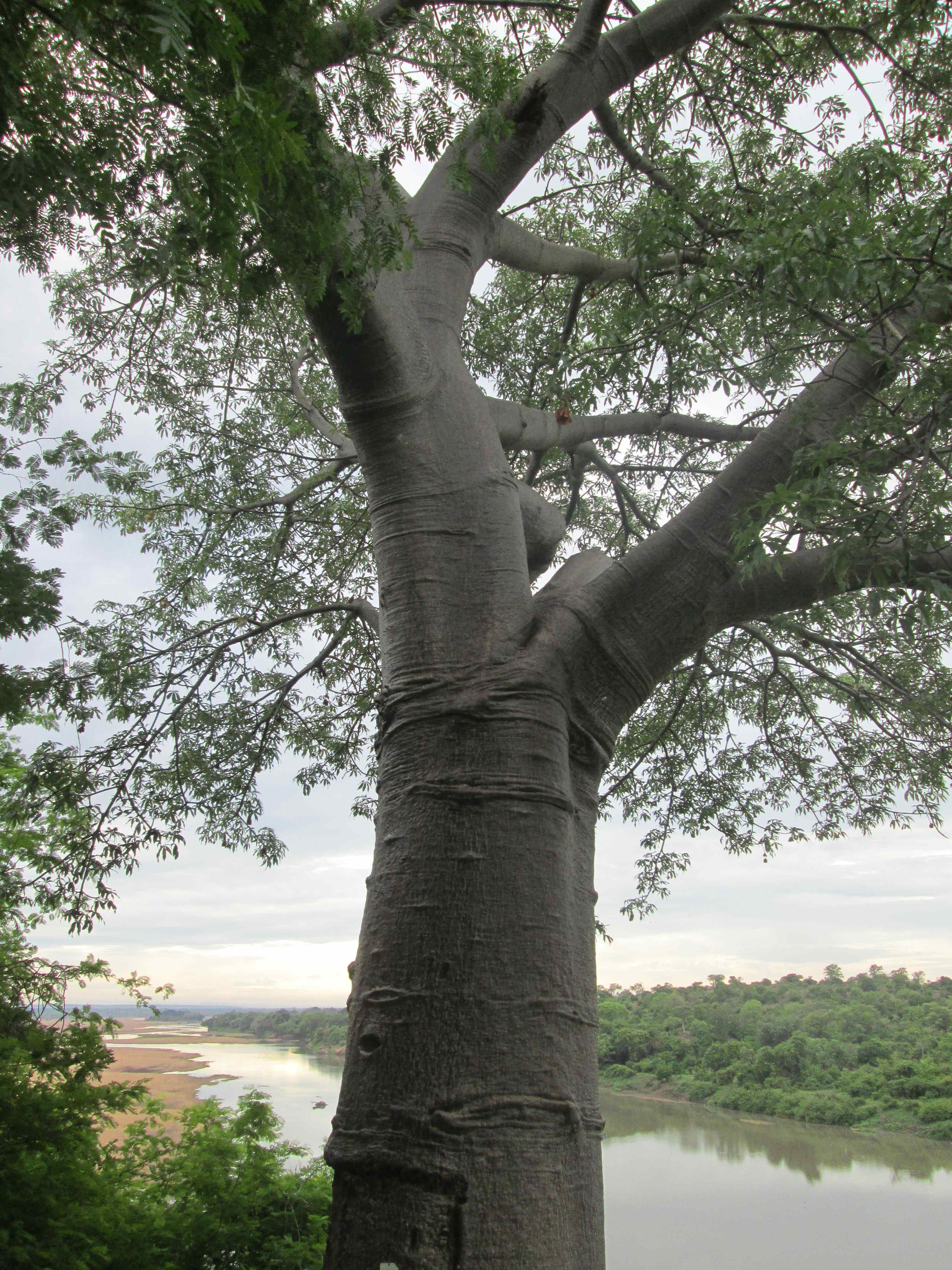
These festive holidays we really are celebrating the Baobab tree- tree of life, our Christmas Tree at Chilo…..we are lucky to have wonderful specimens of these giants around the lodge, framing our views of the Save River…
baobab tree and rainy sky
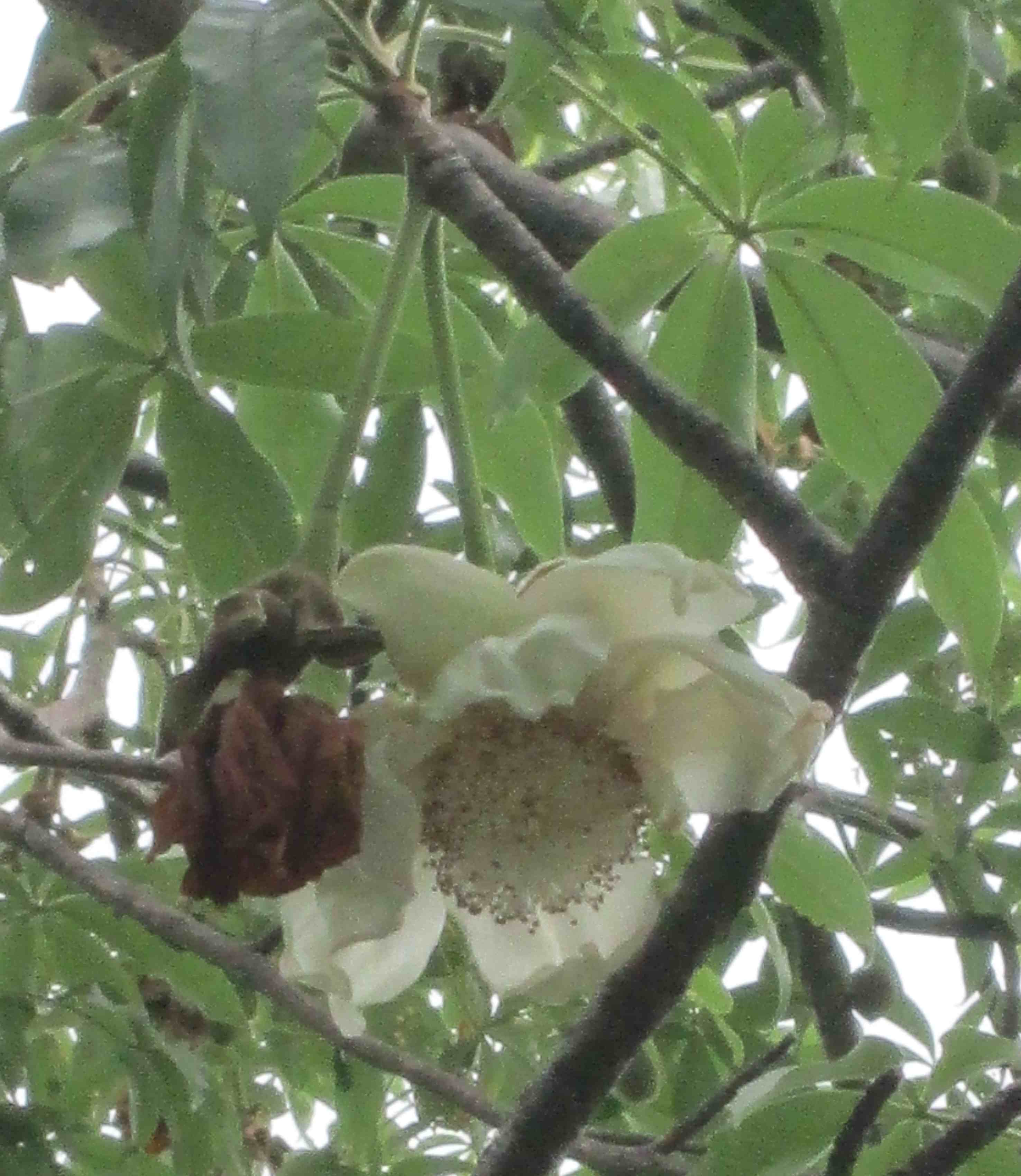
The ethereal white blossoms appear fleetingly…
baobab flower on tree
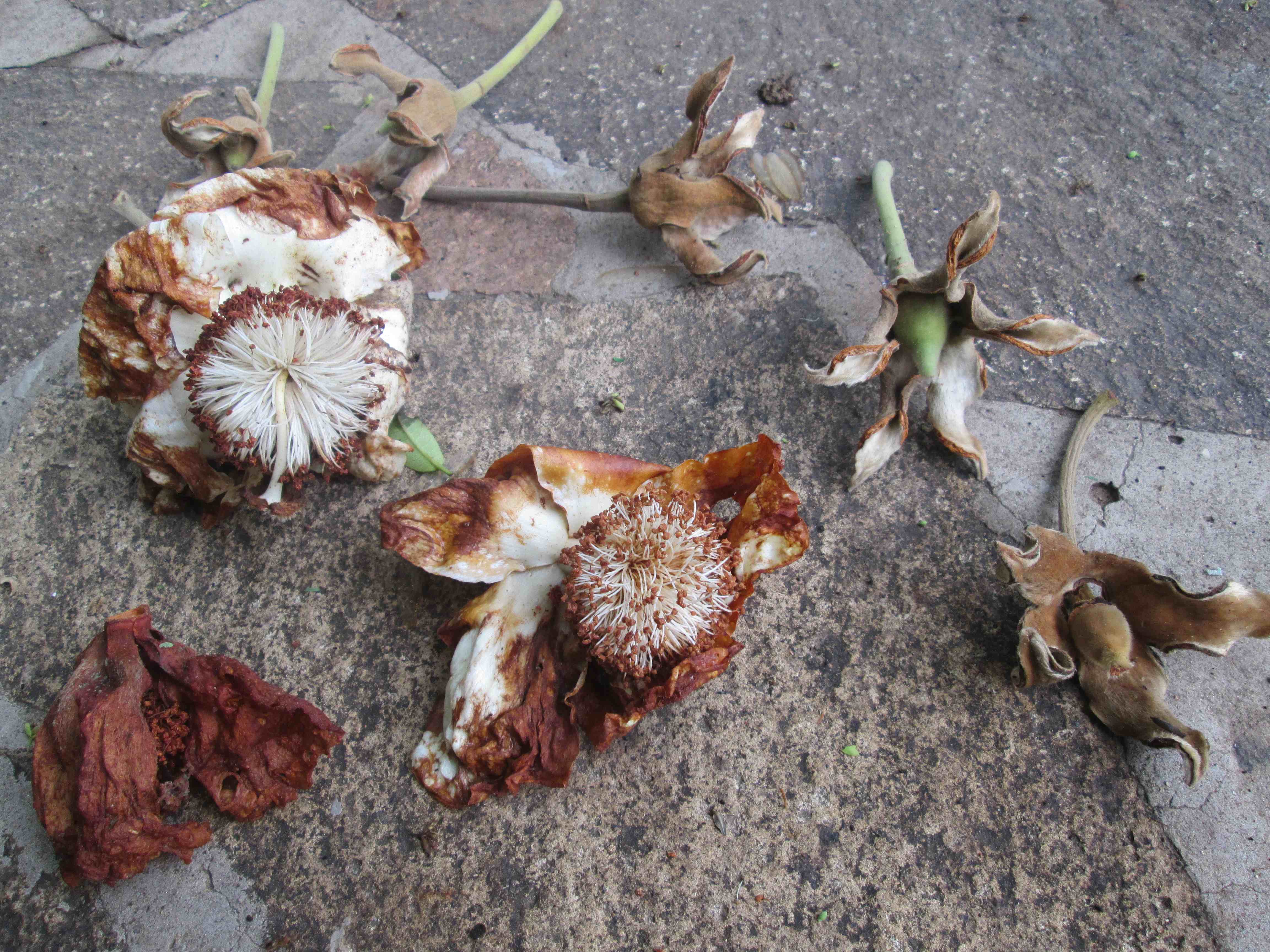
and drop to the wet ground in splendid decadence…
baobab flowers and pods
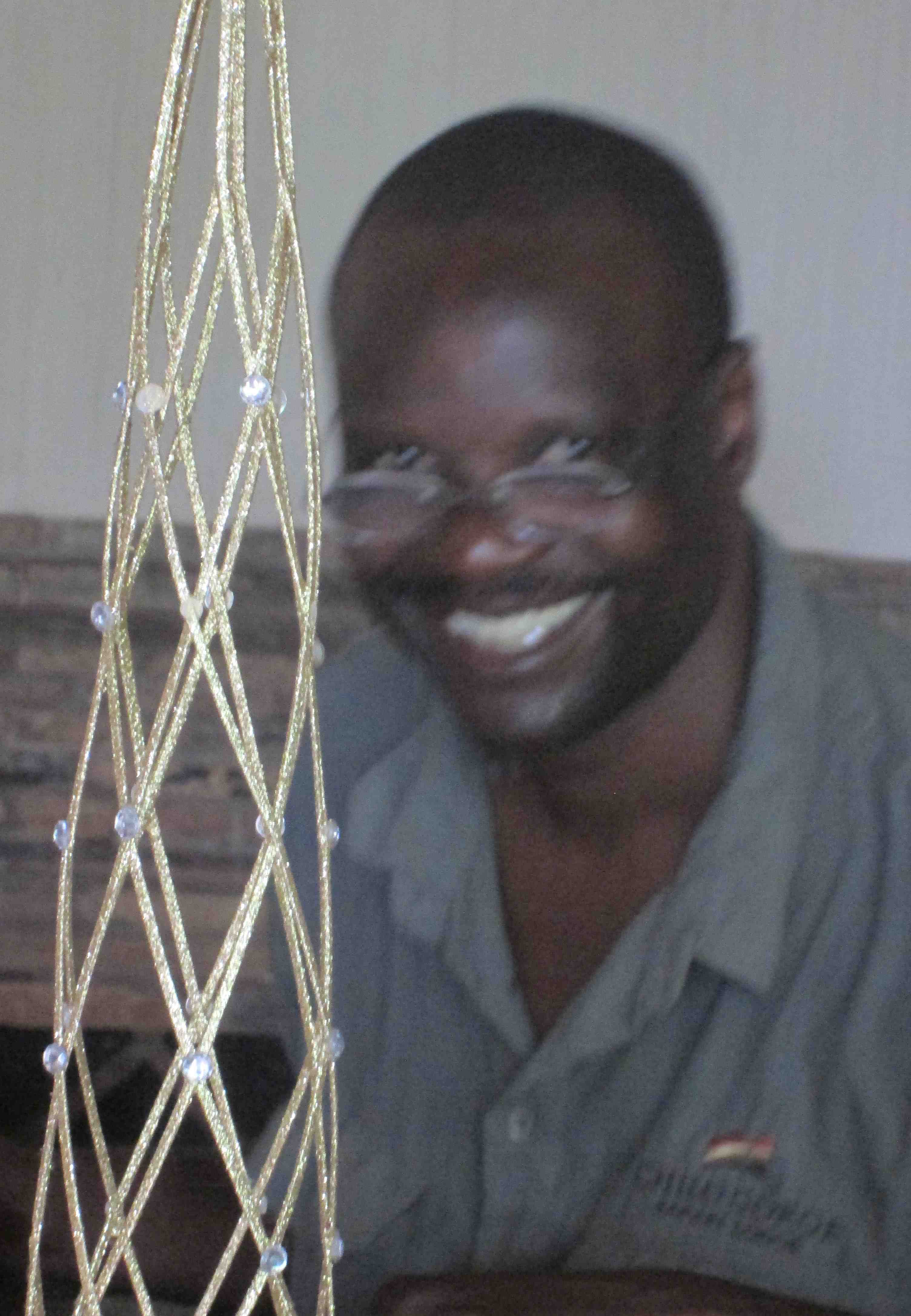
A special season, time for giving thanks to nature’s bounty, and for planning exciting safaris for lucky guests..here is Thomas, Chief Guide, just in from checking the river crossings and now working at his desk. Framed by a sparkly festive tree, he is busy putting together great ideas for drives and walks…..!
Visit these links for amazing video of Whales and Wolves….what a lovely and thought provoking “Saving Wild” blog Lori Robinson writes….about some of my favourite animals…
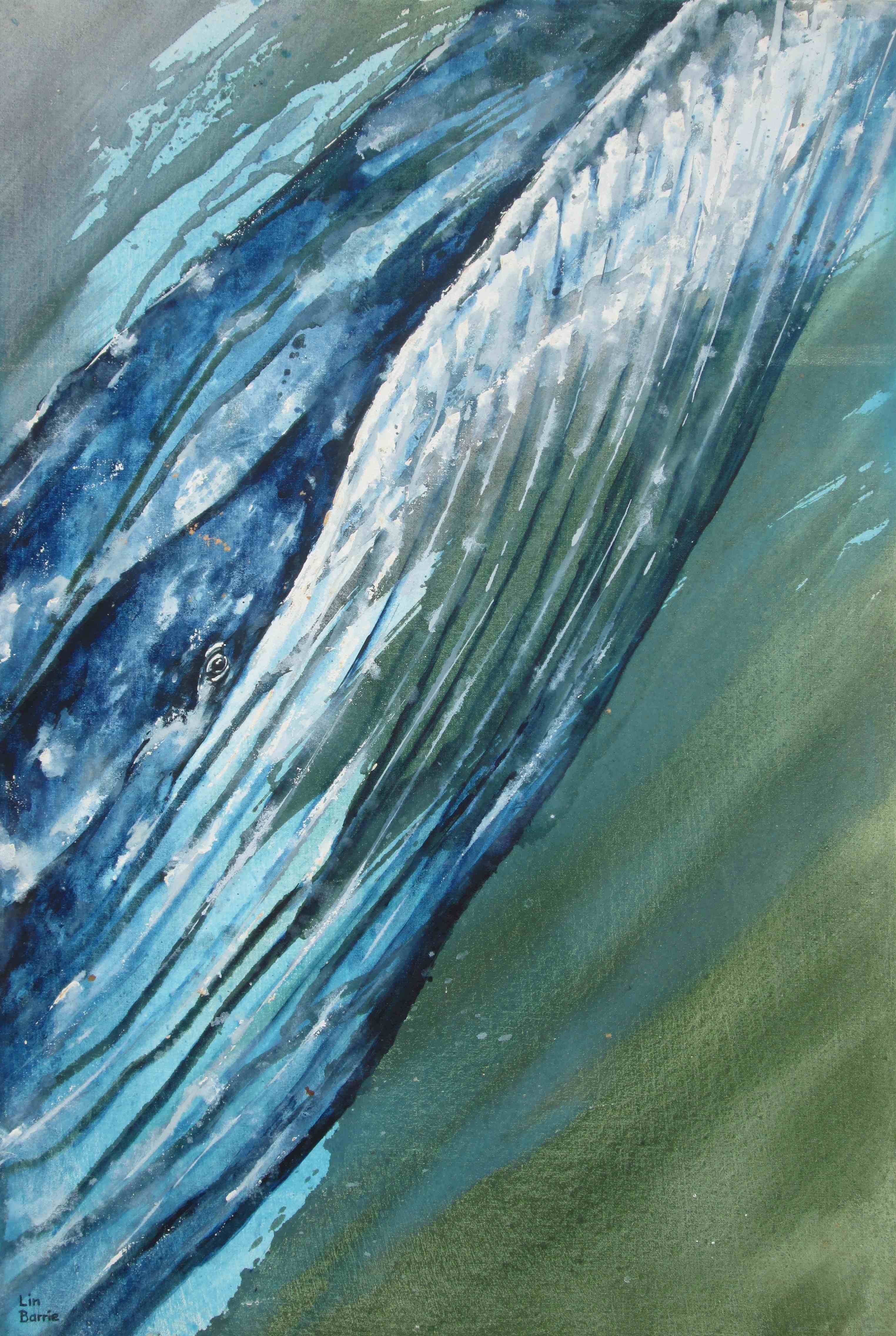
Here below is a Blue whale painting that I did after staying at Kalk Bay, Cape Town, one August with dear friends..
I walked on the shore every day and had Southern Right Whales breaching and rolling before me, some mothers clasping tiny babies in their fins…the gentleness of a “Whale Hug” has to be seen to be believed……bliss…
But I digress…this painting of mine is of a Blue Whale- inspired by the book “Elephantoms” by Lyall Watson, who proposed synergies between Whale and Elephant communications. fascinating…the blue whale has the most powerful and deepest voice in the animal kingdom, and its low-frequency sounds can travel in deep water over hundreds of miles. So, similar to elephants, animals which may appear to us to be alone may actually be talking to others hundreds of miles away……
“Whale Song”, by Lin Barrie, oil on canvas board, 91 x 61 cm
Whale Song, acrylic on canvas board
Lin Barrie Art -for updates, more paintings and catalogue, visit my blog page, ‘Art by Lin Barrie’:
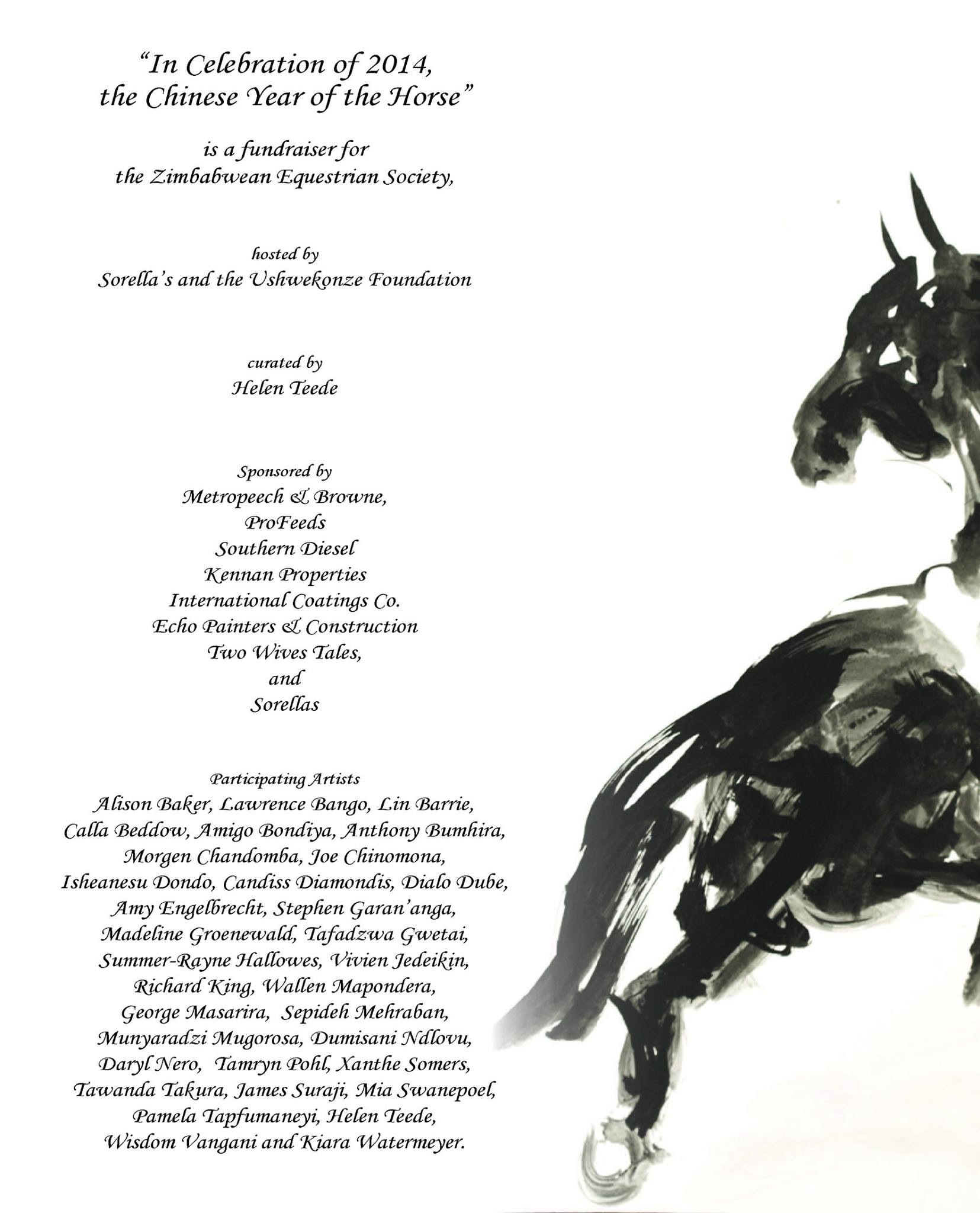
“In Celebration of 2014, the Chinese Year of the Horse,”
“In Celebration of 2014, the Chinese Year of the Horse,” is a group show comprising thirty-four artists, to raise money for the Zimbabwe Equestrian Society. I am excited to be participating, using semi-burnt items from my house fire, to re-create energy and positive statements….
Participants in “In Celebration of 2014, the Chinese Year of the Horse,”
I am soooo excited to be exhibiting with diverse and inspiring fellow artists….and I know that Helen Teede’s curatorship will result in a thought-provoking and inspiring exhibition!
2014 is the Year of the Wood Horse….
Since 2014 is a Wood Horse, the Wood element is about reaching onwards and upwards, planning ahead. Will grand plans come to fruition? Be somewhat circumspect when it comes to formulating your blueprints for the year ahead. Whilst the Wood element may influence you to move forwards, the Fire in the Horse, which sits beneath the Wood, can burn up some of your designs, if you are not careful.
Whew….!
I have direct experience of the destructive force of fire after our house fire earlier this year, when much of our art and possessions were burnt…
Wood energy is renewal, flexibility and boundless creativity. Together with the energy of the noble, powerful horse, this combination is an unstoppable force- in my work I hope to harness and experience the energy of the horse as a creative urge.
My painting, “Zebra Energy, Baobab Burnt” is a powerful zebra, horse of Africa, rearing within the embrace of a gigantic baobab tree….
This is painted on a canvas rescued from the flames of my burning house by brave friends.
“Zebra Energy, Baobab Burnt” , acrylic on canvas, 150 x 200 cm, by Lin Barrie.
Zebra Energy Baobab Burnt
Here is detail from that huge painting….
Detail of “Zebra Energy , Baobab Burnt”
Zebra,
striped horse of Africa.
You are power,
dynamic force,
uncorked enthusiasm.
Baobab,
iconic tree of Africa.
You are stability,
flexibility,
vulnerable earth-force.
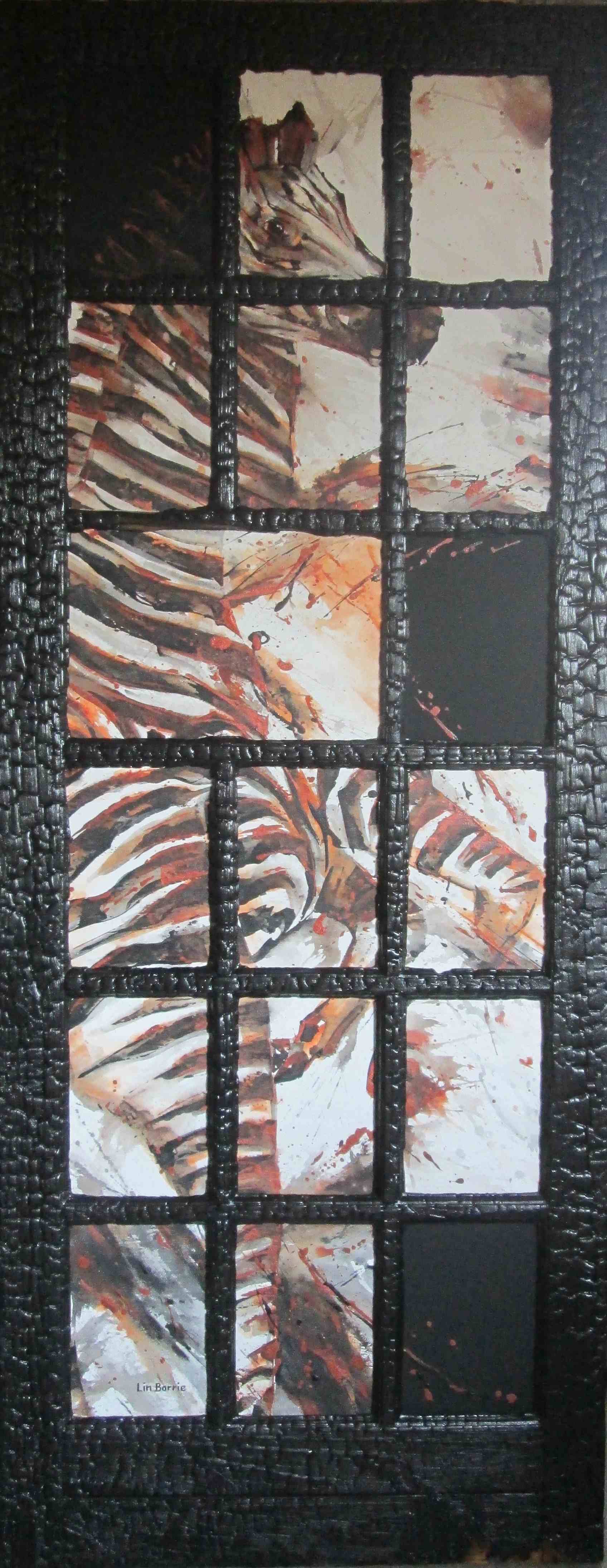
My installation, “Zebra Portal” is created from one of the burnt doors of my home, rescued from a recent fire. The power of that African horse, the zebra, is dynamic, dramatic, even though constrained by the charred frame of the door……
“Zebra Portal”, Acrylic and wood, mixed media installation, 200x100cm
Zebra Portal – acrylic and wood – 200 x 100 cm
From flames ,
Burnt wood,
And destruction
Comes new hope,
Energy
Resilience
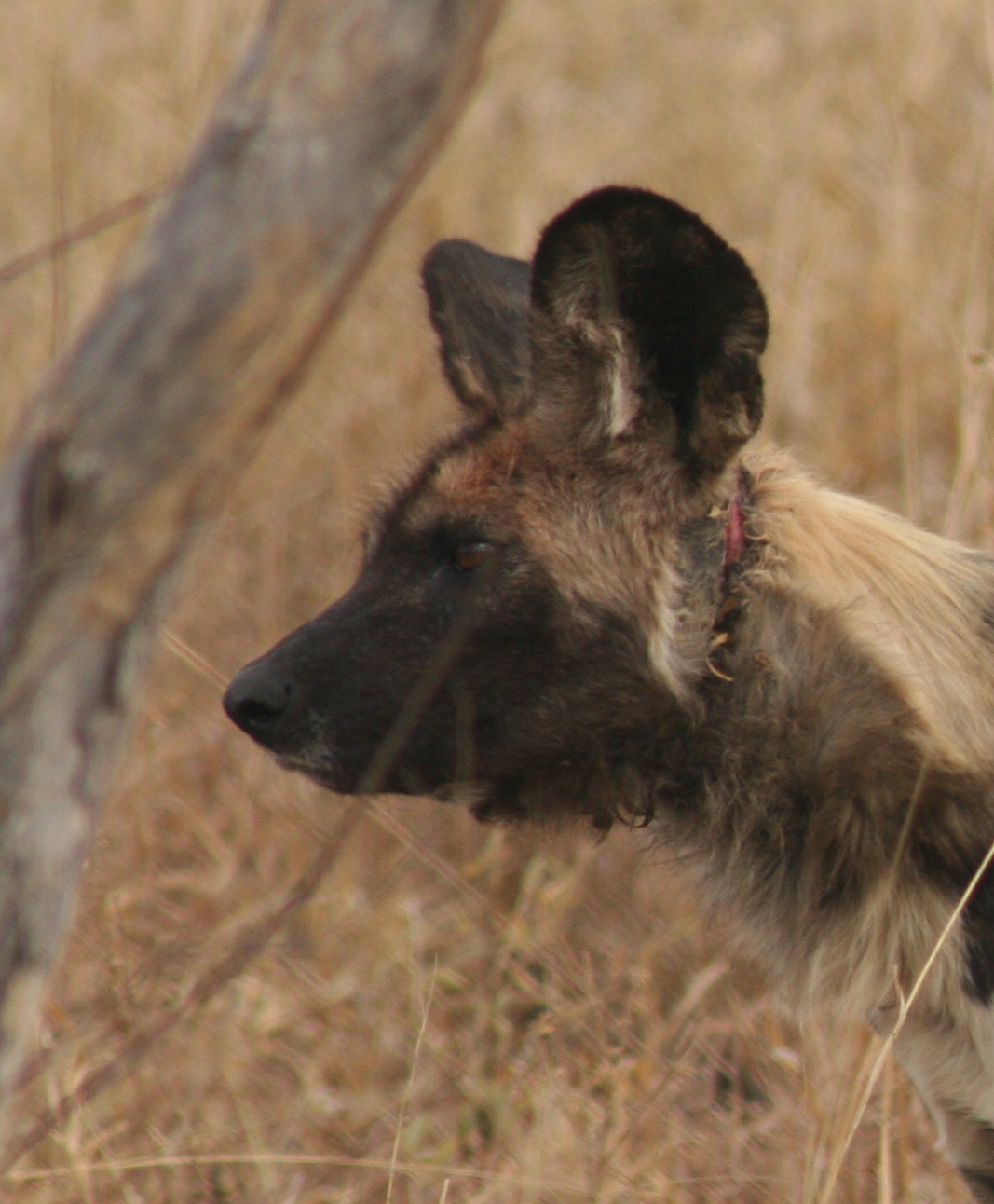
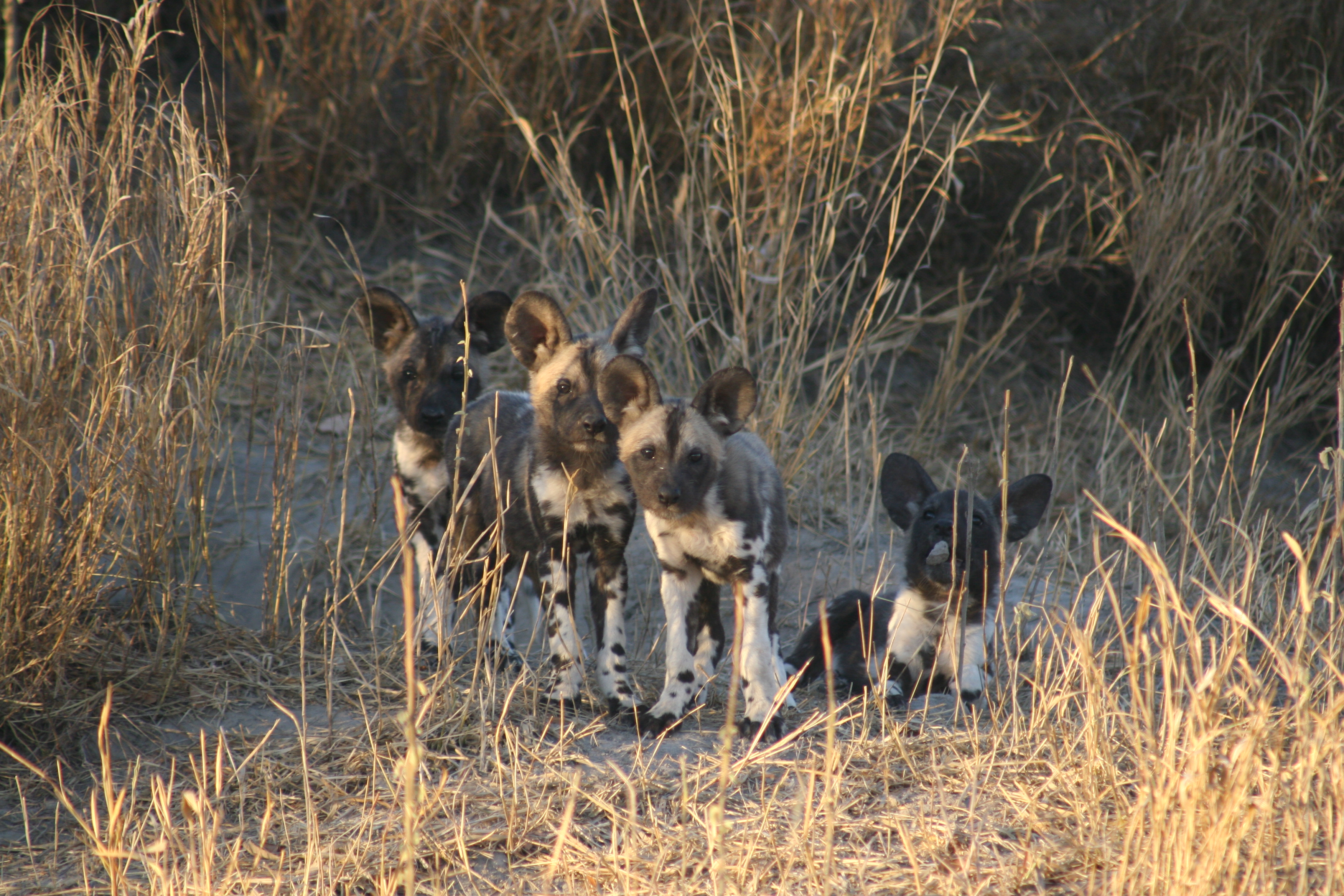
African wild dogs are not generally aggressive to man, very unassuming in fact…
I call them ‘gentle killers’ in homage to one of the first amazing books written about them by Jane Goodall and Hugo Van Lawick, so many years ago…..called “Innocent Killers”.
What an amazing book it was to read, documenting years of research, and personalizing three fascinating predators: African wild dogs, Spotted Hyenas and Golden Jackals.
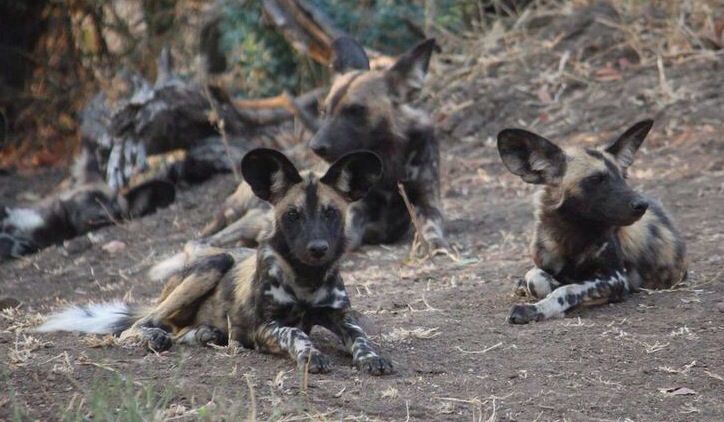
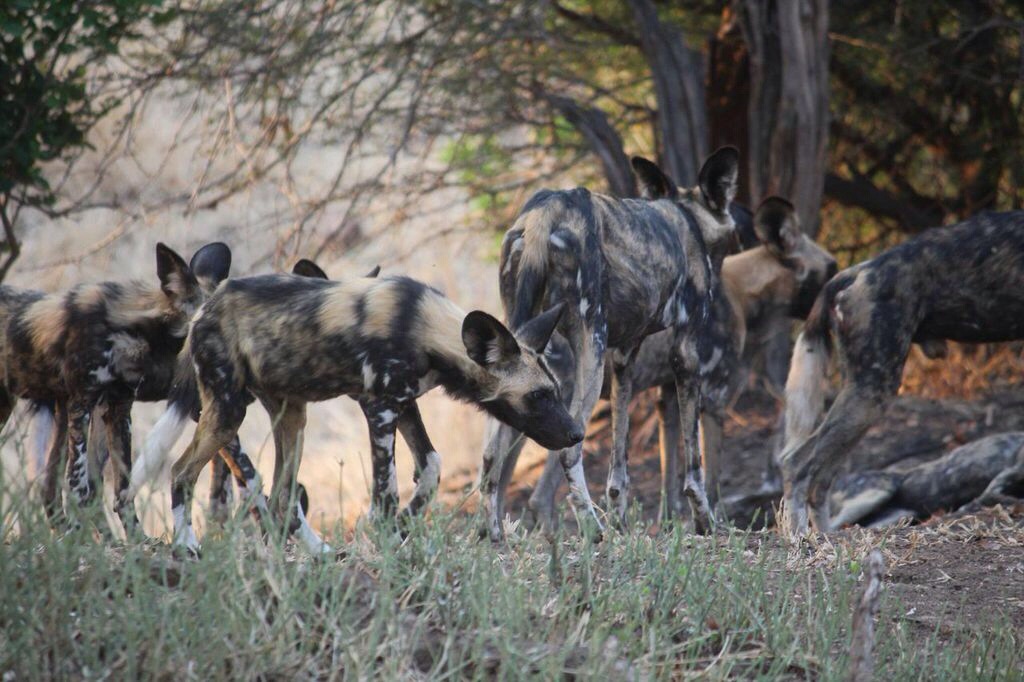
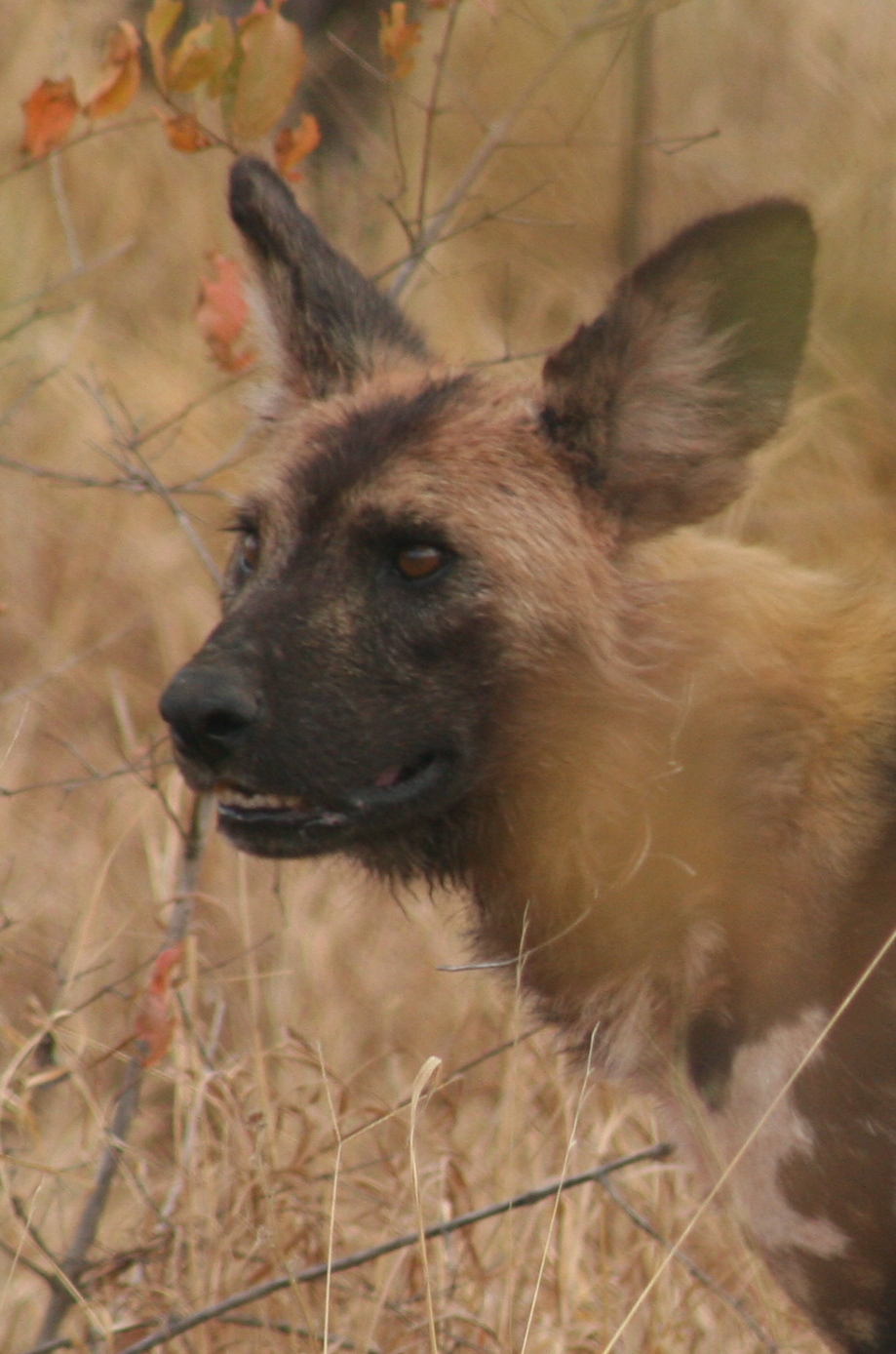
These photos, taken by friend Melanie Anderson Gardener on a game drive near to Chilo Gorge Safari Lodge, with guide Thomas Mutombeni, really capture their mood, relaxed yet very inquisitive…..
Half grown pups are nurtured and protected within the pack…this is a pup on the left….
Gorgeous coats , a painter’s dream in gold, black and white!
The glowing late afternoon light of Gonarezhou National Park echoes the gold in the dogs coats,
I am thrilled to note that each of these photos shows a different pup…plenty of new blood to carry the fortunes of the pack! …here is another pup…
And another…note the differences in coat markings which make these spectacular animals so easily identifiable in the field…
This pup is eagerly following an adult, anticipating the late afternoon hunt…..
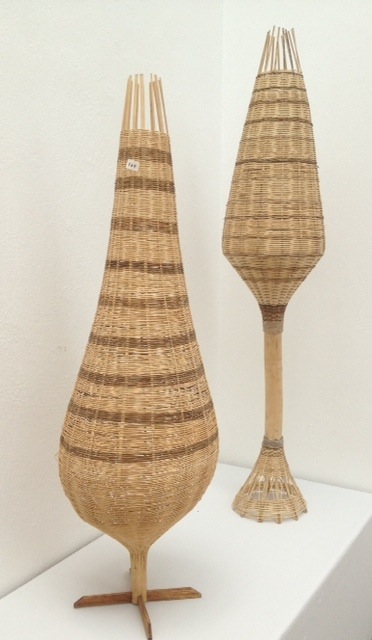
Basket Case II Exhibition @ National Gallery of Zimbabwe is on until 15th December.
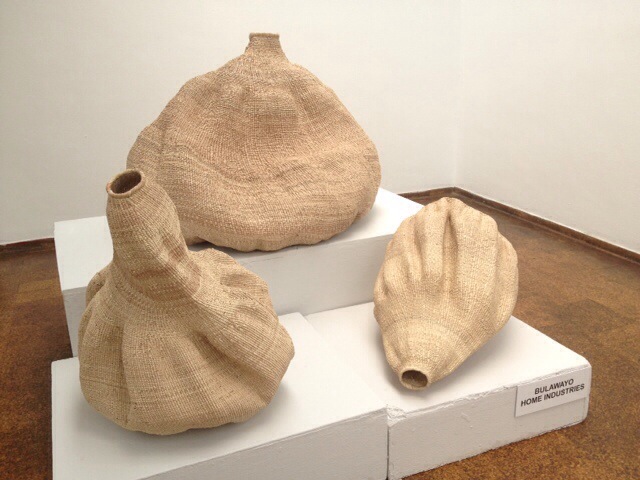
The EUNIC Zimbabwe Cluster (British Council, Alliance Française and the Zimbabwe German Society) and the National Gallery of Zimbabwe, Harare, would like to invite you to Basket Case II, a visual art and design exhibition, which is funded by the European Union.
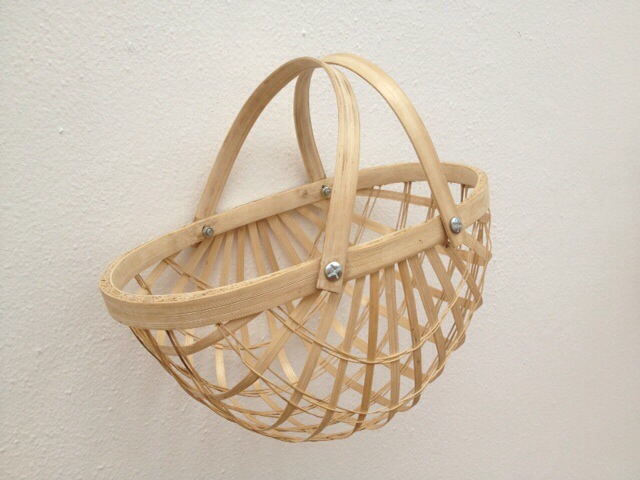
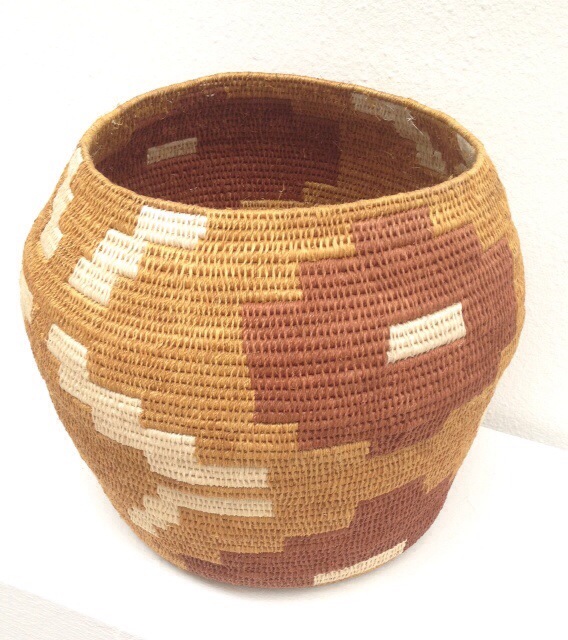
The Creative Zimbabwe Basket Case II Exhibition celebrates the best of Zimbabwean basket weaving through art pieces and designs from Binga Craft Centre (Binga), Bulawayo Home Industries (Bulawayo), Lupane Women’s Centre (Lupane), Step Trust (Honde Valley) and Zienzele Foundation (Masvingo). This brings together work by five prominent African and European artists who are Ifeoma Anyaeji (Nigeria), Alexandra Bircken (Germany), Tapfuma Gutsa (Zimbabwe), Delaine Le Bas (United Kingdom) and Michel Paysant (France), who have been commissioned to create exciting new pieces which will be on display.
Two acclaimed European designers, Nathalie Crasset (France) and Sebastian Herkner (Germany), have also worked with these communities, drawing from their own expertise and the weavers’ traditional craft to develop innovative designs enhancing the communities’ range of objects.
A Public Programme will be run concurrently to this where you can meet the artists and designers and discuss their pieces and experiences.
If you would like to buy any baskets, an Open Market will also be held at National Gallery, which will give you the opportunity to meet with to the weavers and buy items for all your early Christmas shopping needs!
Basket Case II is co-curated by Christine Eyene, Guild Research Fellow in Contemporary Art, University of Central Lancashire, and Raphael Chikukwa, Chief Curator of the National Gallery of Zimbabwe.
Come and be part of this Beautiful Collective and Timeless Experience:.
Venue: National Gallery of Zimbabwe
Exhibition until 15 December, from 9am to 5pm
In September, we shared crocodile love and Malilangwe Magic with our dear friends……Ian and Jane Craig of Lewa Conservancy and Northern Rangelands Trust, Kenya, and Willy and Sue Roberts of Sirikoi Lodge, Kenya.
Driving first to our Senuko home in the Save Valley Conservancy, Clive, Ian and all of us shared laughs, wine and stories and caught up on events since the Prince William Award for Conservation was presented to Clive in London last year.
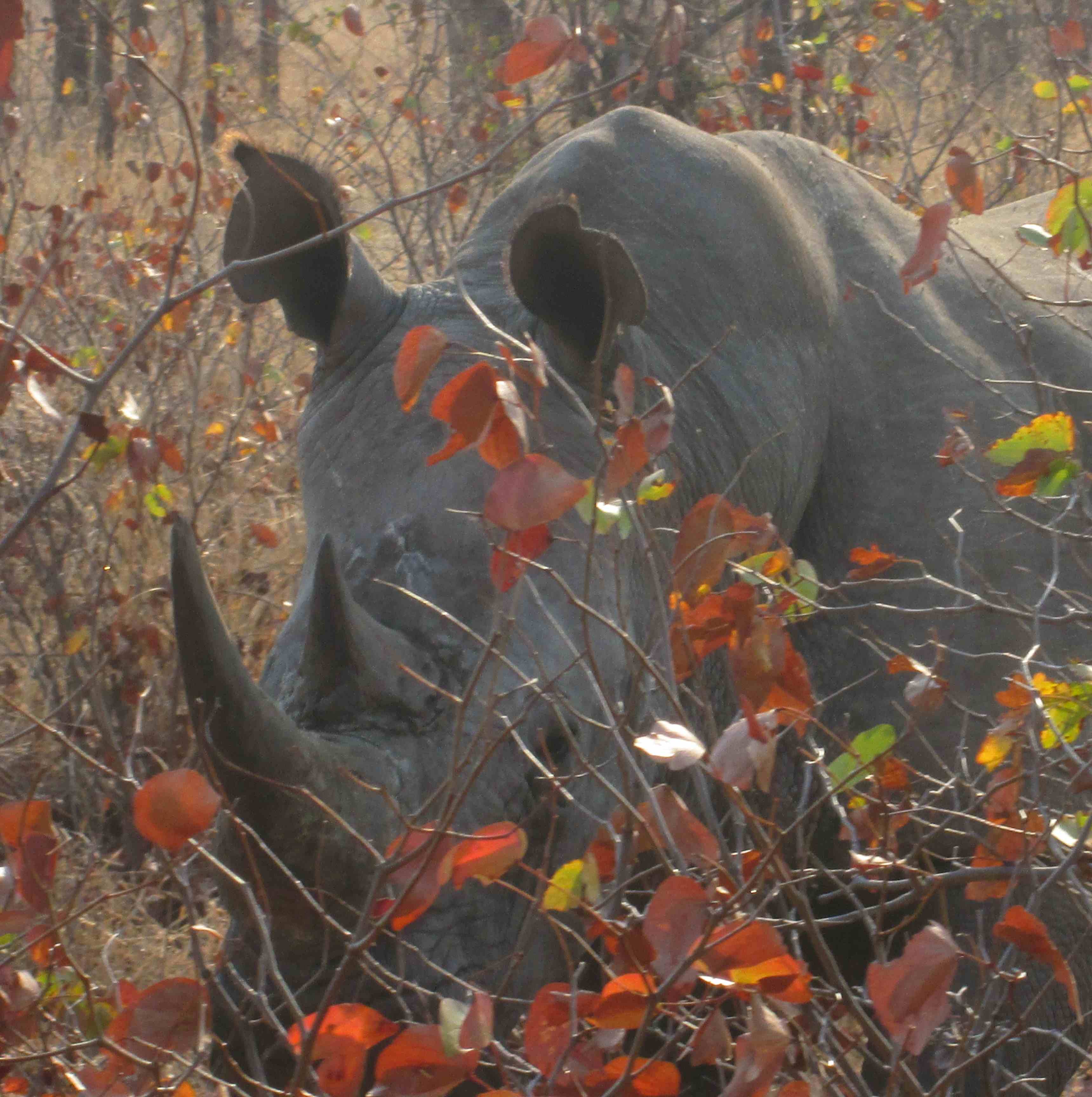
As usual, the talk was of rhinos, elephants and all things pachyderm, from Senuko all the way to Malilangwe!
bull and Mopani leaves
Wherever we are in Africa, preservation of our glorious rhino and elephant populations is paramount to all of us…..
mother and daughter
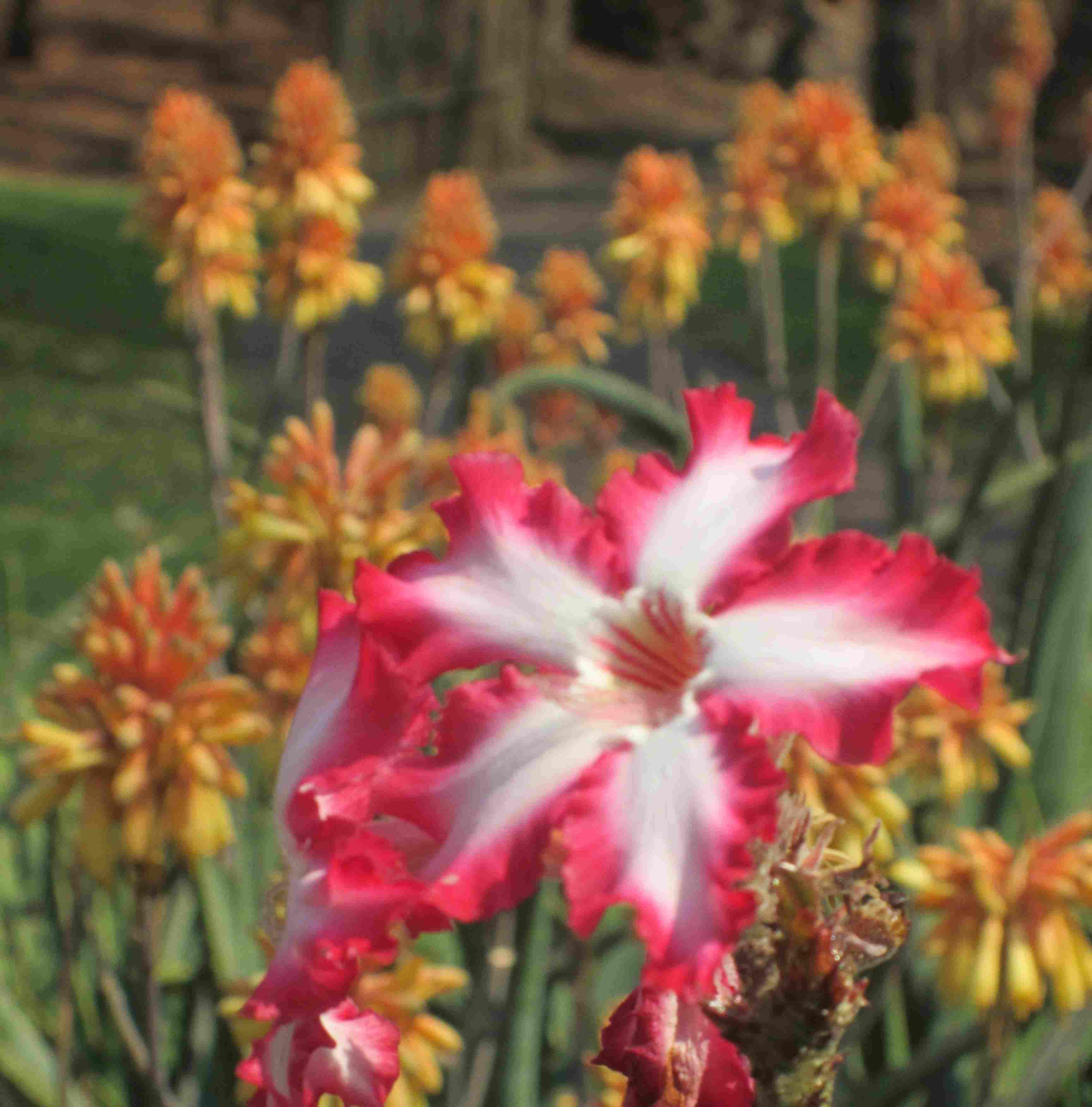
Malilangwe was a delight as usual, the last Bollywood colours of the season, pink Sabi Stars and orange aloes, greeting us at Singita Pamushana…
bollywood colours
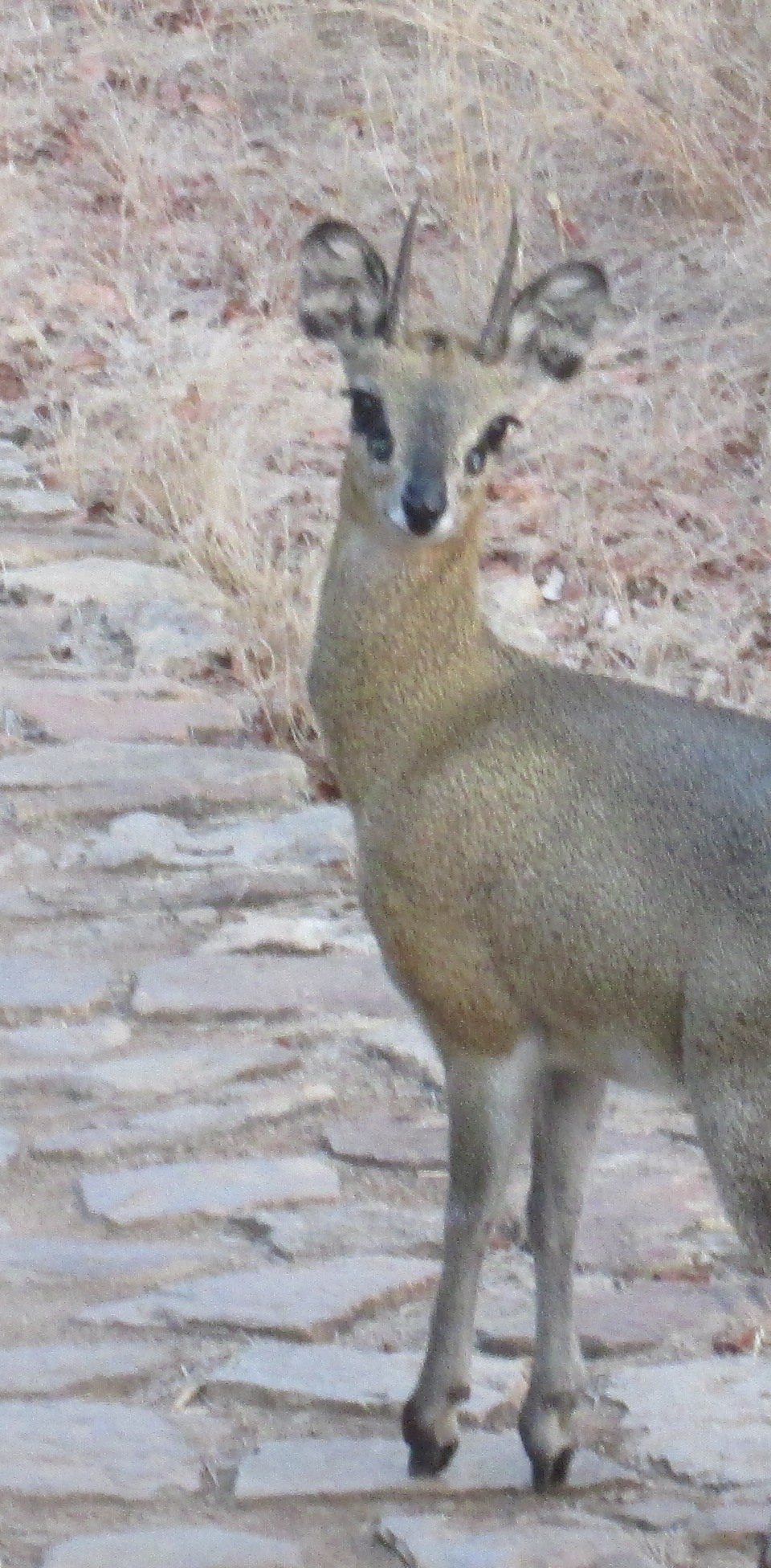
Game drives were spectacular, hosted by the resident klipspringers!
tip toes…
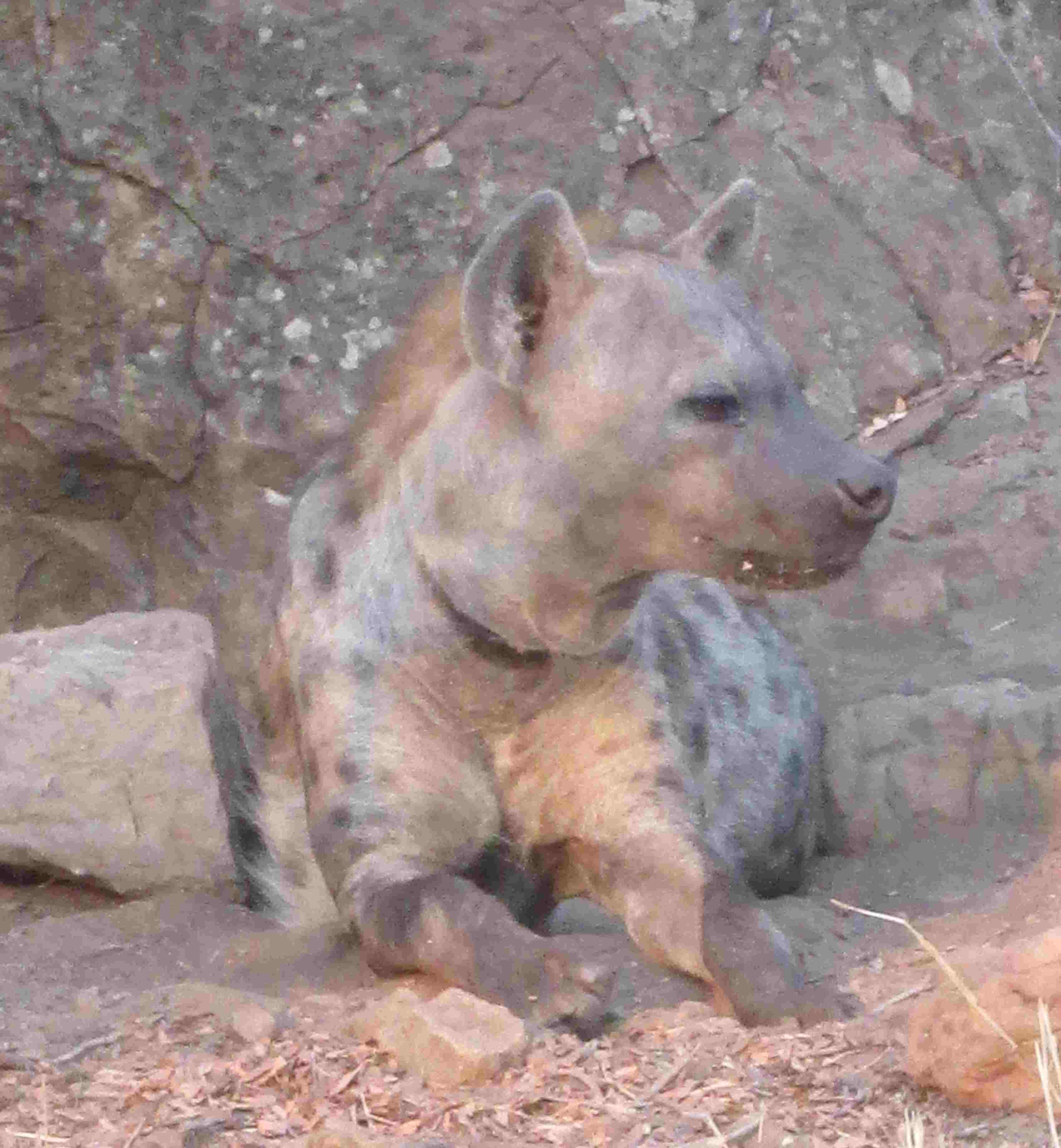
Closely observed by the new mum in the area, a hyena queen who was rescued from a snare years ago by the Malilangwe team…visit the Malilangwe link for facebook updates…..
hyena mum guarding her den
and driving through fabulous Acacia woodland..
acacias and buffalo
to watch the great and gentle bull elephants of Malilangwe have a drink …
elephant reflections- a painting by Lin Barrie
and throwing mud at the local pan…
bull ele mud bath
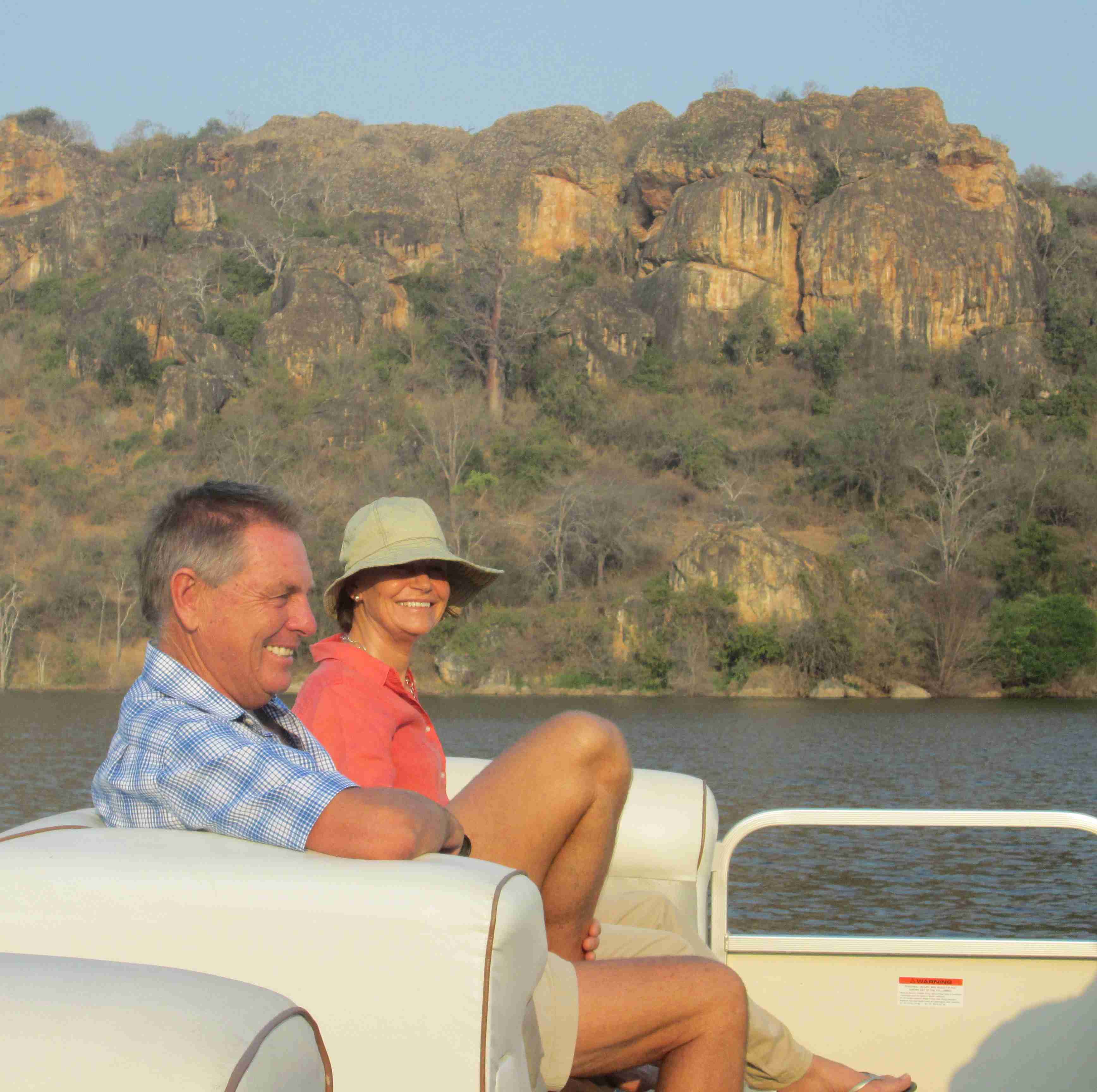
An afternoon boatride on the Malilangwe Dam was a perfect end to the day…
Ian and Jane in rare relaxed mode!
lots of birding…..
Jane loves her birds…
and as the sun began to set……
Malilangwe sunset
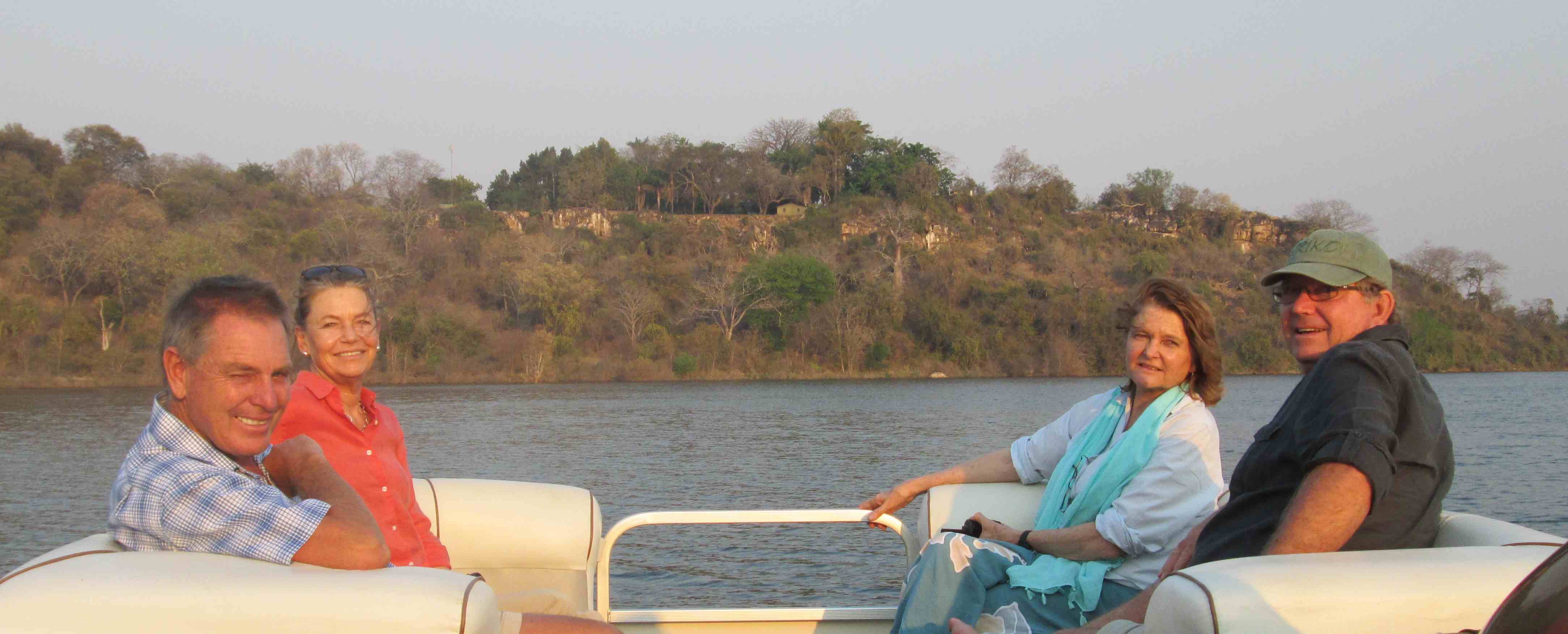
a contented crew of friends….
Ian, Jane, Sue and Willy
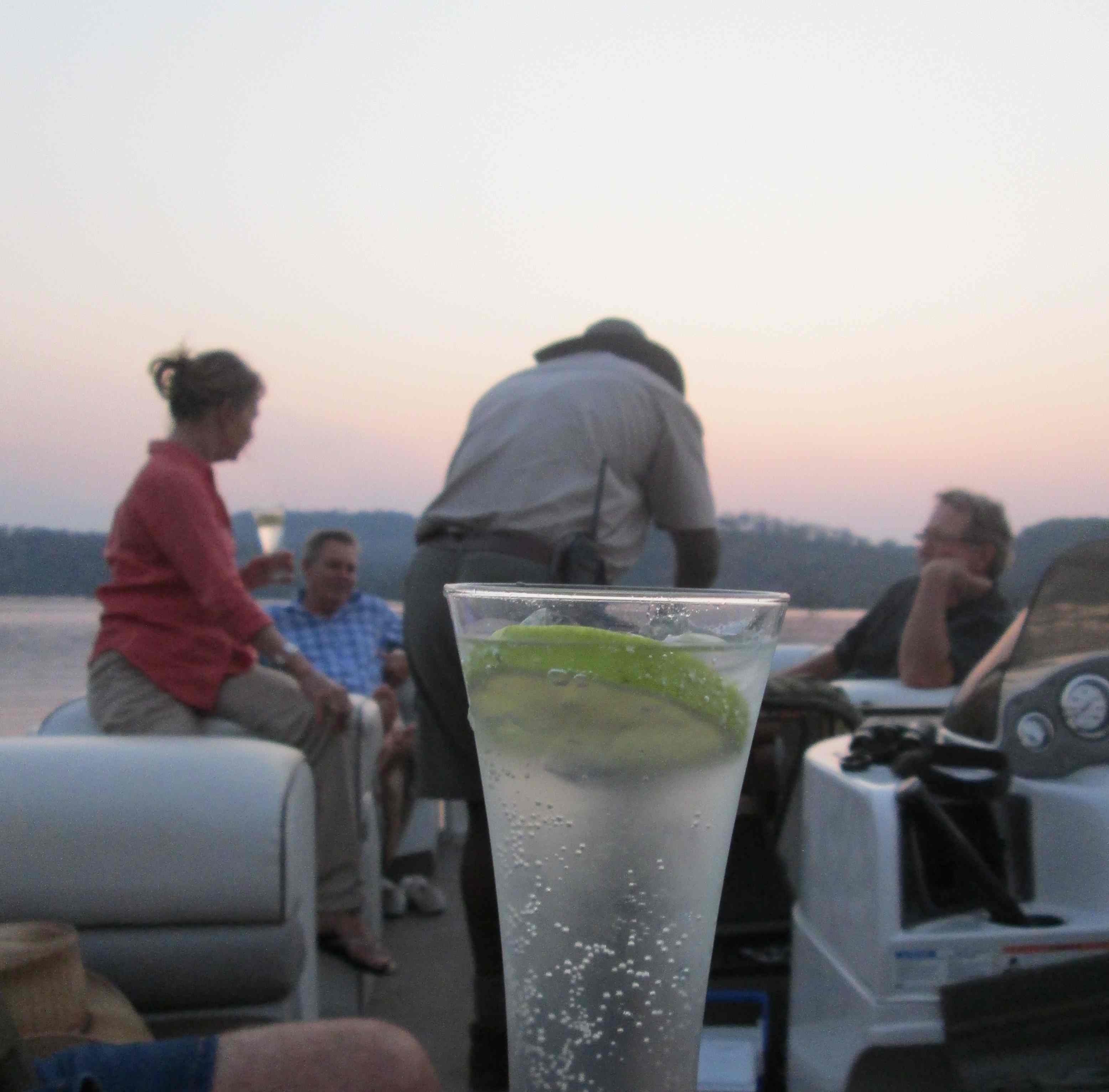
who looked forward to Gin and Tonics expertly prepared by professional guide and friend, Tengwe….
Gin and tonic preparation
what an end to a perfect day…..
juvenile fish eagle on his nest
But just the beginning of our fun together, as we pressed on into the gorgeous scenery of Gonarezhou National Park, passing groves of Lala palms, so similar to the Doum palms of Northern Kenya, when they grow with split stems….
lala palms sometimes grow split stems
and camped at Chitove on the Runde River…graced by Tabernae montana elegans bushes, gorgeous green against the cobalt sky…
cobalt sky and elegans leaves
Chitove…a camp filled with happy memories of many trips for me, and some fun fishing memories this time…(many Tiger fish got away to tell the ‘tail’…!) but what impressed me more were the giant Mummy crocodiles who slithered and slipped all about us as we walked along the river bank, guarding their nests of precious eggs deep in the sand, and leaving their belly prints pressed into the sand all around us…
croc prints 1
abstract design, unbeatable beastly beauty in the sand…
croc prints 2
Moving on at the end of our trip…through stately stands of baobabs between the Runde and Save Rivers….
baobab ridge offers multitudes of these trees
and at last to special Chilo Gorge Safari Lodge on the banks of the Save River, high on a cliff with views forever and a wonderfully peaceful place to finish our trip with these, dearest of friends…
My mind drifts Mana Pools…where we recently shared a Safari with various dear friends, including Gwen Wawn, and travellers extradordinaire Brian and Dee Keating, of Going Wild, Canada.
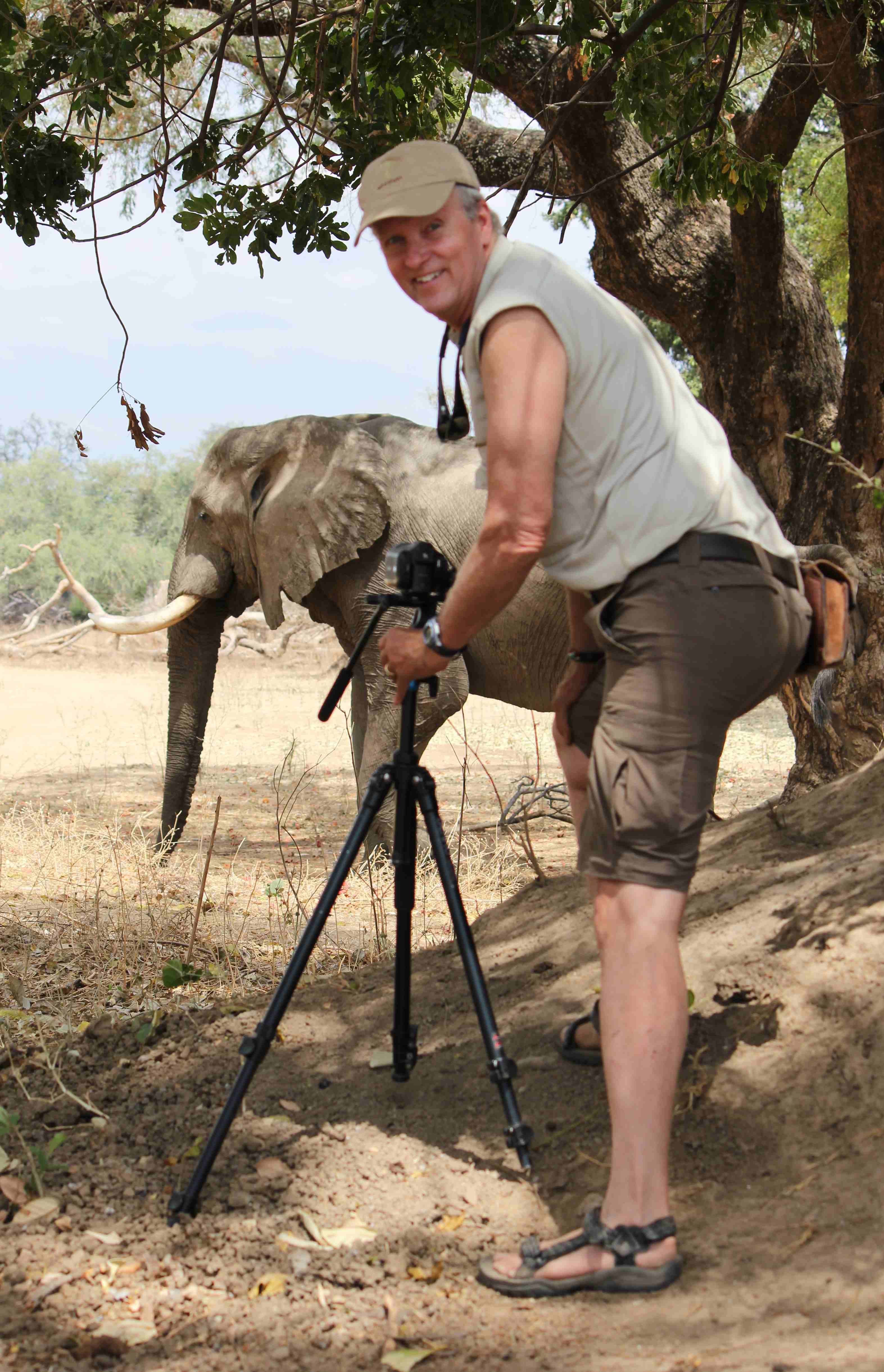
Brian Keating and gentle Bull
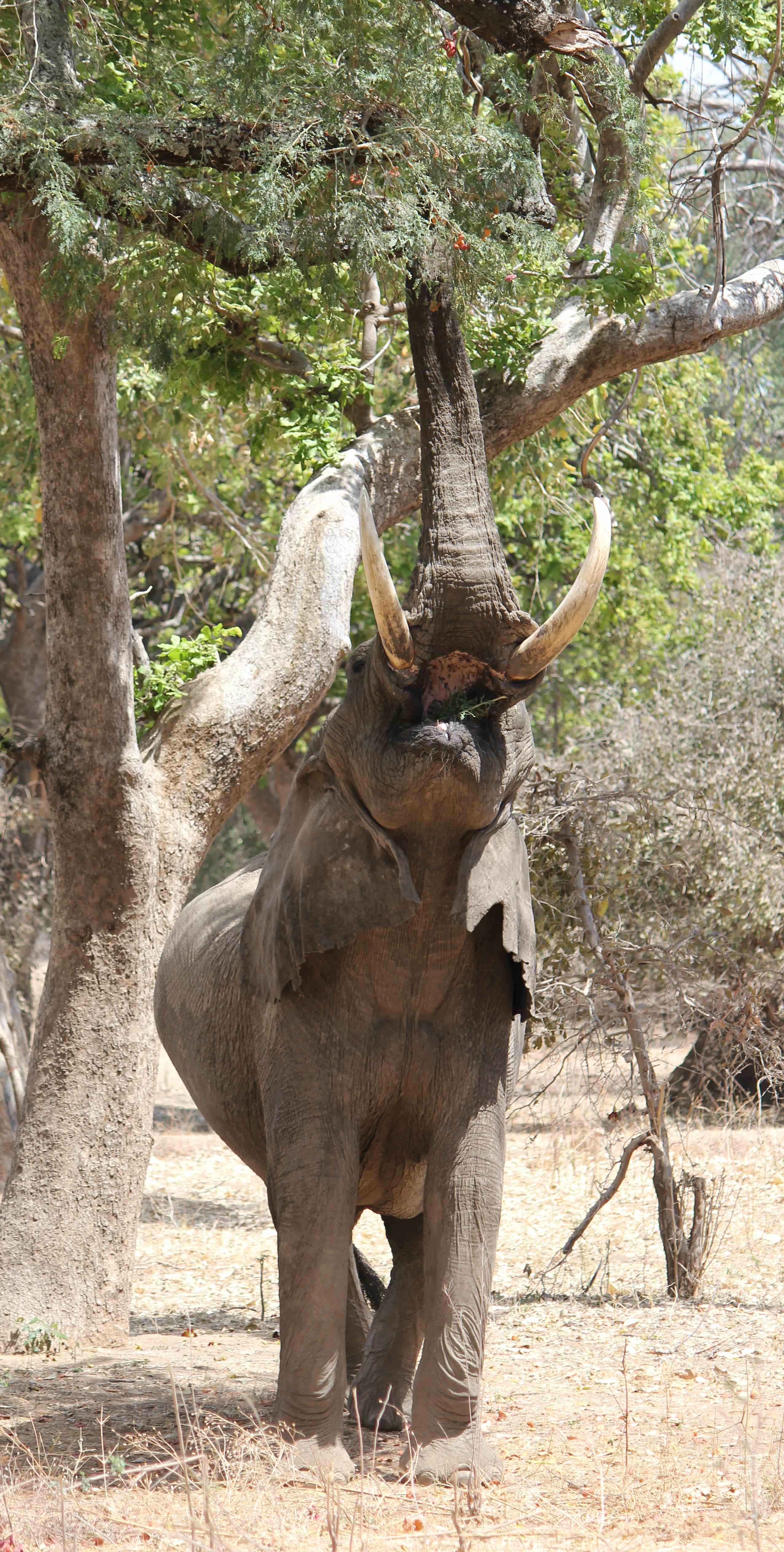
All around our Mucheni 2 camp, gentle elephants wandered and browsed the albida pods, a staple diet at this dry time of the year, parched earth holding its breath before the first rains…
feeding elephant
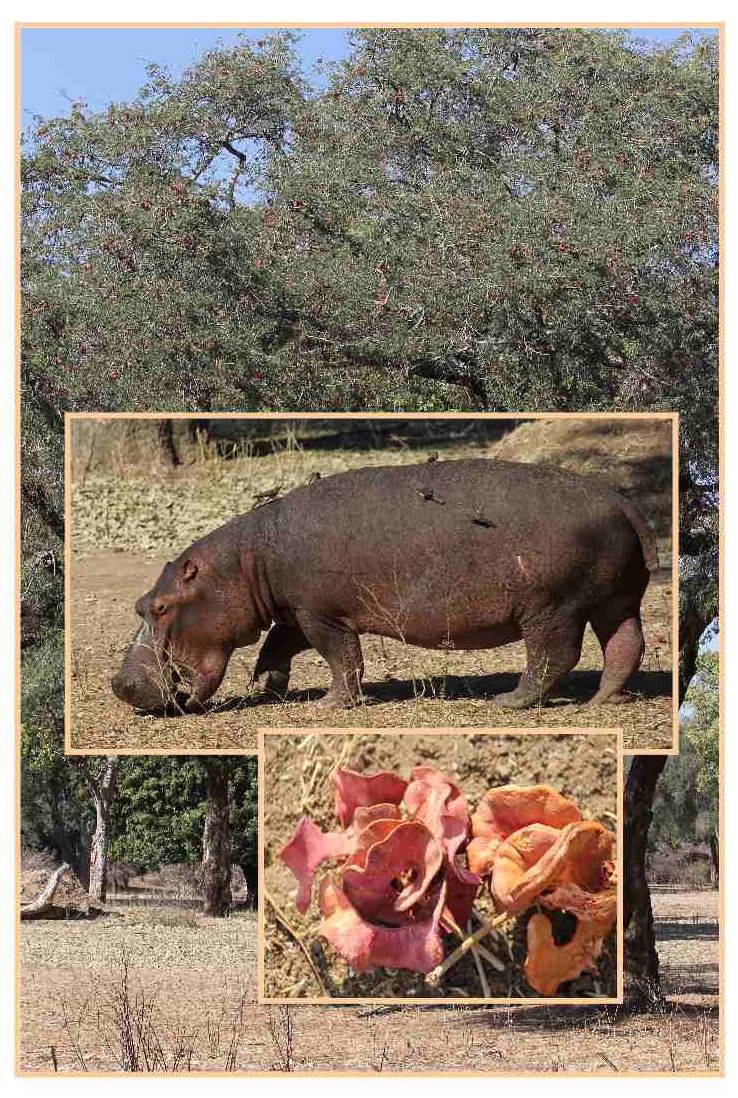
the hippos too were desperate for sustenance, no green grass to be found for miles, and this resident ‘hippo-podamus’ frequented our camp daily…
hippo-podamus
the sweet scent of minute trichelia flowers filled the air at Mucheni 2…dropping delicately into our laps from the evergreen shade of the stately tree above us……
trichelia treat
What a treat for our eyes…’carmine candy’ filled our vision just upriver from the camp, a constant visual delight…and inspiration for me to create some Lin Barrie artworks on handmade paper…
carmine candy
African wild dogs lay in our laps…(well, nearly!)…bloated after a successful morning hunt which saw them bloody necked and contented.
Brian and Dee Keating spent many happy hours watching, photographing, day-dreaming with the dogs!
The best thing when watching resting wild dogs…
The best thing when watching resting wild dogs…
is to lie back and relax with them….
is to lie back and relax with them….
but to be ready for action when they stand up….
Mana dogs
and head out….!
mana dog moving fast
Elephants were the order of the day, filling our eyes and minds with numerous looming images, sometime humourous, always fascinating…
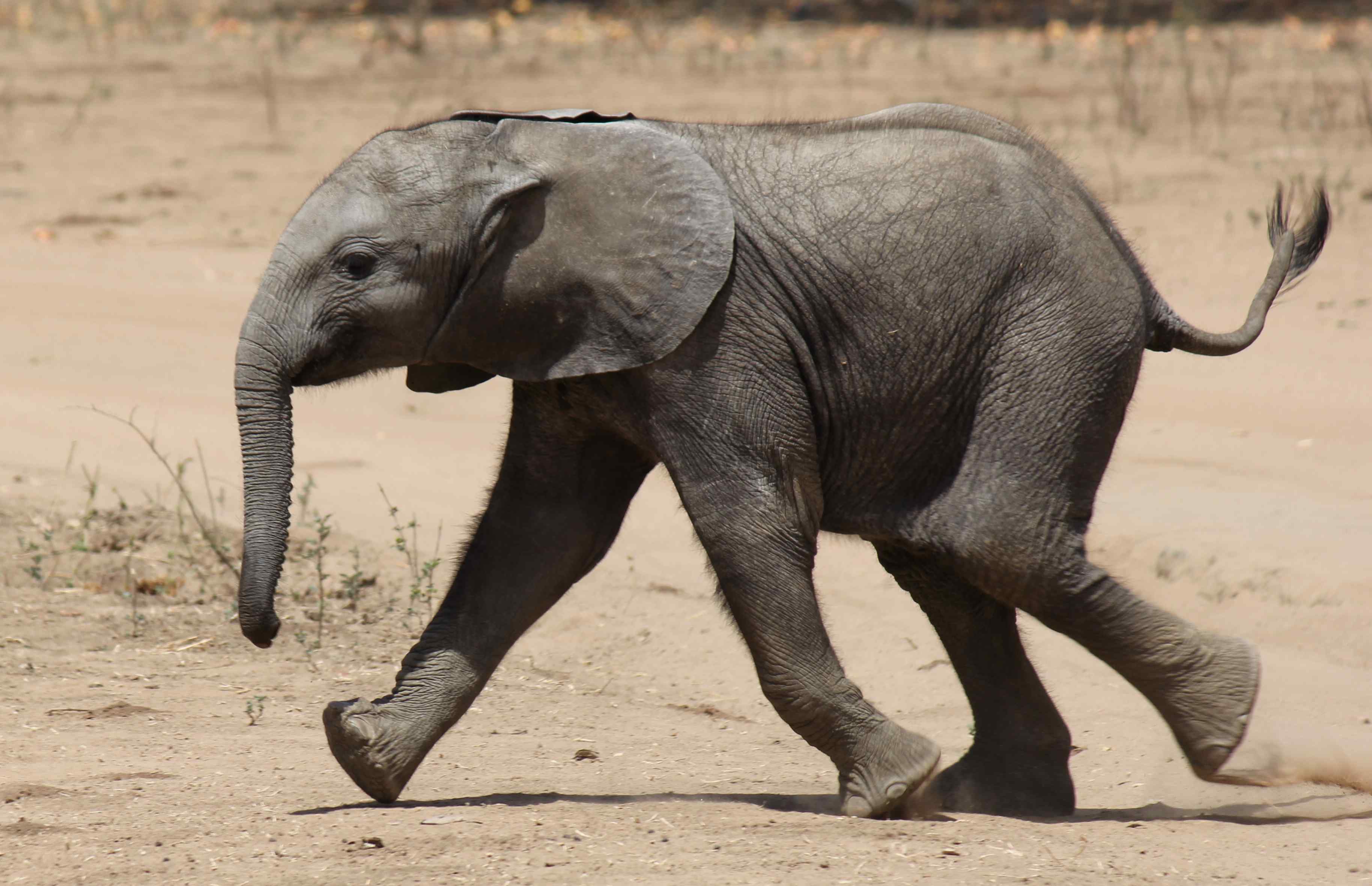
Here is a baby rushing after Mum…..
baby at full speed
Catching up…..
baby catches up
and happily finding the milk bar!
baby gets a drink
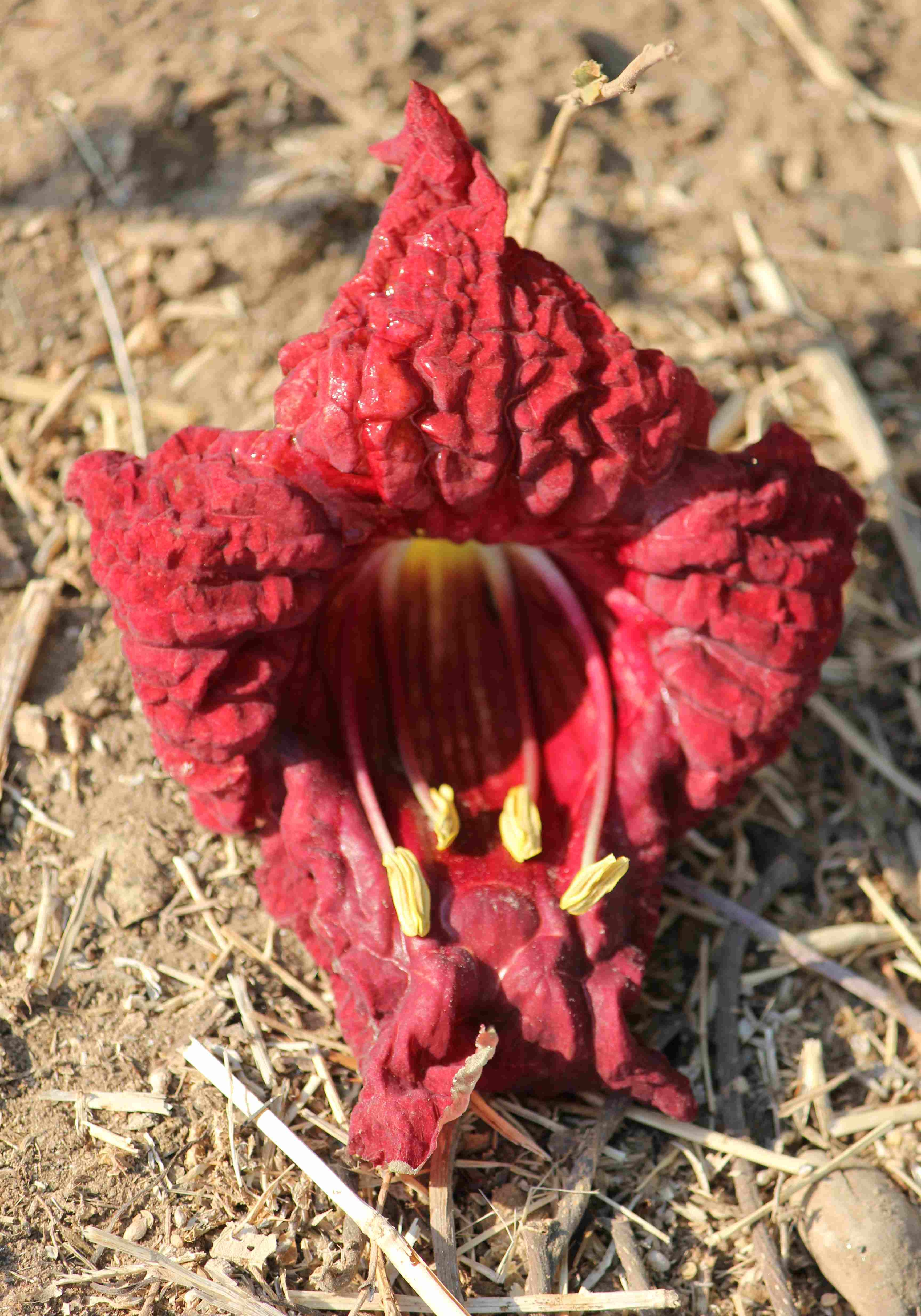
gorgeous jewel coloured kigelia flowers littered the earth like persian carpets…inspiration for an abstract painting, I think!
kigelia fruit and flowers
As was the dry gold and red Mopani woodland…a visual delight for my artist’s eye…
mopani leaves and trunks
baobabs everywhere , of various form and great character…
mana-bab
sad to leave, yet the road out provided baobab vistas aplenty……
the road out of Mana
and gorgeous combretum flowers and pods against a cobalt sky….
October…Suicide month…alternating bouts of heat, with panting plants wilting in the intense sunlight, and then, overnight, cool blasts of wind, bringing slanting rain and lightening streaking across the Gonarezhou wilderness opposite Chilo Gorge Safari Lodge.
This is a month of transition; plump and pregnant impala does waiting out the heat, crocodile eggs incubating in warm sand bars flanking the Save and the Runde rivers, guarded by vigilant, monolithic mothers.
On a recent trip along the Runde River with Ian and Jane Craig of Lewa, Kenya, and Willy and Sue Roberts of Sirikoi Lodge, Kenya, we fished between dozens of these lady monsters, who slipped around us as they guarded their precious eggs…read that story in my blog, Malilangwe Magic; Crocodile Mothers…..
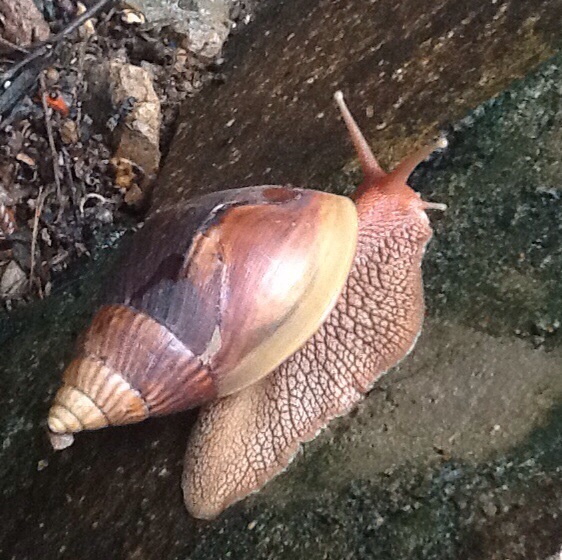
The first splattering drops of rain bring promise of more, and the tentative emergence of Giant land snails on the pathways at Chilo Gorge heralds the official start of the Summer……
We have a mollusc specialist from Europe visiting Chilo, and within less than one metre square of leaf litter and soil, she has discovered at least 10 different species of terrestrial snails! Ranging from microscopic to fingernail-sized, these diminutive creatures form a vast ecosystem beneath our feet…a sobering thought – every time we take a step, we are standing on countless living things…
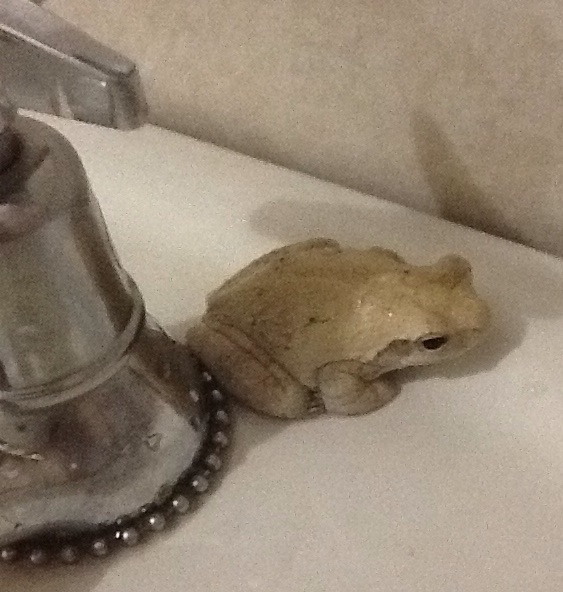
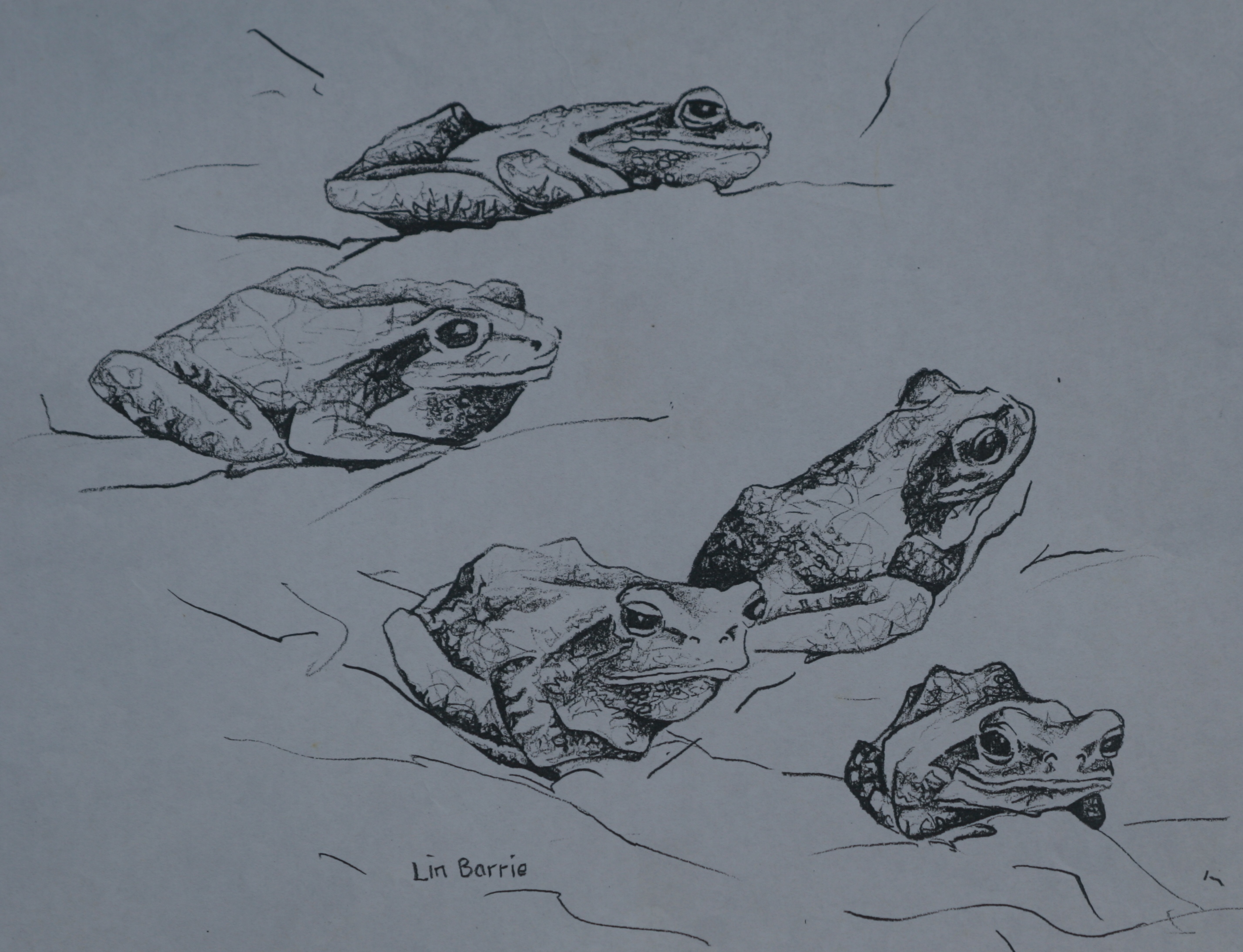
Cute Chiromantis tree frogs have, within the last two days, revived themselves from their Winter aestivation and are variously decorating picture frames and porcelain basins, adapting their skin colour to their surroundings and merrily chirping their welcome to the rain-dark skies…
These frogs are a delight to me, subjects of many sketches…
Lin Barrie sketch of Chiromantis tree frogs
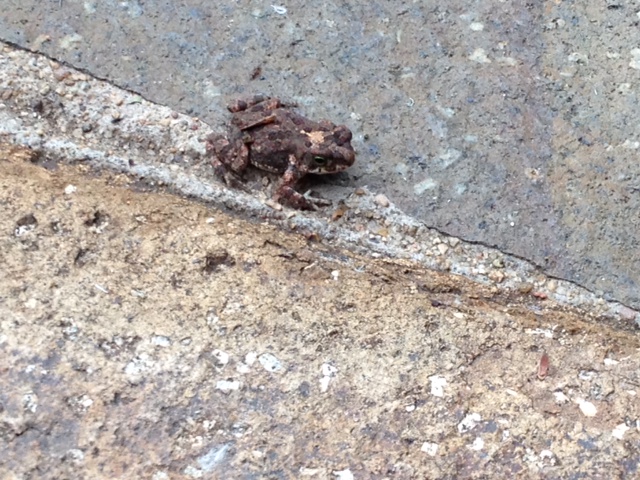
For two days an army of tiny Pygmy toads has hopped the pathways, out from their dry season hideaways…hard not to step on them as they bounce everywhere!
tiny toads emerging from aestivation
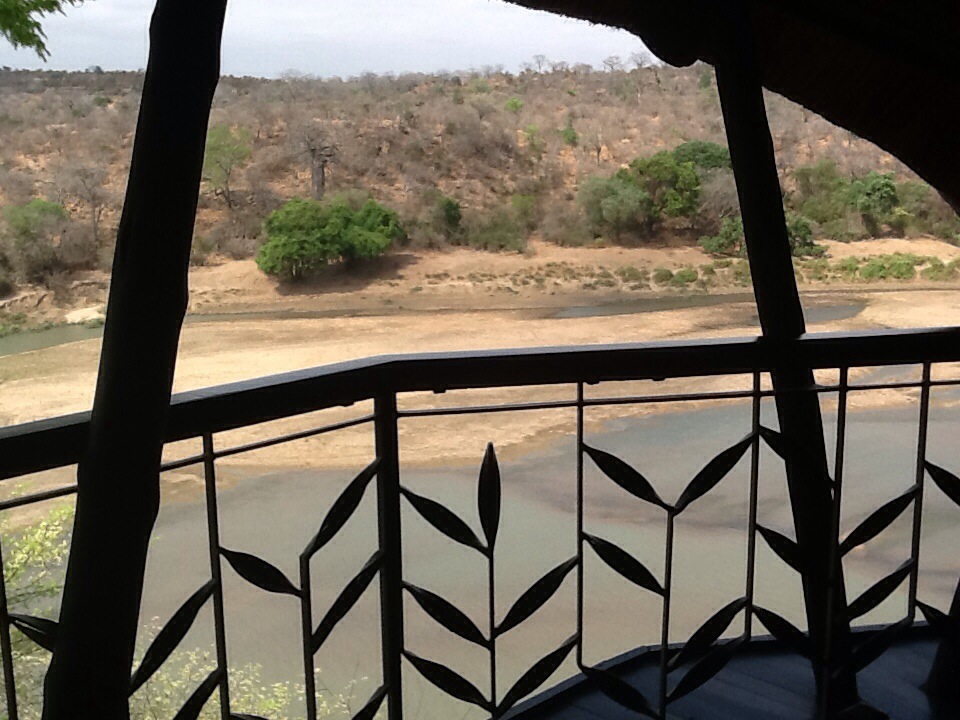
Grey skies and a cool breeze decide me..today I will write this blog upstairs , on a sheltered, favourite balcony overlooking the Save River…
From here I can keep an eye for the five young bull elephants, who have been crossing the river morning and evening to raid their favourite plants in the Chilo gardens!
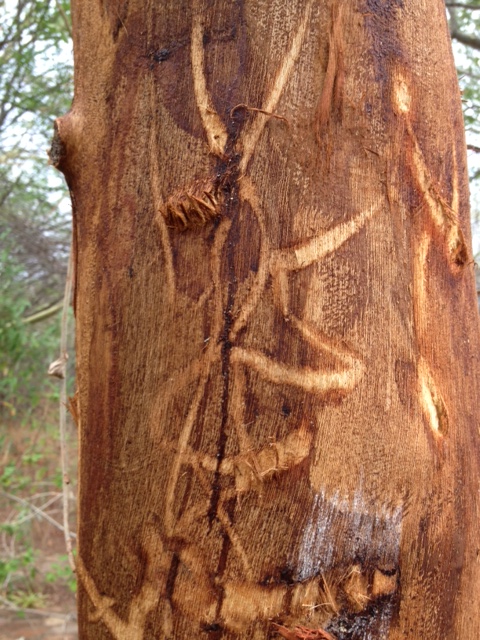
Striletzia nicolae and Phoenix reclinata palms have been the flavour of the month in the Chilo gardens, as has the bark of the fig and Albizia trees…
elephants have stripped the bark of this fig…
Perhaps, now that the rains are looming, the elephants will move their attention elsewhere!
Elephant hieroglyphs in the bark…
elephant hieroglyphs in the bark of a doomed tree…
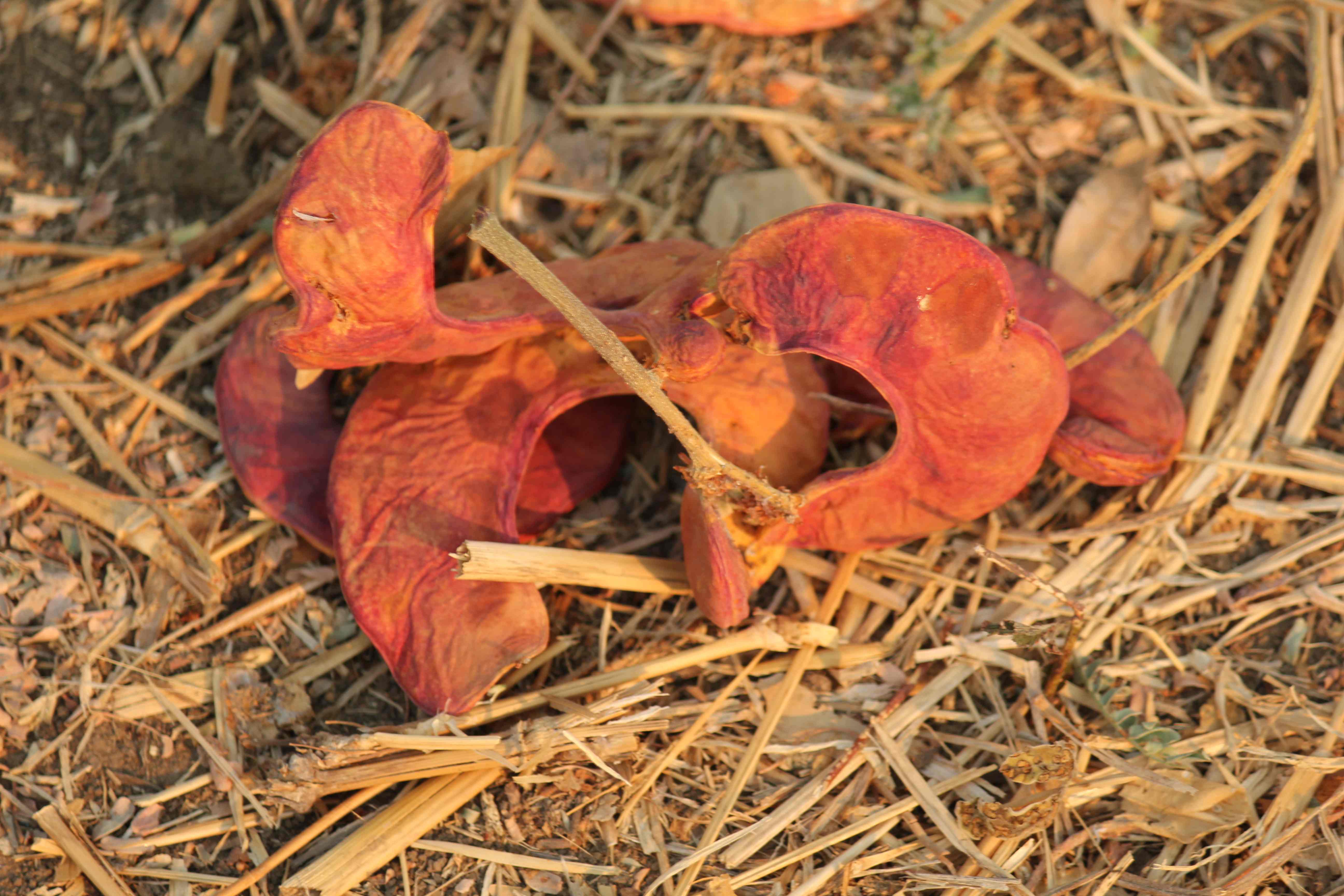
Maybe the pachyderms will head back to the Fayderbia albida trees on the Runde River to browse on the apple ring pods of those pretty plants…
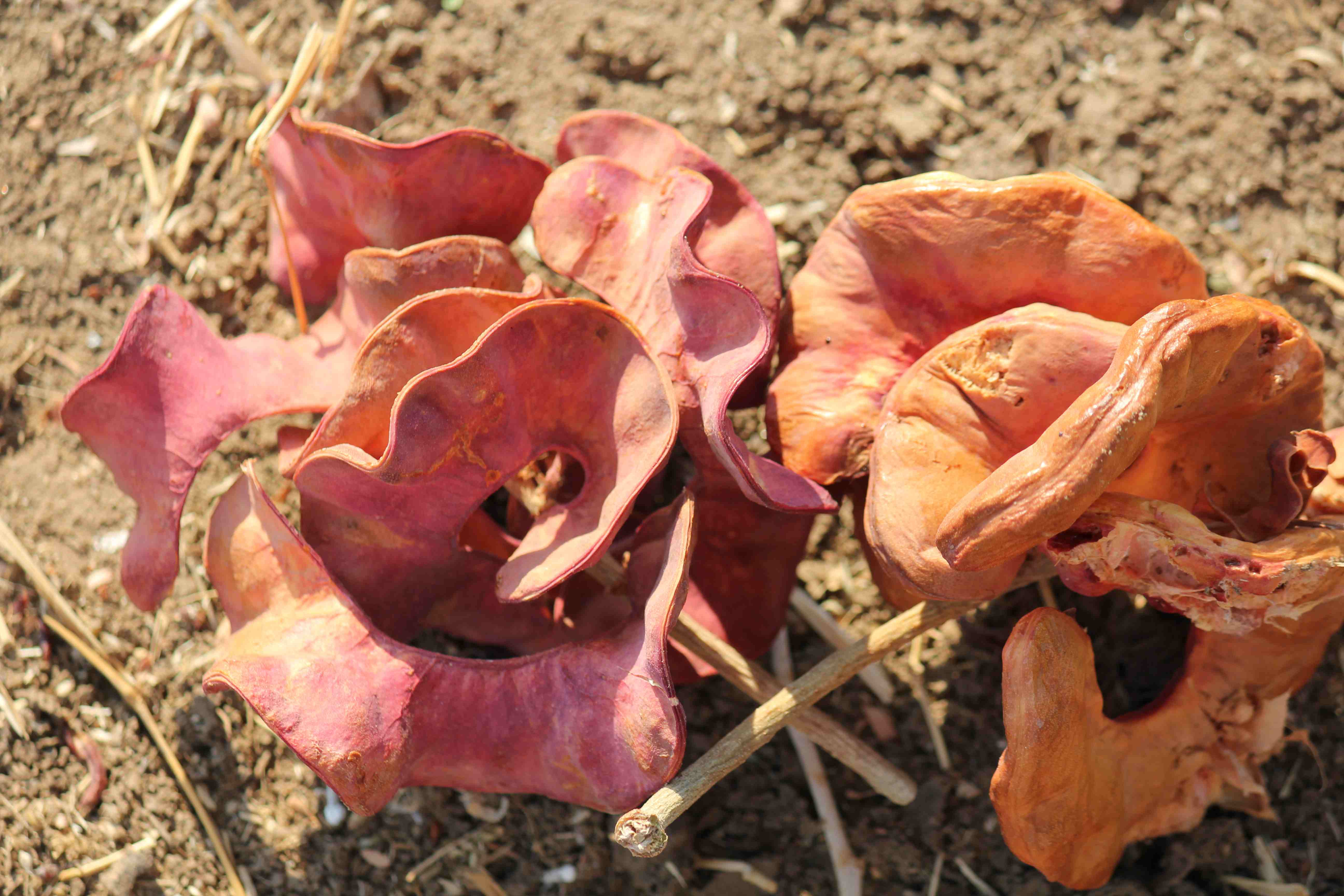
albida pods
a delicious and nutritious food, these pods sustain all manner of animals at this time of year, from elephants……
elephant foot and albida pods
Meanwhile, with helpful advice from Ian Craig and Lewa in Kenya, we are planning elephant fences to suit our needs, both at Chilo and at the developing community project, Jamande Wilderness……
Still daydreaming about elephants, I ponder the state of the Fayderbia albida trees on the Runde River, in Gonarezhou National Park, where the elephant bulls are pushing huge trees over to get at the pods…hopefully with the fast approaching rainy season, the pressure on these gorgeous old trees will be lessened.
My mind drifts back to Mana Pools…where we recently shared a Safari with various dear friends, including Gwen Wawn, and travellers extradordinaire Brian and Dee Keating, of Going Wild, Canada.
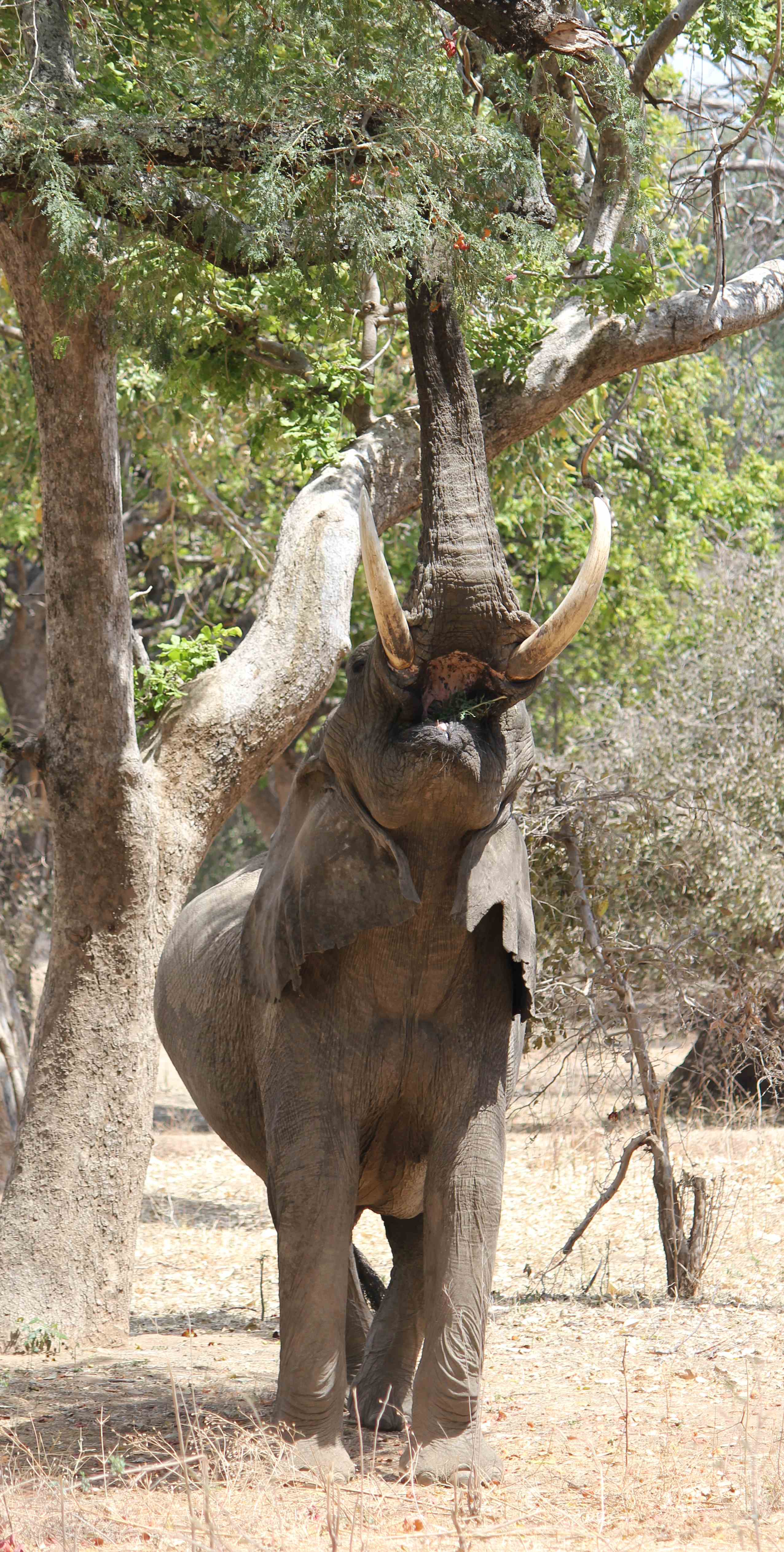
Here is the wonderful inner lining of a bull’s mouth, as he reaches high into an albida tree…
elephant reaching into albida tree
and his look of contentment as he chews…
delicious….
From my refuge in the balcony at Chilo Gorge, I can happily reminisce, daydream, and plan paintings such as the two I am currently growing in my mind…abstract Persian carpets of colour reflecting the glowing shapes of albida pods …
gorgeous albida pod
and kigelia flowers …..favourite snack for Kudus…
kigelia beauty
………I can also indulge peacefully in a cup of fresh brewed La Lucie coffee……
And a home baked scone….appreciated also by the juvenile Mocking chat who comes to join me in my quiet place of retreat!
World Rhino Day is today, 22nd September….and Chilo Gorge Safari Lodge has high hopes for the future re-introduction of rhinos into Gonarezhou, our pristine Zimbabwean wilderness….
Read this message from Elsabe Van Der Westhuizen of Frankfurt Zoological Society, September 2013:
“Together, Zimbabwe Parks and Wildlife Management Authority (ZPWMA) and Frankfurt Zoological Society (FZS) are making plans to re-introduce rhinos in the Gonarezhou National Park.
It is planned to create an intense rhino protection zone in Gonarezhou National Park in the future. Tremendous efforts are required to secure the future for the black Rhino in Zimbabwe and we think strategic rhino re-introductions may be necessary to continue establishing viable wild rhino populations in their natural habitat. The IUCN Species Survival Commission published guidelines for the re-introduction of different species, including the rhino. In these guidelines the term “re-introduction” is defined as an attempt to establish a species in an area which was once part of its historical range, but from which it has been extirpated or become locally extinct.
Gonarezhou National Park (GNP) is the second largest protected area in Zimbabwe after Hwange National Park, covering an area of 5,053 km2 in the southeast lowveld of Zimbabwe and sharing an international boundary with Mozambique. GNP, which has been part of the Great Limpopo Transfrontier Park (GLTP) since 2002, lies within the Greater Limpopo Transfrontier Conservation Area (GLTFCA). GNP contains many animals of conservation significance, some which are considered rare in Zimbabwe, e.g. pangolin, bat-eared fox, African wild dog, roan antelope and nyala, among the larger mammals.
GNP is probably one of the few protected areas where black rhino went locally extinct twice – first, sometime during the late 1930’s or 1940’s due to sport hunting, poaching and conflict with an expanding agriculture sector and human population. A second extinction occurred when a population of 77 founder rhinos, reintroduced in 1969-71, went locally extinct in 1994 after reaching a population peak in excess of 100 animals. This second extinction was mainly due to poaching and the 1991/92 drought.
Primary objective is to to re-introduce founder populations of black (and possibly white rhino) which will be the start of the re-establishment of a free ranging rhino population in the Gonarezhou National Park.
There is a future for rhinos in Zimbabwe. They should live where they belong, which of course includes Gonarezhou National Park.”
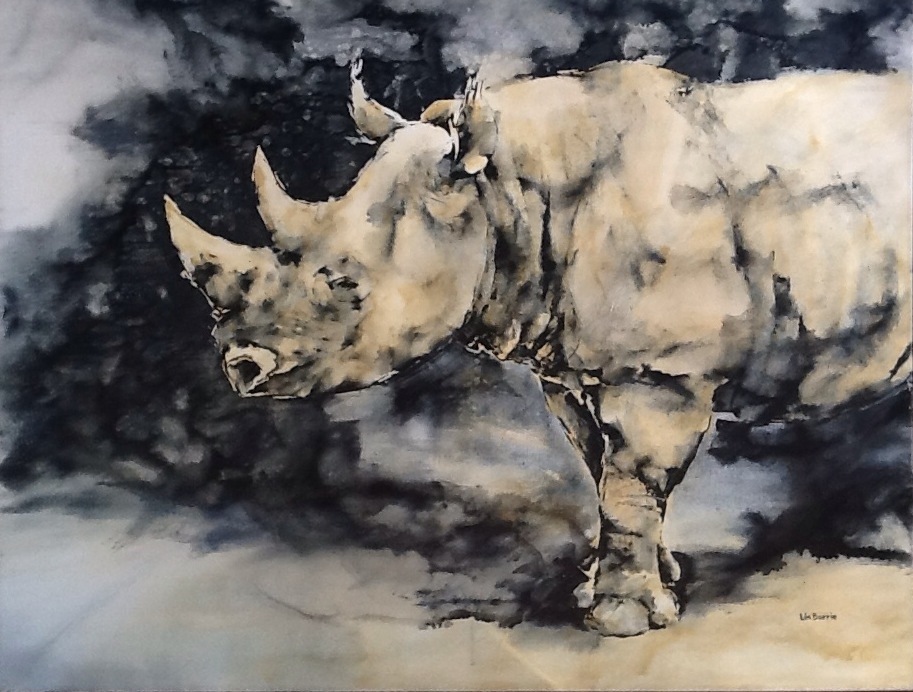
As an artist I have been so privelidged to live in “rhino country” , in the Save Valley Conservancy, and to have the inspiration of these great beasts around me……
Here is one of my paintings, “Black Rhino” oil on stretched canvas, 100 x 130 cm:
Read my previous blog, “Extinction is Forever- Russet Rhinos must survive” for more information on the organizations who go to such great lengths in their efforts to save our Zimbabwean Lowveld rhinos: https://wildlifeandwilddogs.wordpress.com/2014/08/29/2483/
Rhino and Elephant Zimbabwe – Facebook page – hosted by Environment Africa, (http://www.environmentafrica.org/ ) highlights ongoing initiatives for our endangered pachyderms in Zimbabwe:
Plus visit The Malilngwe Trust Facebook to see the wonderful initiatives they are creating to raise awareness of rhinos in rural schools, including a poetry competition! https://www.facebook.com/themalilangwetrust
More heartwarming initiatives for WORLD RHINO DAY :
Houston Zoo, in Texas, will celebrate World Rhino Day on September 20 through September 22. Some proceeds from activities at Houston Zoo will benefit the Lowveld Rhino Trust, which is helping to educate schoolchildren in Zimbabwe about rhinos and other animals.
In addition the Houston Zoo has a call to action this weekend:
“Be a Rhino Hero: Donate a Wildlife Book!
Directly contribute to saving rhinos in the wild by bringing in a new or gently used book about wildlife to donate to our friends in the field who are protecting rhinos in Africa. These books will be used to educate local communities in Zimbabwe about their amazing wildlife. Each person that donates a book will receive a rhino conservation bracelet AND a Houston Zoo Conservation Hero pin!”
Houston Zoo is a leading organization in wildlife conservation. I have spent many happy hours sketching rhinos there, and I know that this will be a great World Rhino Day Celebration!
Fossil Rim (Endangered species breeding programme and wonderful game park), in Glenrose, Texas, is another excellent facility which I have visited. They will celebrate World Rhino Day 2014 on Saturday, September 20. Well done Pat Condy and team!
In the year of 2008, we spent much of our time observing a pack of African hunting dogs (Lycaon pictus) in the south of the Save Valley Conservancy, Zimbabwe.
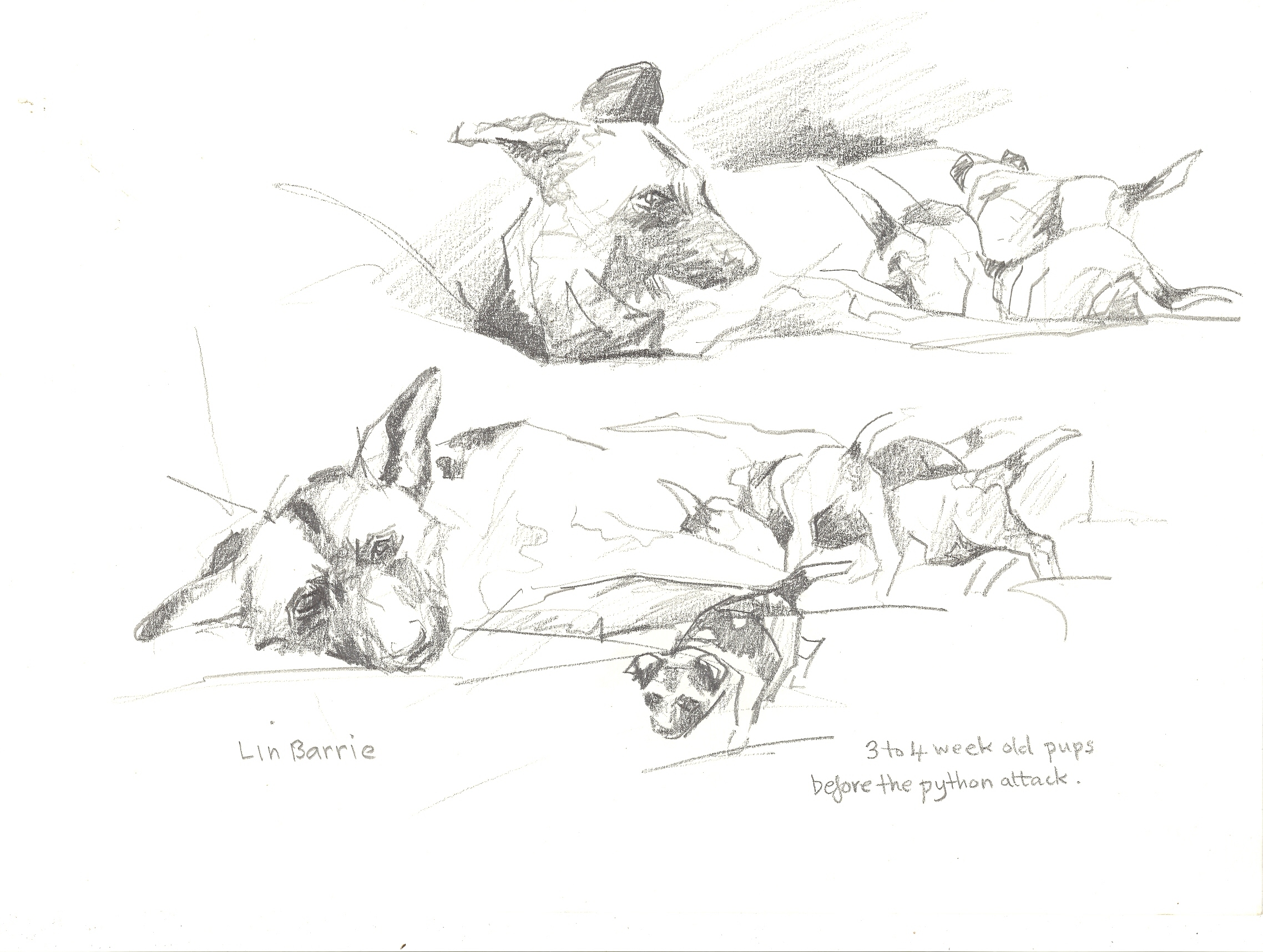
Consisting of four adults, four yearlings and, initially, more than nine puppies, this pack had had more than its share of tragedy, including a python attack!
The young female, “Snare”, was so called because when we first saw the adult dogs, she had a wire snare tight around her neck, causing a gaping wound. She was difficult to approach since the pack had not yet denned down, still pursuing their nomadic way of life.
Snare with wire on her neck _ photo by Lin Barrie
The Alpha female was visibly pregnant, and obviously hunting for a suitable den site.
All we could do was to keep alert for occasional sightings of the dogs, as our local research and conservation team, African Wildlife Conservation Fund, had not yet managed to put a tracking collar on any dogs in this particular pack…
I truly became discouraged-Snare’s wound was so traumatic that it seemed she could not possibly survive if we were unable to remove the vicious wire.
her pain filled eyes said it all…. Photo by Lin Barrie
At last, scouts from the African wild dog research and monitoring team, African Wildlife Conservation Fund, (AWCF), located a den site and we were able to begin to visit the dogs, slowly habituating them to our presence, and discovering that they had at least nine fat pups ensconced in a warthog burrow.
Joyful hours were spent watching the new family, but we struggled to coordinate a darting team in the first few days.
the Alpha female and her new pups… sketch by Lin Barrie
Each day I would watch poor Snare struggling to breathe and keep up with her pack. She resolutely trailed after them on every hunt, interacting as best she could with her boisterous siblings-always thinner than the rest and staying away from the new babies, unlike her sisters. Her siblings, in turn, cleaned her terrible wound and chaperoned her constantly. She tried hard to jump and play with them before evening hunts, but was always subdued in comparison to their exuberance.
Snare”s brother tries to remove the wire snare from her neck… sketch by Lin Barrie
Another tragedy then hit the dogs-a huge python found the burrow, whether by intent or accident we will never know, and overnight it ate many of the pups-leaving only four, whom the Alpha female immediately relocated to another den close by.
only four puppies left..photo by Lin Barrie
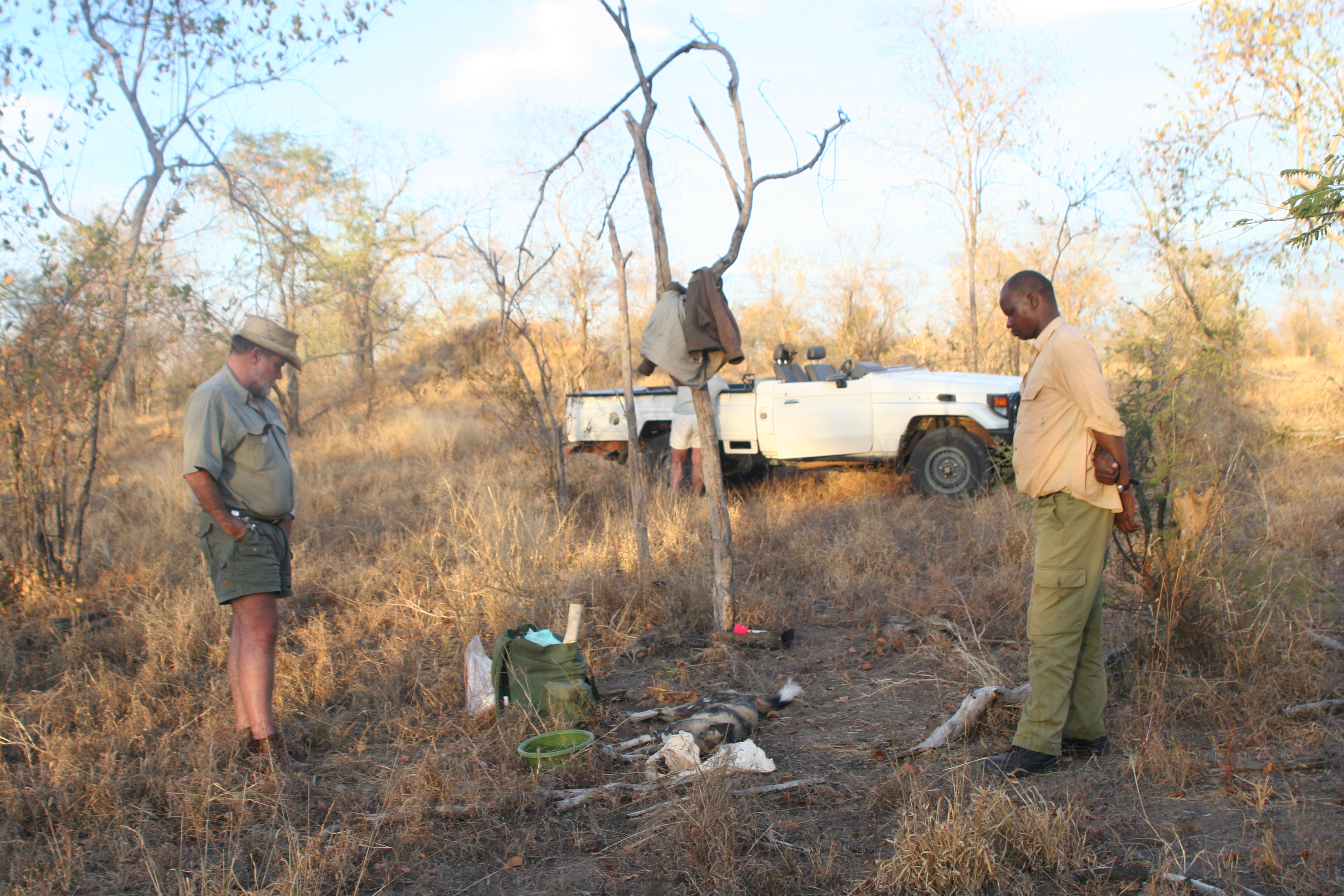
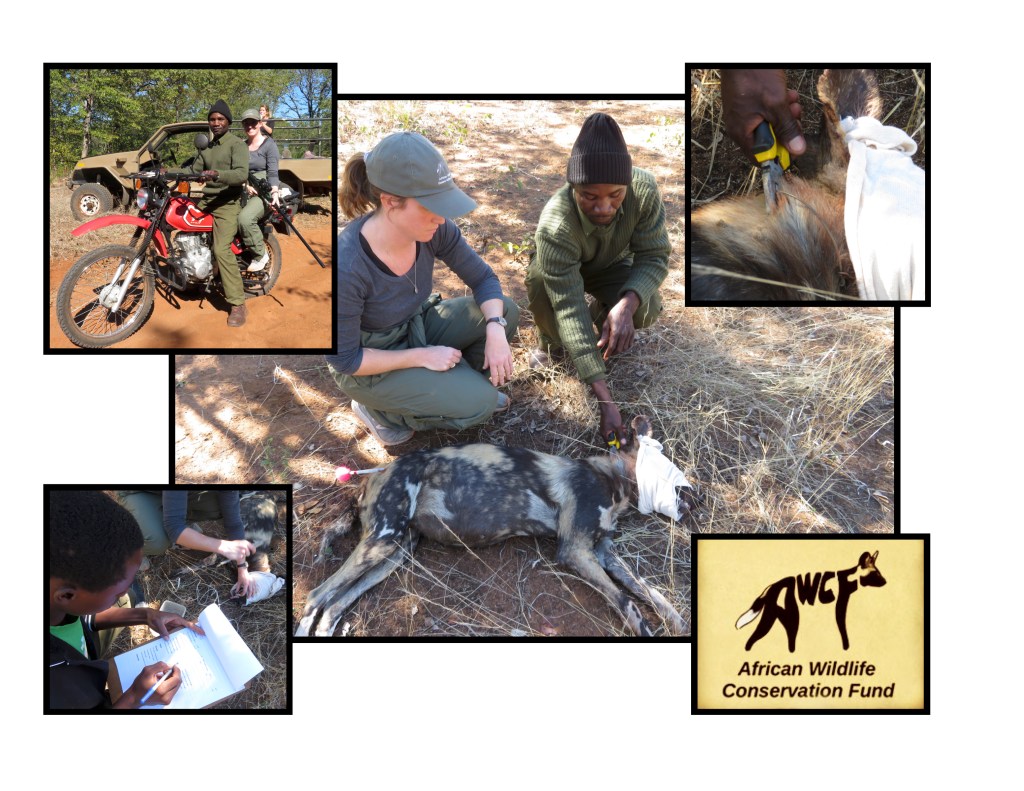
After some aborted attempts to dart Snare, (because she was so clever at staying just out of dart gun range!!), eventually we got lucky and immobilized her, with the help of Reuben from the African Wildlife Conservation Fund, and Graham Connear of Hammond Ranch.
Rueben and Graham at work on poor Snare…
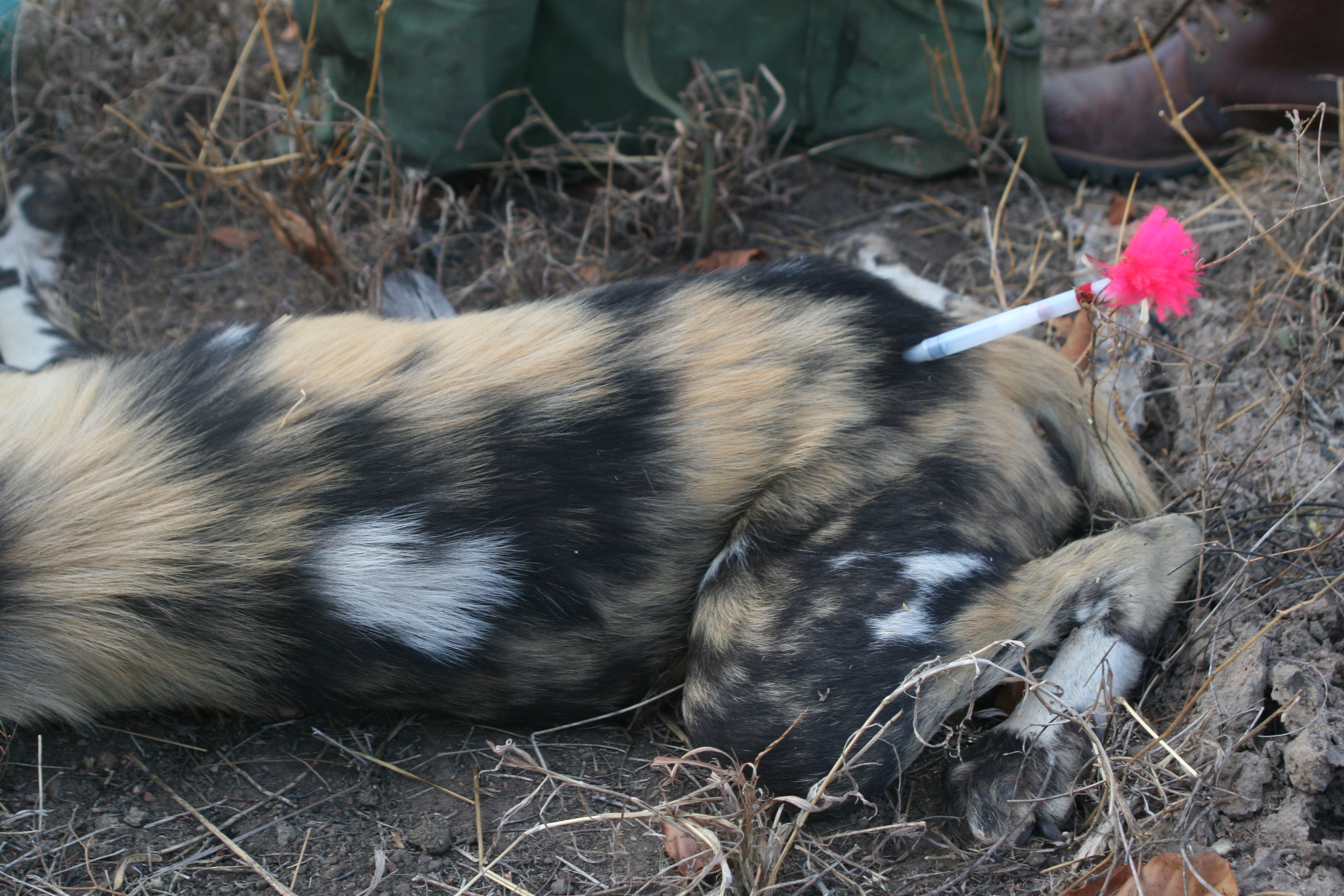
Once Graham had darted “Snare”, the pink dart made it easy to see where she fell….
the pink tranquilliser dart
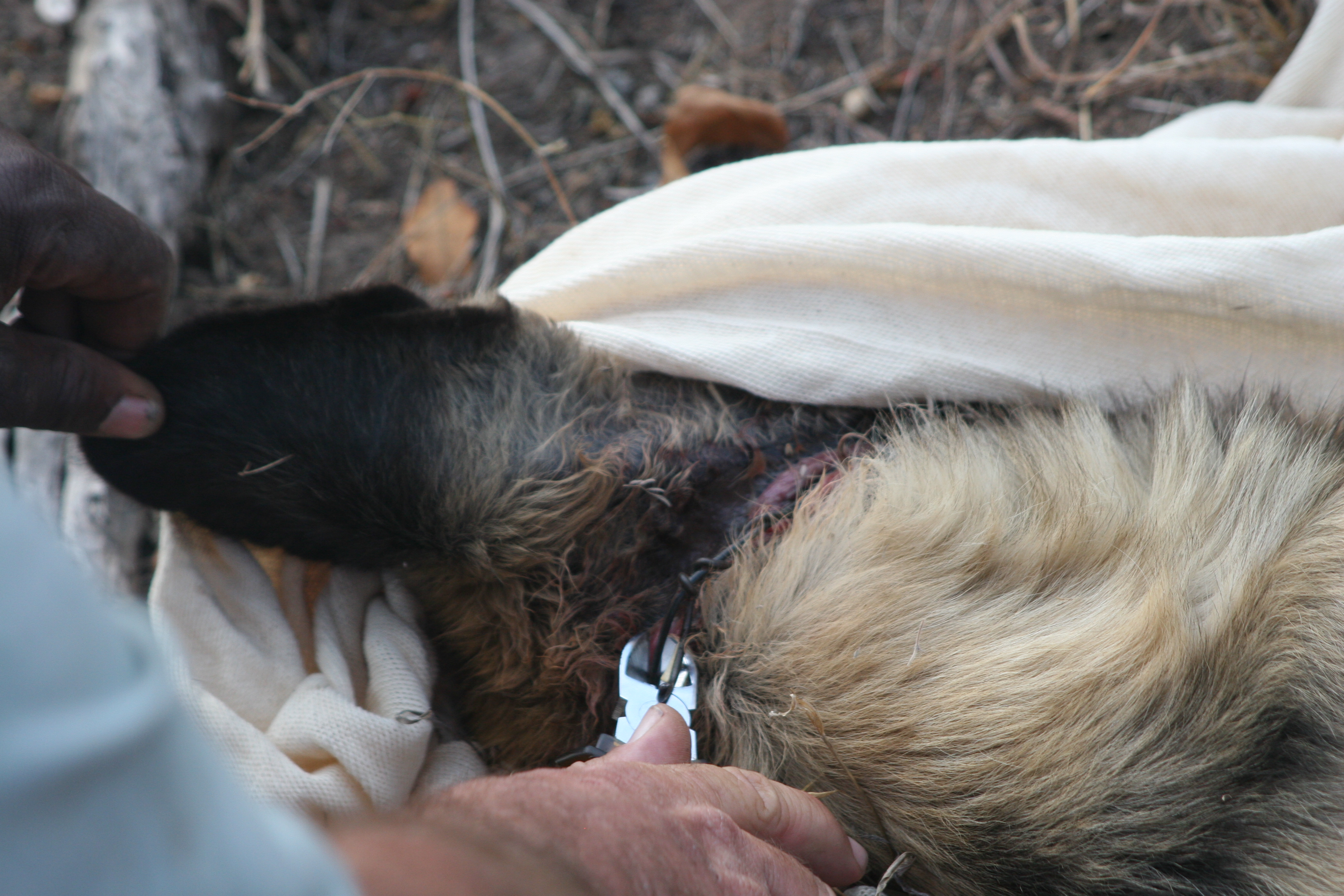
Removing the wire, we found that it had begun to cut into her trachea, thank goodness still a small hole. Cleaning the wound as best we could, we administered antibiotics and left her to recover.
removing the terrible wire- photo by Lin Barrie
Clive and Reuben admire their handiwork…
Clive, Rueben and Snare- Photo by Lin Barrie
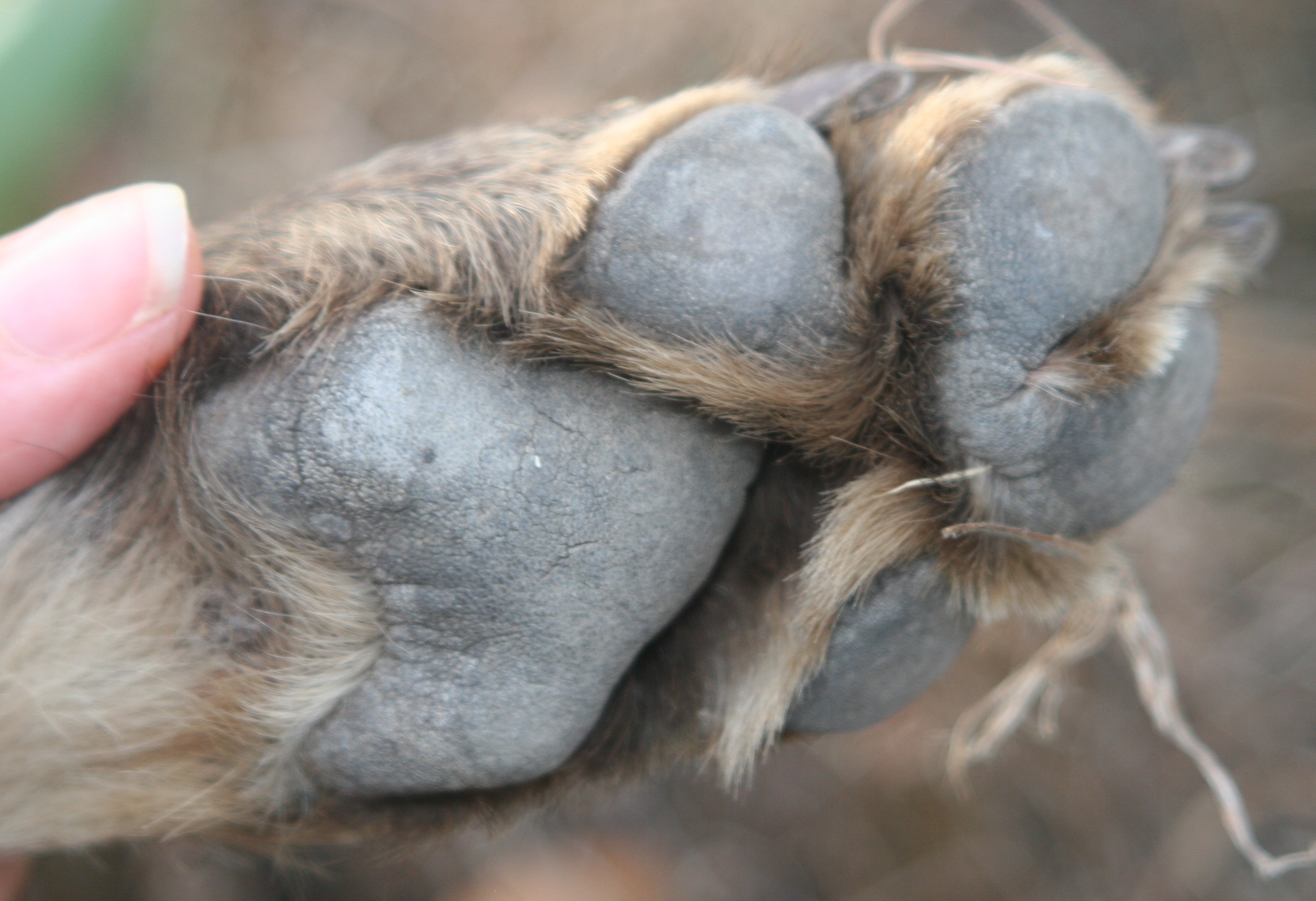
Snare’s paw, gently held in my hand….
Snare”s elegant paw… Photo by Lin Barrie
We watched over her until she recovered from the anesthetic and wobbled away from the area, eagerly accompanied by her siblings who had call waited for her at a discreet distance while we worked on her.
Over the next few days I saw a transformation that was wondrous to behold-she went from strength to strength, daily interacting more and more with the four tiny pups and hunting enthusiastically with her pack.
On the Hunt- sketch by Lin Barrie
Snare was a new animal, the breath still faintly whistling through the now healing hole in her neck, but her eyes bright and her enthusiasm boundless.
She became a leader of the hunt, often being the one to return first with the Alpha male, both bloody-necked from a successful kill, to regurgitate food for her mother, the Alpha female, and the four new pups.
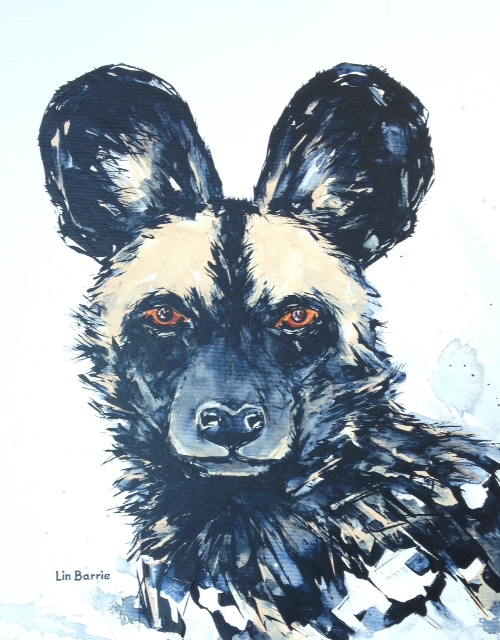
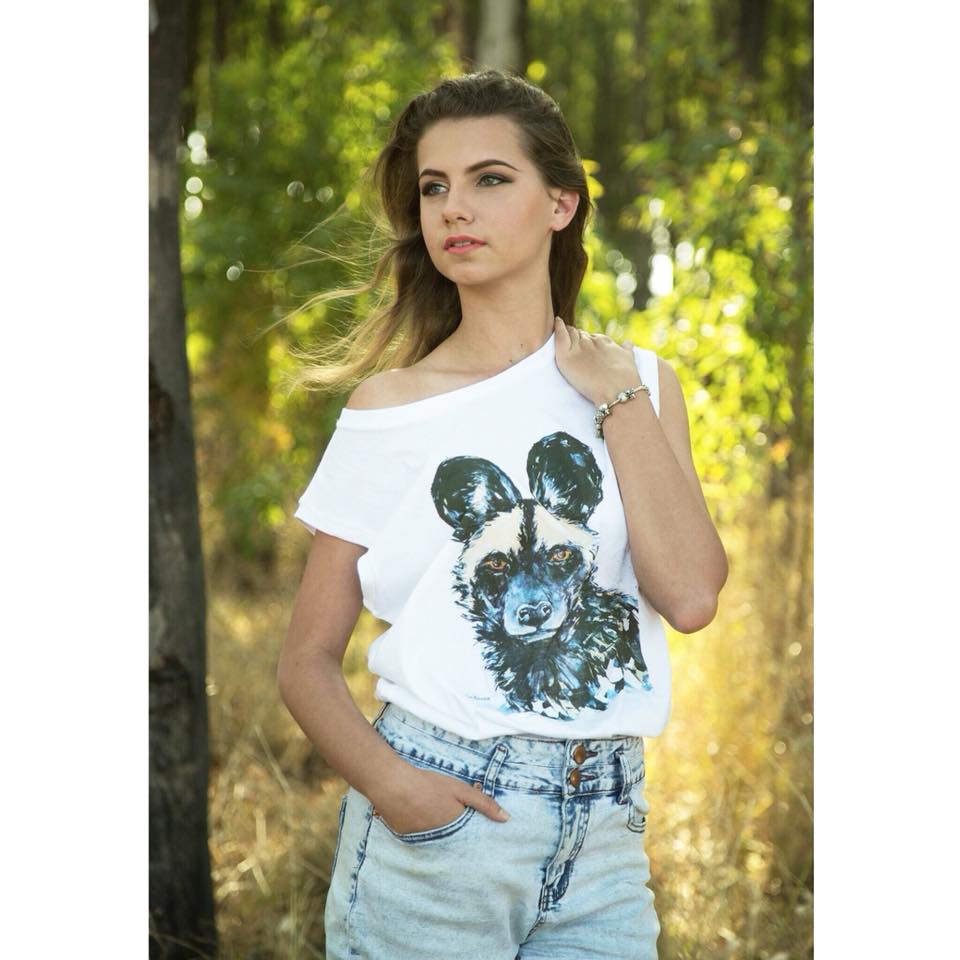
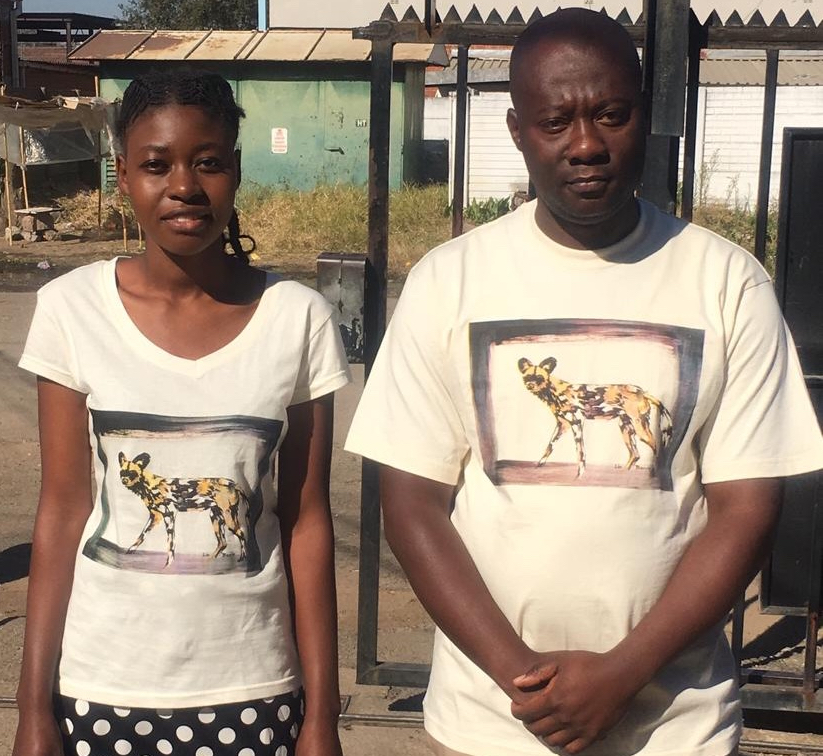
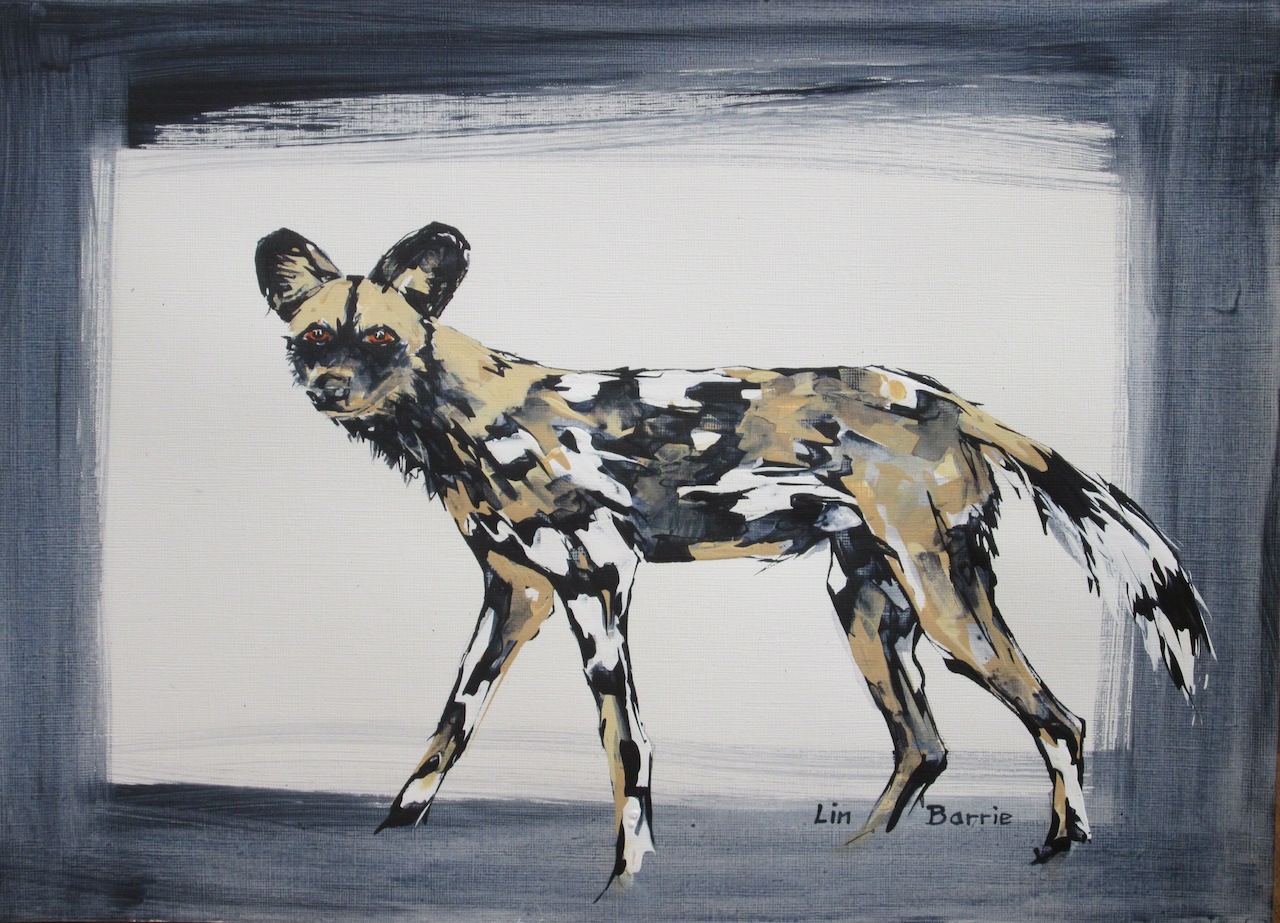
Here is my portrait painting of her, since used as a T shirt design as well.
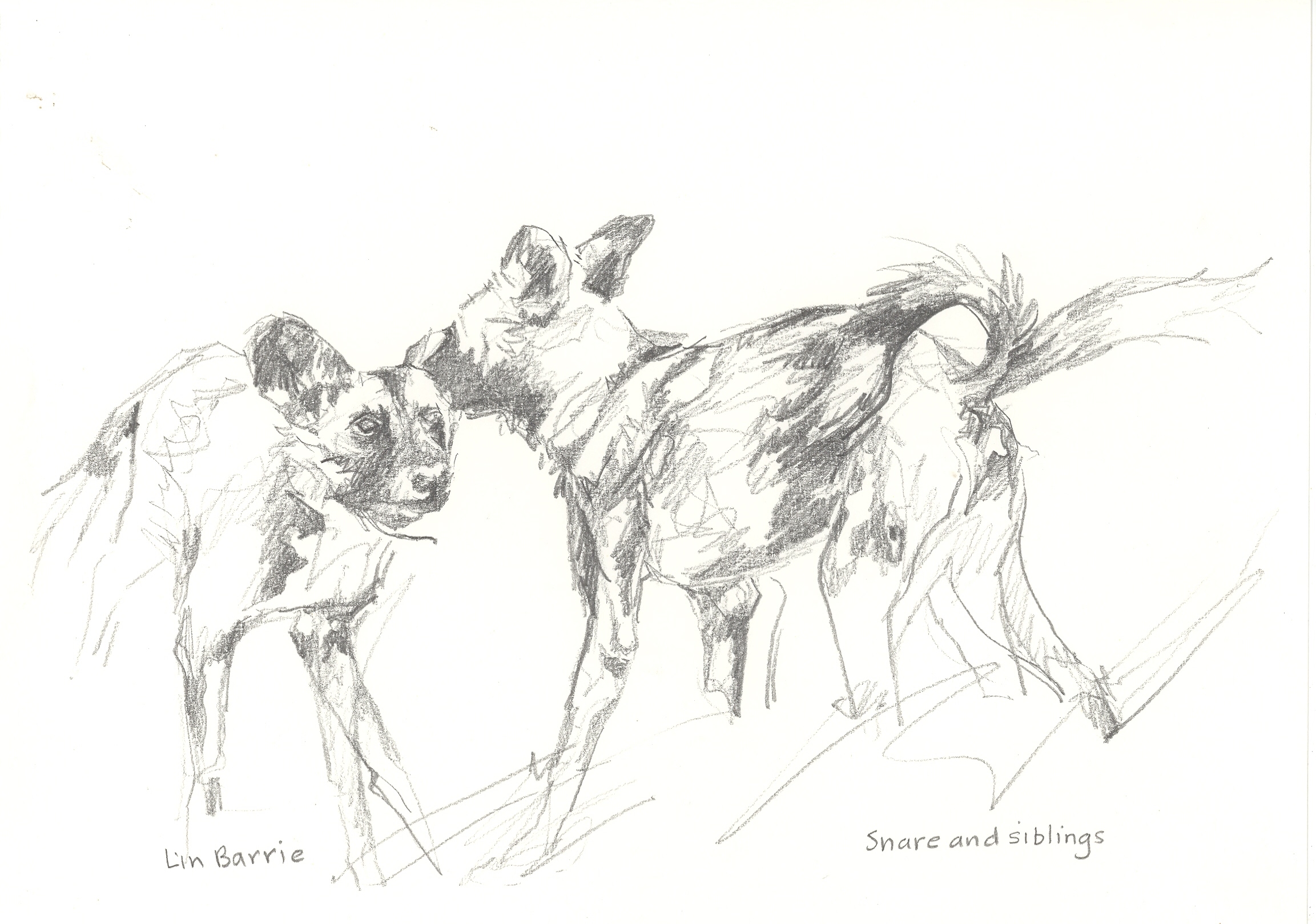
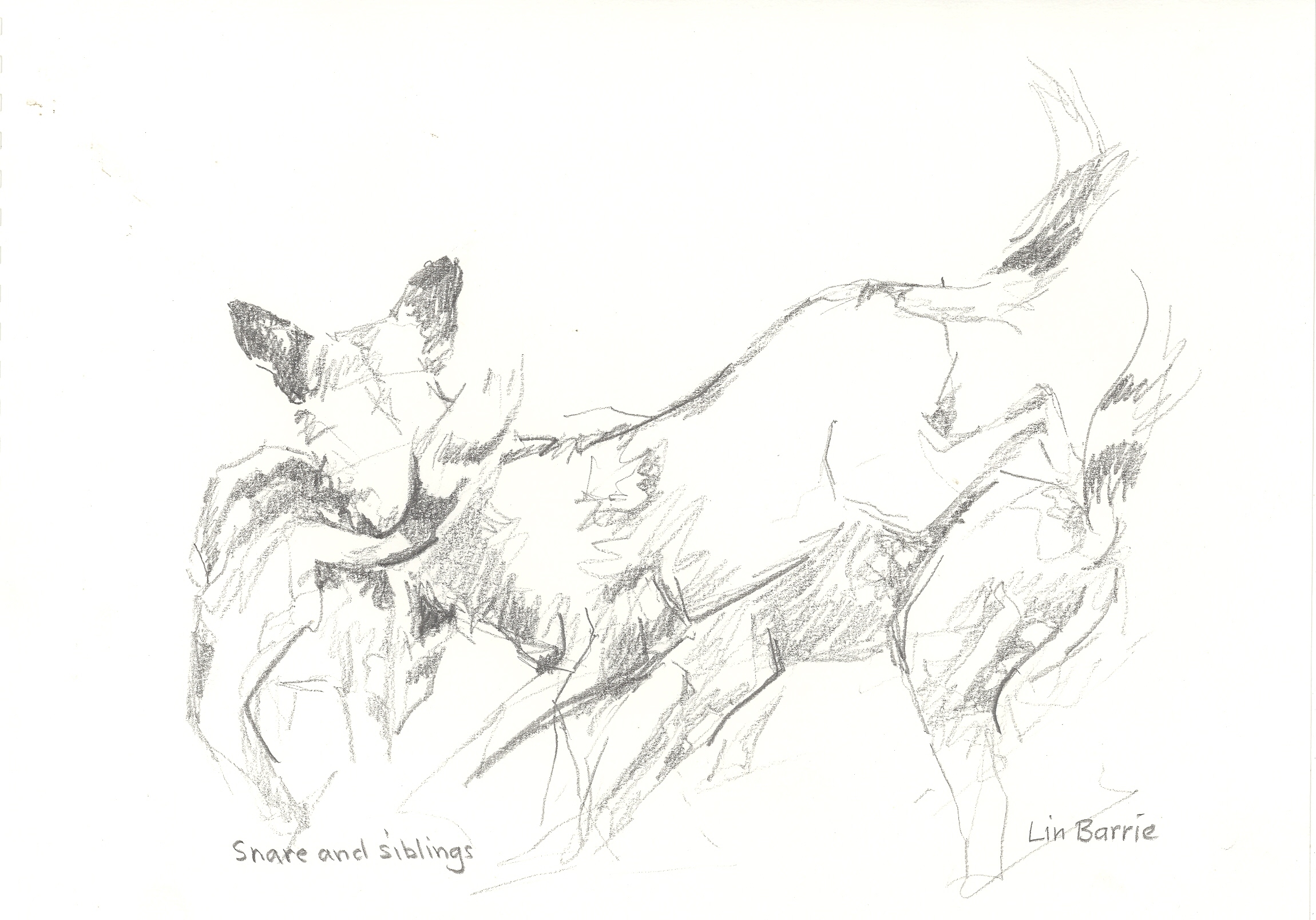
My sketch of Snare, playing with her siblings, reflects her joy…
snare and siblings, sketch by Lin Barrie
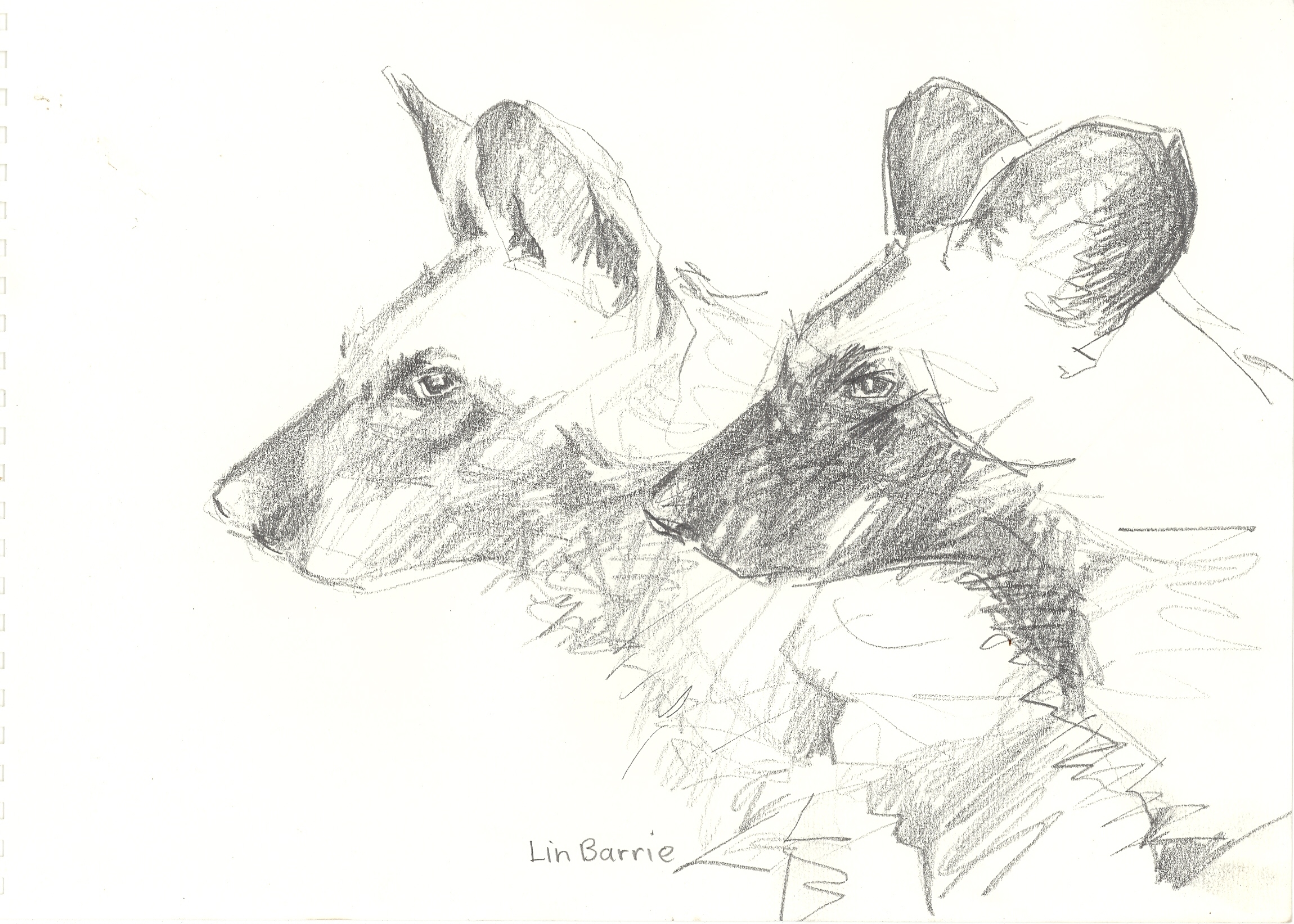
Inspired by her story, my many oil paintings and sketches show Snare interacting before a hunt with her siblings, a symbol of the stamina and will that these dogs show in the face of adversity. She now had the strong potential to be a leader, an Alpha female with pups of her own in the future.
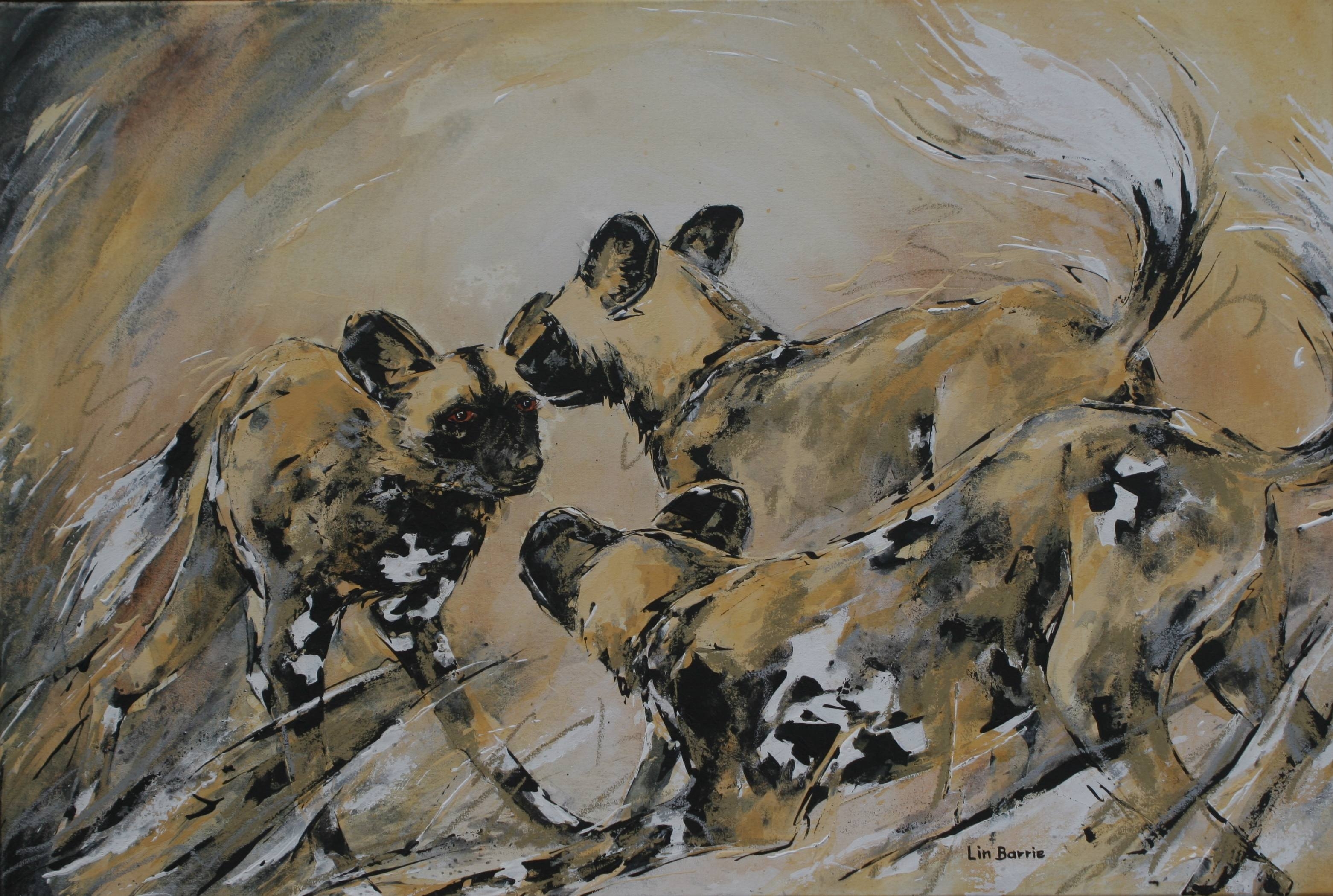
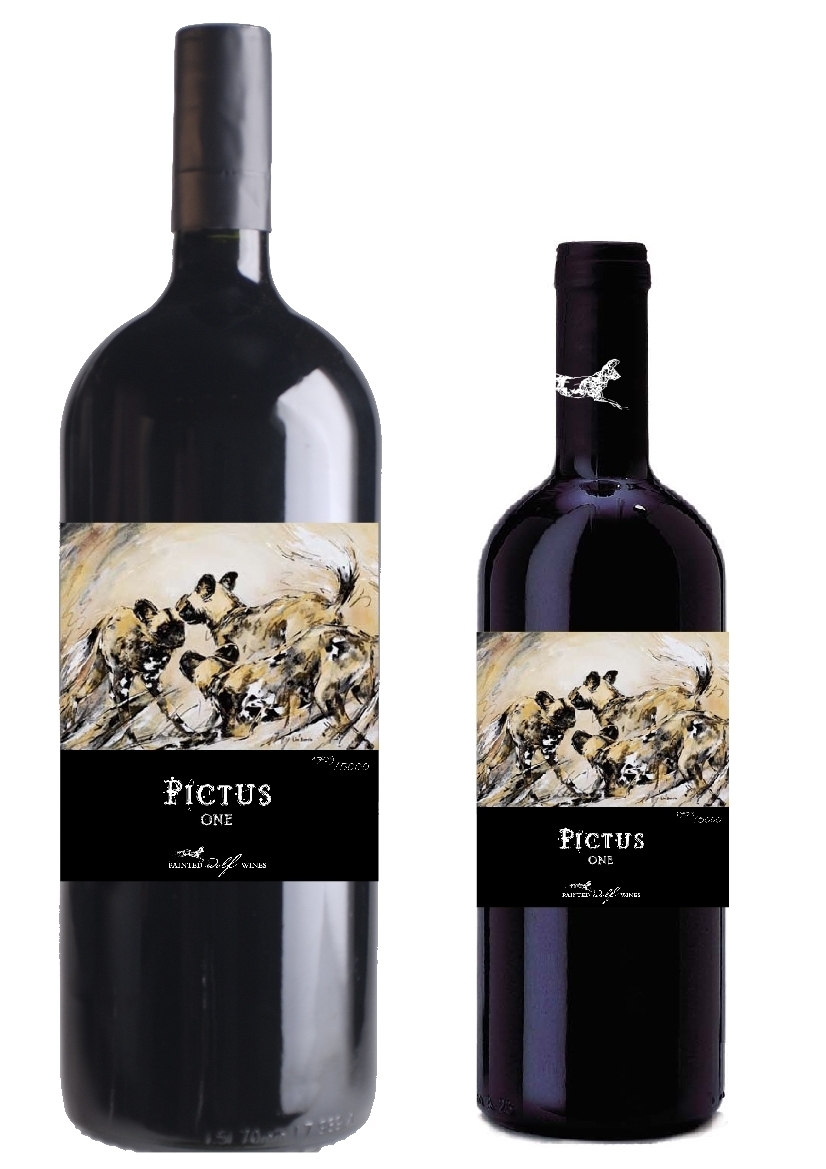
Snare was my inspiration for a large oil painting, auctioned through Tusk Trust and Painted Wolf Wines, to raise money for African wild dog conservation and to become a label for “Pictus One”, a limited edition of Painted Wolf Wine…
Snare and her brothers-original painting by Lin Barrie for Painted Wolf Wines and Tusk Trust
The wine labels looking good! and tasting even better….
Pictus One
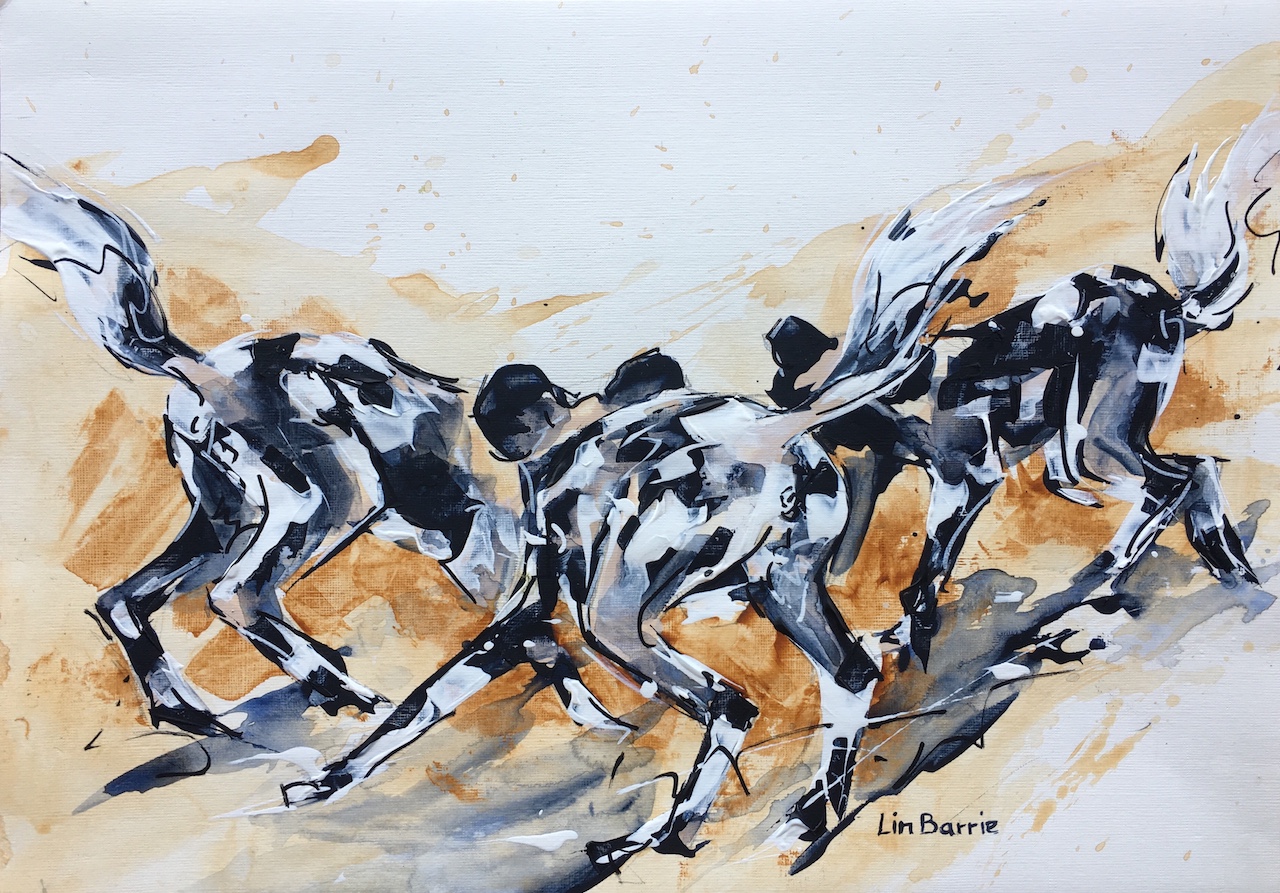
My paintings below celebrate Snare and her release from the deadly wire, but her haunted eyes also emphasize the ongoing threat of wire snares set for bushmeat, which the wild dogs inadvertently run into when hunting at speed…
“Wild Dog Snare and snare wire under a full moon”, acrylic on canvas diptych, (2 x 2 feet each panel), plus two smaller works, each called “Pep Rally”:
Close view of “Sketch Pep rally III”, acrylic on canvas paper, A3:
“Sketch Pep rally III”, by Lin Barrie, acrylic on canvas paper, A3
The Story of Snare has since then truly inspired some great collaborations, such as the Tshirt printed range that Bertie Bondi of Canned Clothing has created, using my painting of Snare as inspiration.
Fun t shirts, celebrating the endangered African wild dog……
Canned Clothing, T shirts celebrating “Snare”Snare, painting by Lin Barrie
In my artworks, Snare still has those haunted eyes, memories of the deadly wire tight on her neck, but her eyes reflect also also the wise and gentle light of a mature female in her prime, a mother, a mentor, and a dedicated chaperone to generations of puppies.
“Snare” the iconic wild dog female, whatever Happy Hunting Ground she now roams, is an everlasting symbol of resilience and conservation success!
African Wildlife Conservation Fund do endlessly great work in field conservation for Lycaon pictus, our endangered, social and fascinating wild dogs.
Plus their community outreach and education programmes make a real difference to rural communities living with wildlife in our South Eastern Lowveld of Zimbabwe…































 wine and wild dogs